
Are Hims & Hers Earnings just a temporary GLP-1 growing pain or the start of a tougher chapter for this telehealth favorite?

How bad was the market reaction to Hims & Hers?
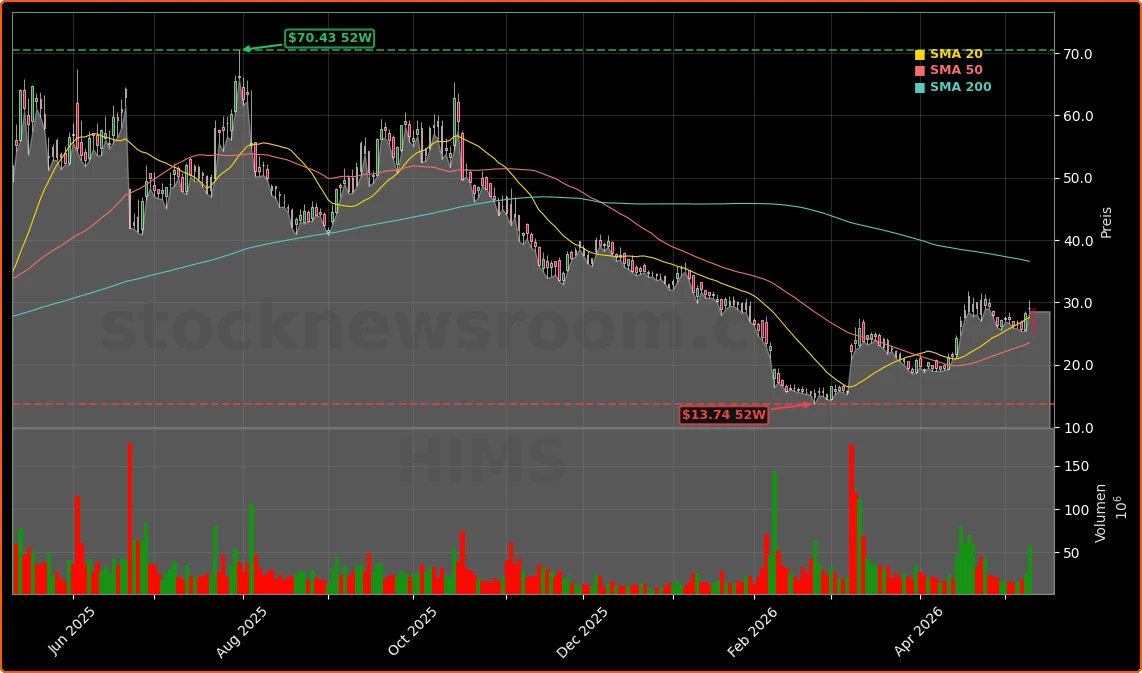
Hims & Hers Health, Inc. (HIMS) was under heavy pressure ahead of Tuesday’s opening bell on Wall Street. After closing at $25.13 on Monday, the stock had recently surged to $29.14 and is now indicated at about $24.95 in pre‑market trade, down roughly 14%. That follows a slide of more than 15% in extended trading after the company released its first‑quarter numbers and outlook. For a name that had been a retail favorite in telehealth and weight‑loss plays, the move signals a rapid sentiment shift as traders reassess the risk‑reward profile.
The setback also comes against a backdrop where high‑growth health and consumer names on the NASDAQ have been sensitive to even modest guidance disappointments. While Hims & Hers Earnings still show top‑line expansion, the quality of that growth and the near‑term impact on profitability are now firmly in the spotlight.
What did Hims & Hers Earnings reveal about Q1?
For the first quarter, Hims & Hers generated about $608 million in revenue, roughly 4% higher than a year earlier but shy of consensus estimates around $616 million. That slowdown in growth, particularly in the core U.S. market where sales declined about 8% year over year, was one of the first red flags for investors who had grown accustomed to stronger momentum.
The bigger shock in the latest Hims & Hers Earnings, however, came on the bottom line. The company reported a loss of $0.40 per share, swinging from a prior‑year profit of roughly $0.20 per share and badly missing analyst expectations that had called for a small positive result. In dollar terms, the net loss widened to about $92 million, up from roughly $50 million in the comparable quarter a year earlier.
Key profitability metrics also deteriorated. Gross margin slipped from about 73% to 65%, and adjusted EBITDA fell by more than half to around $44 million from $91 million in the prior year. Average monthly revenue per subscriber dropped from $85 to $80, even as the subscriber base increased about 9% to around 2.6 million customers. That mix of more users but less revenue per user underscores the pressure on unit economics during the current transition phase.
Why is the GLP‑1 transition hitting margins?
A central theme in the latest quarter was the company’s strategic shift away from compounded GLP‑1 formulations toward FDA‑approved branded drugs through its partnership with Novo Nordisk and the addition of Wegovy to its platform. Management has framed this as a necessary move to align with regulators and secure long‑term, sustainable access to the lucrative weight‑loss category.
That pivot, however, is currently expensive. The company is absorbing higher product costs, restructuring charges and write‑downs associated with discontinuing some compounded offerings. The chief financial officer, Yemi Okupe, has emphasized that these are short‑term headwinds, arguing that the transition should ultimately restore profitability as the business scales on a more compliant, brand‑driven model. For now, though, the hit to gross margin and EBITDA is precisely what the market is punishing.
Citigroup analysts labeled the outlook “mixed,” noting that the second‑quarter forecast landed below their internal estimates even as the company talked up long‑term opportunities. Their stance highlights a broader Wall Street concern: the path to monetizing demand for GLP‑1 weight‑loss solutions without sacrificing margin quality.
How did guidance shift for 2026?
Despite the weak start to the year, Hims & Hers raised its full‑year revenue outlook. Management now expects $2.8 billion to $3.0 billion in sales, compared with a previous range of $2.7 billion to $2.9 billion. For the second quarter, the company is targeting revenue between $680 million and $700 million, topping the roughly $643 million many analysts had penciled in.
On profitability, the tone was more cautious. The full‑year adjusted EBITDA target was set between $275 million and $350 million, with a margin of 10% to 12%. For Q2, Hims & Hers guided to an adjusted EBITDA margin of 5% to 8% and absolute EBITDA of up to about $55 million. Those figures represent a clear step down from prior quarters and suggest that the margin rebuild will take time.
For growth‑oriented investors, the updated guidance confirms that the company is prioritizing scale and regulatory alignment over immediate earnings expansion. Value‑focused buyers on Wall Street may be less forgiving, particularly after a strong run‑up in the stock and notable insider share sales by senior executives like CFO Okupe and Chief Legal Officer Soleil Boughton in April, even if those transactions were executed under pre‑planned Rule 10b5‑1 programs.
How does Hims & Hers stack up against U.S. peers?
In the broader digital health space, Hims & Hers competes with names like Amwell and health‑adjacent consumer platforms from Amazon and sometimes even lifestyle‑oriented ecosystems at Apple. Unlike mega‑caps such as NVIDIA that dominate the NASDAQ with diversified revenue streams, Hims & Hers remains a focused telehealth and consumer‑medicine story, making it more exposed to regulatory swings and product‑level shifts like GLP‑1 policy changes.
For U.S. investors building exposure to healthcare innovation alongside holdings in giants such as Tesla or Apple, the latest Hims & Hers Earnings illustrate the trade‑off between high growth potential and volatility. The company has demonstrated that it can add subscribers and expand product categories, but the Q1 numbers show that turning that scale into consistent, high‑margin earnings is far from guaranteed in the near term.
Related Coverage
Investors looking for more context on the regulatory backdrop can revisit earlier analysis of the FDA’s evolving stance on peptides and GLP‑1‑like therapies. In particular, this deep dive into how peptide regulation fueled a 10.5% rally in Hims & Hers and tested the market’s FDA bet explores why any shift in oversight can quickly translate into sharp moves in the share price. Together with today’s sell‑off, that piece underscores how tightly the stock is tethered to Washington and drugmaker decisions.
In summary, the latest Hims & Hers Earnings report delivered a classic growth‑stock contradiction: stronger long‑term sales guidance paired with weaker near‑term profitability, triggering a swift pullback in the shares. For U.S. investors, the stock now hinges on whether management can execute the GLP‑1 transition, rebuild margins and prove that its larger subscriber base can support durable earnings power. The next few quarters of Hims & Hers Earnings will be critical in showing whether this quarter’s pain is a temporary reset or the start of a more challenging phase in the company’s maturation.