
Can Lululemon Earnings regain investor trust after an 11% after-hours drop and a sharp full-year guidance reset?

What Did Lululemon Earnings Reveal?
Lululemon Athletica Inc. reported Q1 fiscal 2026 results ending May 3, 2026, with net revenue rising 4% to $2.47 billion—beating the $2.43 billion consensus—but gross margin collapsed 410 basis points to 54.2%. Operating income fell 37% year-over-year to $276.9 million, and diluted EPS of $1.69 trailed last year’s $2.60 by 35%. The company attributed the weakness to two converging headwinds: spikes of negative media and social commentary impacting traffic, and underwhelming guest response to recent product launches—including its ‘New Look of Yoga’ campaign, which failed to generate the expected halo effect across the assortment. While international sales surged 22%, North America—representing ~65% of revenue—declined 3%, with comparable sales down 5% for the fifth straight quarter.
Why Did Lululemon Cut Full-Year Guidance?
Lululemon Athletica slashed FY2026 EPS guidance from $12.10–$12.30 to $10.95–$11.15 and lowered revenue expectations from $11.35–$11.50 billion to $11.00–$11.15 billion. The cut reflects worsening trends in the Americas, where full-price sales are now expected to decline mid-single digits in Q2 despite sequential improvement in Q1. Gross margin pressure remains acute: tariffs delivered a 280-basis-point drag in Q1, and markdowns rose 40 bps. Analysts at RBC Capital Markets noted the guidance revision ‘underscores structural pricing vulnerability in a softening discretionary spending environment’—a concern amplified as the S&P 500’s consumer discretionary sector trades near its 12-month low.
How Does Lululemon Compare to Peers?
Unlike Nike, which posted resilient Q4 margins despite macro pressures, Lululemon Athletica’s 11.2% operating margin trails the sector average of 14.8%—and lags behind Apple’s services-led gross margin discipline and Tesla’s aggressive cost controls. While Nike (NKE) maintained pricing power through premium storytelling and supply chain agility, Lululemon’s SKU reduction strategy—cutting 15% of in-store items—has yet to translate into improved conversion. Citigroup analysts pointed out that ‘Lululemon’s gross margin compression is the steepest among major apparel peers this quarter,’ citing tariff exposure and elevated clearance activity. Meanwhile, competitors like Under Armour and Columbia Sportswear have stabilized margins through regional diversification and private-label sourcing—strategies Lululemon is only now accelerating in China, where revenue grew 30% in Q1.
Lululemon Earnings: What’s Next for Wall Street?
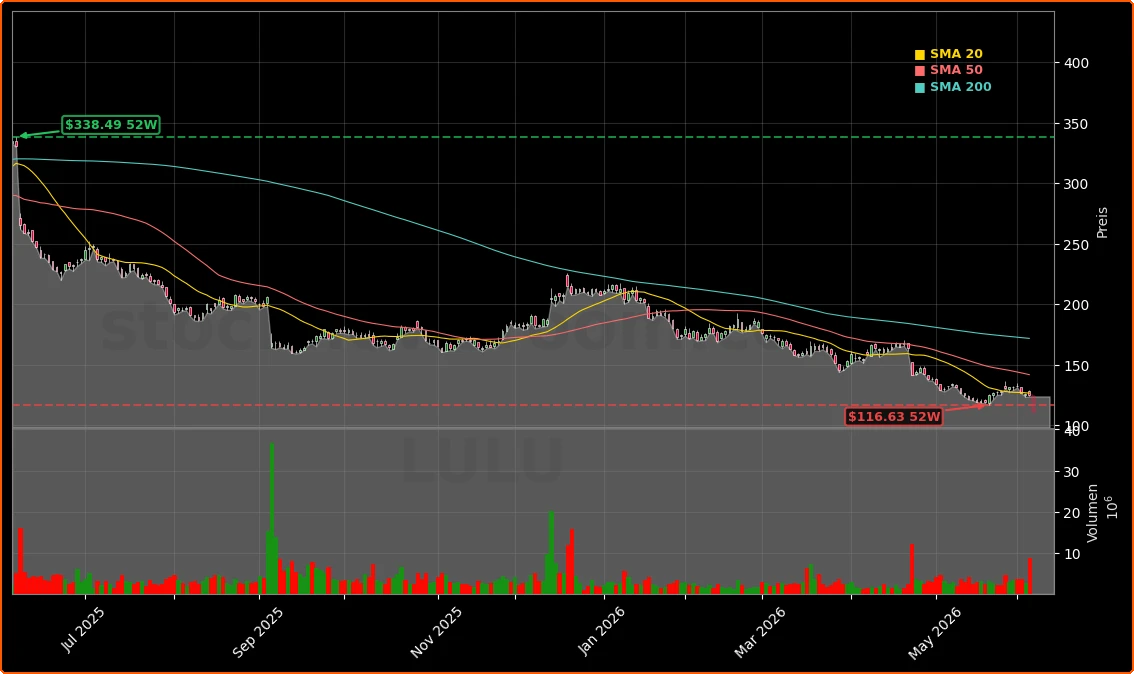
Investors are now pricing in a prolonged turnaround. Lululemon Athletica’s Q2 EPS guidance of $1.76–$1.81 falls well below the $2.68 consensus, and its $2.45–$2.48 billion revenue range implies a 2–3% decline—marking the first quarterly top-line contraction since 2021. The company expects gross margin to fall another ~410 bps in Q2, driven by tariffs and seasonal clearance. With $1 billion remaining in its share repurchase program and insider buying by Director Charles Bergh and Interim Co-CEO André Maestrini, sentiment may stabilize—but only if full-price sales rebound meaningfully in Q3. Goldman Sachs maintains its ‘Neutral’ rating but lowered its 12-month price target to $132 from $148, citing ‘uncertainty around North America stabilization timing.’
Can New Leadership Reverse the Trend?
Heidi O’Neill, former Nike executive, assumes the CEO role in September—bringing deep experience in product-led growth and global brand expansion. Lululemon Athletica’s interim leadership has already launched three strategic pillars: accelerating product development (reducing lead time from 18–24 months to 15–16 months), expanding chase capacity by 20%, and increasing marketing spend by 10–15% to reignite ‘brand heat.’ But analysts warn the turnaround hinges on execution in North America—not China, where growth remains strong but represents just 12% of total revenue. As Morgan Stanley observed, ‘The real test isn’t whether Lululemon can grow in Beijing—it’s whether it can win back trust in Boston and Chicago.’
We experienced spikes of negative commentary in the media and on social channels with regard to our brand, which had an impact on traffic and overall top line performance. And second, not all of our product launches have met our expectations.— Meghan Frank, Interim Co-CEO and CFO, Lululemon Athletica Inc.
Related Coverage: The recent resolution of the Lululemon proxy battle could provide critical breathing room for management to execute its turnaround plan—especially as founder Chip Wilson’s influence recedes following his 18-month standstill agreement. Lululemon Proxy Fight Ends as Stock Jumps 4.9% on Deal details how the settlement paves the way for board refreshment and strategic clarity ahead of O’Neill’s arrival.