Can Lululemon Earnings mark the bottom for the stock, or is this brand slowdown only getting started?

What Did Lululemon Earnings Reveal?
Lululemon Athletica Inc. reported Q1 2026 revenue of $2.47 billion — up 4.3% year-over-year and $30 million above the $2.44 billion consensus — while adjusted EPS landed at $1.69, meeting estimates but collapsing 35% from $2.60 in Q1 2025. Gross margin fell to 54.2%, missing the 54.6% estimate, and operating margin slipped to 11.2% versus 11.5% expected. Beneath the surface, the story was stark: Americas comparable sales plunged 6% (better than the -7.1% forecast, but still the fifth straight quarterly decline), while international comps rose just 8% — well below the 13.2% estimate and a sharp deceleration from prior quarters. China delivered 28.5% growth, yet that surge couldn’t offset the 3% sales drop across North America, which accounts for 74% of total revenue.
Why Did Wall Street Punish Lululemon Earnings So Severely?
The market didn’t react to Q1 — it reacted to the outlook. Lululemon cut full-year 2026 revenue guidance to $11.0–$11.15 billion from $11.35–$11.5 billion, and EPS guidance to $10.95–$11.15 from $12.10–$12.30 — a 10% reduction in earnings power. Q2 guidance was even more alarming: revenue forecast at $2.45–$2.48 billion (vs. $2.6 billion consensus) and EPS of $1.76–$1.81 (vs. $2.69). Barclays analyst Adrienne Yih downgraded the outlook, citing ‘traffic trends weakened at the end of April and into May due to bad press and product issues.’ Piper Sandler’s Anna Andreeva noted conversion rates ‘dropped off into April,’ while Stifel warned domestic challenges have ‘no obvious near-term fix.’ The consensus is clear: Lululemon Earnings exposed a brand in retreat, not a temporary hiccup.
How Is the Broader Sportswear Sector Responding?
Lululemon’s stumble reverberated across the sector. Shares of Adidas and Puma initially dipped on Friday morning amid concerns about contagion risk in a softening discretionary environment — though both recovered modestly as investors distinguished Lululemon’s self-inflicted wounds from broader macro pressures. Analysts at Bernstein, led by Aneesha Sherman, cut their price target from $170 to $145, stressing that ‘the question is no longer product versus brand — it’s whether the brand damage is reversible.’ Meanwhile, Bank of America slashed its target from $175 to $140, and Goldman Sachs lowered its to $122, maintaining a Neutral rating. Oppenheimer warned that ‘stagnation could take hold amid a void of senior leadership,’ while BNP Paribas issued the most bearish call — downgrading to Underperform with a $88 target, citing ‘square footage growth outpacing comps’ and ‘product launches not working.’
What’s Next for Lululemon Athletica Inc.?
Interim Co-CEO and CFO Meghan Frank acknowledged ‘spikes of negative commentary in the media and on social channels’ and cited ‘product launches that didn’t meet expectations’ — including renewed backlash over see-through leggings — as headwinds. With founder Chip Wilson now seated on the board following a May proxy settlement, attention shifts to incoming CEO Heidi O’Neill, the respected former Nike (NKE) executive who starts in September. But analysts are skeptical about near-term impact: Oppenheimer notes her non-compete delays meaningful product relaunches until early 2028, and William Blair projects ‘900 basis points of operating margin contraction’ in 2026. The company plans to reduce store SKUs by 15% and accelerate digital responsiveness, but with North America sales in freefall and gross margins under pressure, the turnaround timeline has stretched into 2027–2028.
Is Lululemon Earnings a Buying Opportunity?
We experienced a solid start to 2026 as our teams executed with speed, agility, and discipline. Our work to drive improvements in North America resulted in some positive signals in the quarter, including a sequential improvement in full-price sales.— Meghan Frank, Interim Co-CEO and CFO, Lululemon Athletica Inc.
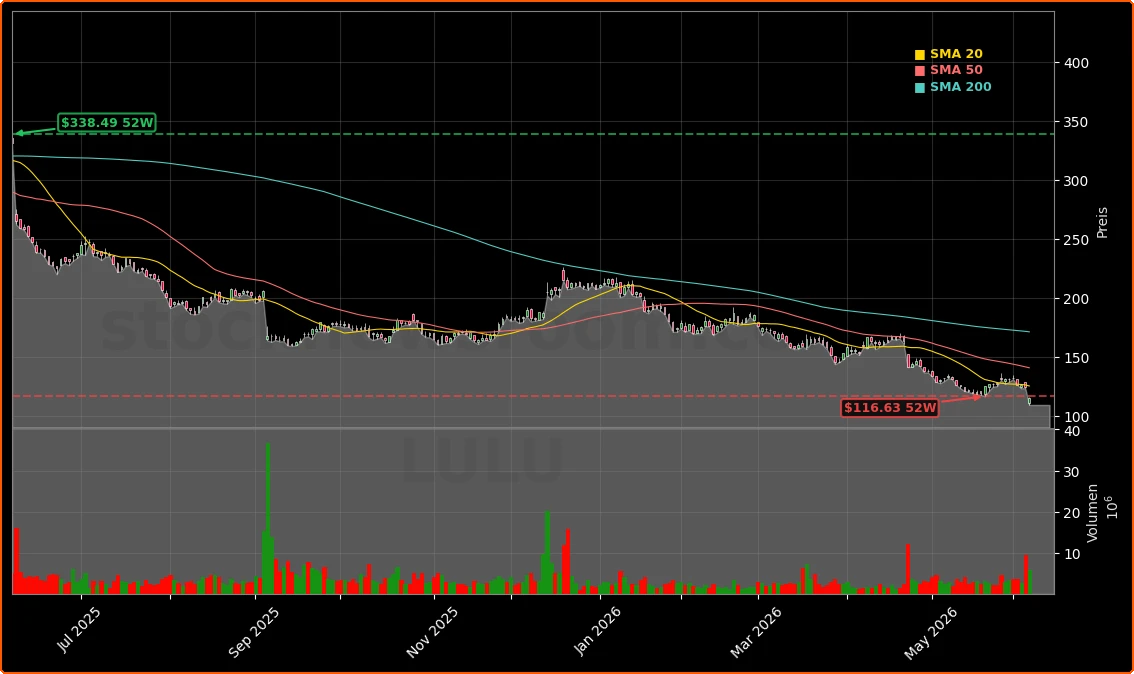
At $115.11 — down 7.94% on the day and near a 52-week low — Lululemon trades at a forward P/E of just 10.0, far below its five-year average of 32. Morningstar analyst David Swartz sees ‘significant undervaluation’ with a $295 fair value, citing $1.8 billion in cash and zero debt. Yet sentiment data from LikeFolio shows Lululemon’s consumer mindshare has dropped from 25% to 21%, while competitors like Alo Yoga have doubled theirs to 8%. As one analyst bluntly put it: ‘Lululemon isn’t just losing customers — it’s losing cultural relevance.’ For U.S. investors, the risk isn’t just earnings — it’s whether the brand can re-earn its premium pricing power in a crowded, digitally native landscape dominated by NVIDIA-powered e-commerce and shifting consumer loyalties.