
Can MicroStrategy Liquidity hold up if Bitcoin stays weak and preferred dividend pressure keeps rising?

What’s Driving MicroStrategy Liquidity Stress?
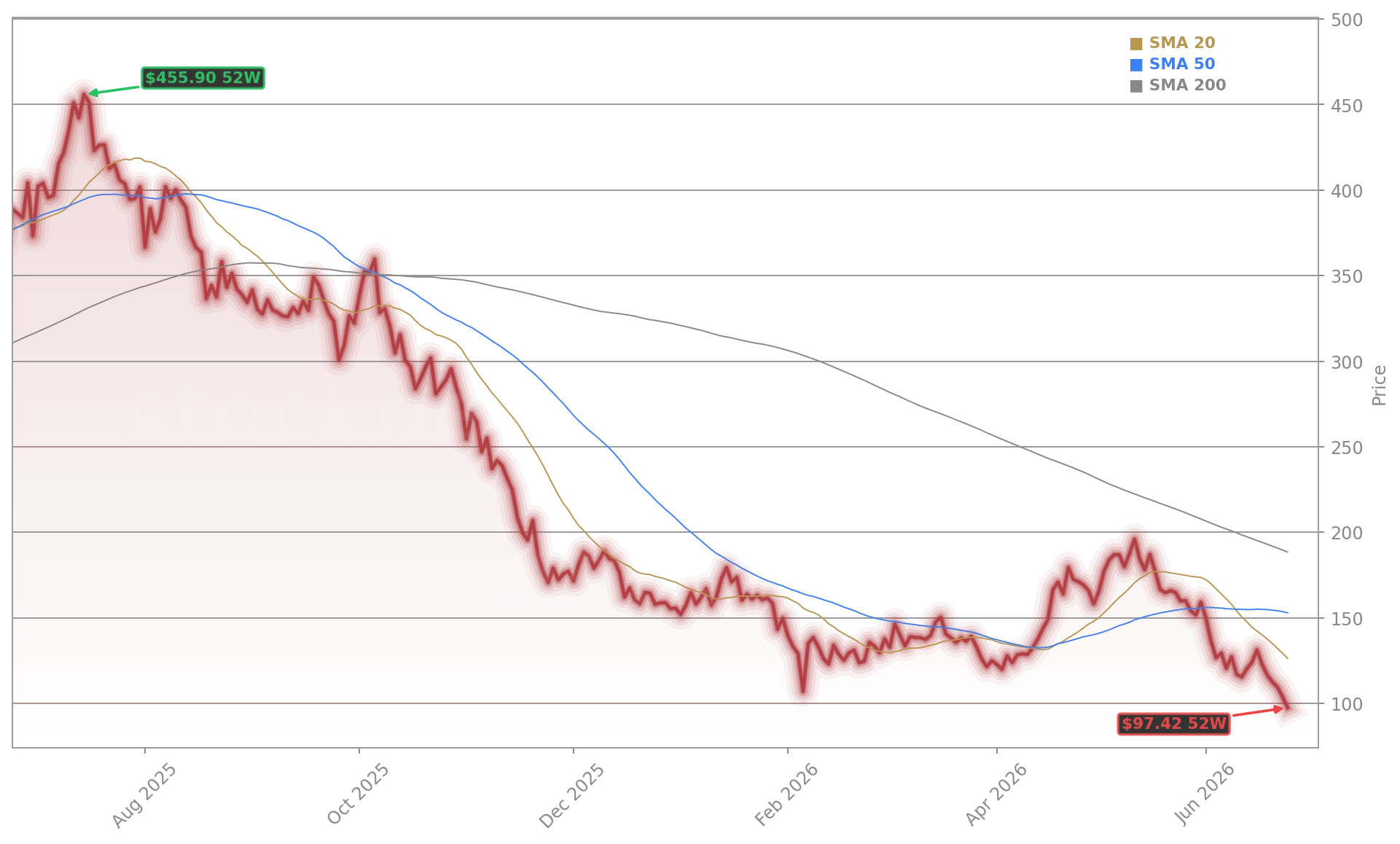
MicroStrategy Incorporated fell to $92.28 intraday—its lowest level since February 2024—down 7.88% on the day and on pace for its weakest close in over two years. The drop accelerates a brutal six-day losing streak, with shares down 27% over that stretch and 39.87% month-to-date. While Bitcoin is down 27% year-to-date, MicroStrategy Incorporated is off 37% YTD and 79.8% from its November 2024 all-time high of $473.83. That outsized decline underscores how MicroStrategy Liquidity is now constrained not just by Bitcoin’s price, but by its own financing architecture: $1.4 billion in cash reserves, $1.2 billion in annualized preferred dividend obligations, and $8.16 billion in long-term debt.
How STRC Is Straining the Balance Sheet?
MicroStrategy Incorporated’s Variable Rate Series A Perpetual Stretch Preferred Stock (STRC) has collapsed to $84.35—15.7% below its $100 par value—after hitting a record low of $82.50 last week. Launched in July 2025 to fund Bitcoin acquisitions, STRC now carries cumulative dividend obligations that CryptoQuant estimates have quadrupled to $1.2 billion annually in 2026. Yet cash reserves fell 38% year-to-date, largely due to a $1.5 billion May repurchase of convertible notes. The result? A shrinking coverage ratio: from over seven years of dividend coverage at year-end 2025 to just 14 months today. Benchmark Equity Research calls the STRC pullback a ‘market-driven repricing,’ but CryptoQuant insists the firm must suspend Bitcoin purchases until reserves hit $2.8 billion for 24-month coverage.
Is MicroStrategy Liquidity Enough to Avoid Bitcoin Sales?
With $51.65 billion in Bitcoin assets recorded at fair value—and $10.6 billion in unrealized losses—the question isn’t whether MicroStrategy Incorporated *can* sell BTC, but whether it *must*. Selling now would crystallize losses and violate Michael Saylor’s long-standing accumulation narrative. Yet without meaningful premium expansion or new equity issuance at favorable mNAV ratios (currently near 1.1x), the company faces a three-way squeeze: fund STRC dividends, replenish cash, or slow Bitcoin buying. Each choice undermines another pillar of the model. Notably, weekly BTC acquisitions have slowed to just 520 coins—the lowest in 18 months—while $300 million from recent ATM sales went straight to cash reserves, not Bitcoin.
How Does MSTR Compare to Spot Bitcoin ETFs?
BlackRock’s iShares Bitcoin Trust (NASDAQ:IBIT) offers spot exposure at a 0.25% expense ratio—no leverage, no premium compression, no preferred dividend stack. In contrast, MicroStrategy Incorporated trades at a 10% premium to its Bitcoin-per-share value, a premium that has collapsed from 2x+ in 2024. That compression amplified losses: over the past year, MSTR fell 70.4% while spot Bitcoin dropped 39.5%. Citigroup analysts recently downgraded MicroStrategy Incorporated to ‘Neutral’, citing ‘increasingly untenable dilution pressure’ and ‘structural liquidity risk.’ Meanwhile, RBC Capital Markets maintains an ‘Underperform’ rating, warning that ‘the STRC-MSTR feedback loop now dominates near-term price action.’
What’s Next for MicroStrategy Liquidity and Shareholders?
With shares down 75% from their 52-week high and trading near two-year lows, MicroStrategy Incorporated faces mounting pressure to clarify its capital priorities. The company’s next move—whether raising STRC dividends, issuing more MSTR, or pausing Bitcoin purchases—will signal whether MicroStrategy Liquidity remains a buffer or has become the bottleneck. Investors are watching closely: if Bitcoin fails to hold $59,000, STRC could test $80, triggering margin calls on preferred holders and further dilution for common shareholders. For Wall Street, this isn’t just a crypto story—it’s a stress test for levered corporate wrappers in a hawkish Fed regime.
The STRC-MSTR feedback loop now dominates near-term price action.— RBC Capital Markets
Related coverage: Is MicroStrategy’s growing cash pile a smart defense move, or an early warning that its Bitcoin machine is under real stress? MicroStrategy Bitcoin Reserve: -5% Warning on Cash Shift. Can Cardano’s latest wallet scandal shake investor trust more than any blockchain upgrade can repair it? Cardano Wallet Exploit: $2.4M Loss Hits ADA Confidence.