
Is the NextEra Energy Acquisition of Dominion a bold AI power bet or an overpaid gamble that investors will regret?

How is Wall Street reacting to the Dominion move?
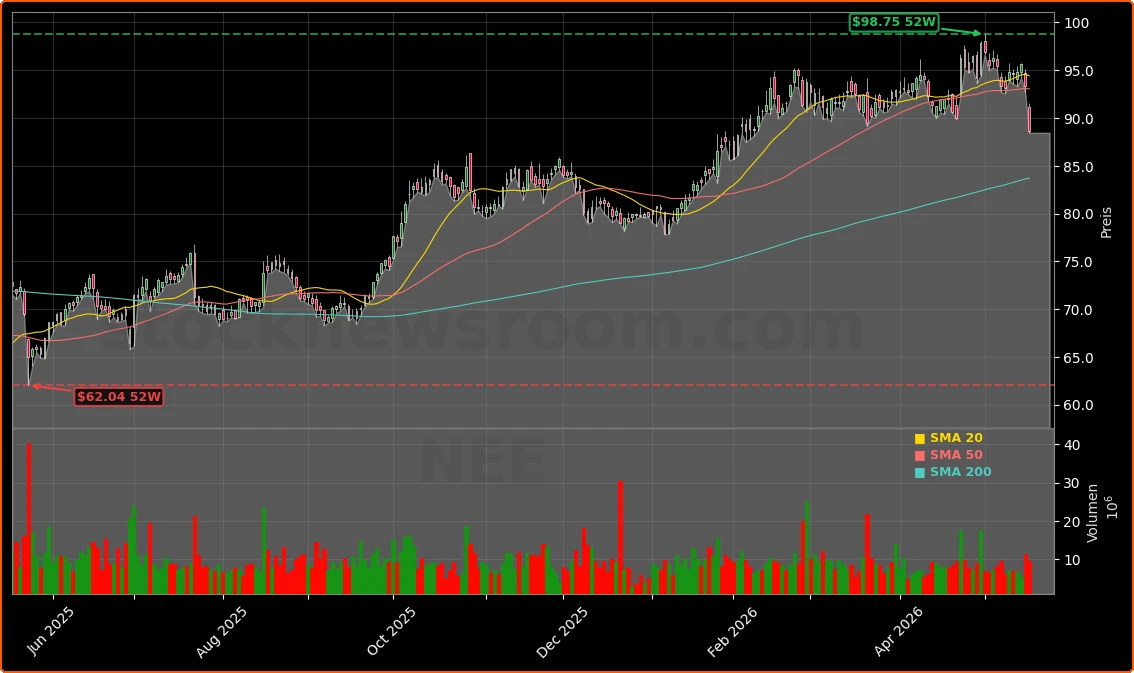
NextEra Energy, Inc. (NEE) agreed to acquire Dominion Energy (D) in an all‑stock transaction valuing Dominion at about $66.8 billion, or roughly $76 per share, a premium of just over 20% to its last close before the announcement. In early U.S. trading, Dominion stock jumped about 14%–15% as investors priced in the takeover premium, while NextEra slid around 5% to $88.68, reflecting classic buyer’s remorse fears over dilution and integration risk.
Under the terms, Dominion shareholders will receive 0.8138 NEE shares for each D share plus a one‑time $360 million cash payment at closing. After completion, NextEra shareholders will own about 74.5% of the combined company, with Dominion investors holding 25.5%. The business will continue to trade on the NYSE under the NEE ticker and NextEra name.
NEE already commands a market cap near $195 billion and is the largest utility in the S&P 500. The combined enterprise value, including Dominion’s more than $40 billion of debt, will place the group among the biggest listed utilities globally, positioning it as a core infrastructure holding for large-cap U.S. equity and ESG mandates.
What does the NextEra Energy Acquisition change strategically?
The NextEra Energy Acquisition is fundamentally about scale and securing exposure to the fastest‑growing pockets of power demand: AI and cloud data centers. Dominion controls a critical Mid‑Atlantic footprint, including northern Virginia’s Loudoun County, dubbed “Data Center Alley,” the largest concentration of data centers in the world. Data centers in Dominion’s region already consume more than a quarter of local electricity sales, and contracted capacity is set to expand sharply.
By combining Dominion’s regulated wires and data‑center‑heavy territory with NextEra’s dominant renewables and utility operations, the merged company will serve roughly 10 million customer accounts across Florida, Virginia, North Carolina and South Carolina and own about 110 gigawatts of generation across nuclear, natural gas, wind, solar and battery storage. More than 80% of earnings are expected to come from regulated businesses, supporting predictable cash flows that many income‑oriented investors seek.
Management targets more than 9% annual adjusted EPS growth through 2035 off the 2025 base, a step up from the already robust >8% CAGR guidance NextEra had outlined through 2032. The company argues that size will allow it to buy, build, finance and operate assets more efficiently, keeping customer bills competitive even as capex accelerates to accommodate AI‑driven load growth.
How does this fit into AI and clean‑energy themes?
Utilities that can reliably power hyperscale data centers are emerging as indirect AI infrastructure plays, sitting alongside chip leaders like NVIDIA and servers operated by tech giants such as Apple and Tesla. The NextEra Energy Acquisition squarely targets this theme. Dominion brings nearly 51 GW of contracted or committed data center capacity, while NextEra is already the largest U.S. developer of renewables and has expanded into nuclear and natural gas to backstop intermittent sources.
NextEra’s unregulated energy resources segment has been adding gigawatts of solar, wind and storage to its backlog; as of Q1 2026, total renewables and storage backlog stood near 33 GW after signing an additional 4 GW of projects. The company is also investing in nuclear restarts, including a deal with Google to reopen the 615‑MW Duane Arnold plant in Iowa later this decade, specifically to serve tech‑sector demand.
For investors who want AI exposure beyond semiconductors and cloud owners, the enlarged NEE‑Dominion platform offers a regulated, dividend‑paying way to play “AI‑powered electrification” rather than AI algorithms themselves.
What about valuation, analyst views and risks?
Even before the NextEra Energy Acquisition, NEE traded at a premium multiple versus traditional utilities, around 24x earnings with a dividend yield in the mid‑2% range and a relatively low beta near 0.7. Institutional interest has been strong: recent 13F filings show firms like Dana Investment Advisors, AlphaCore Capital, Lawood & Co., Bessemer Group and Vanguard all increasing or maintaining sizable positions.
On the sell‑side, price targets have been moving higher on the back of solid Q1 2026 results and upbeat long‑term guidance. JPMorgan recently raised its NEE target from $100 to $105 with an “Overweight” rating, while Evercore ISI boosted its target by $10 and reiterated “Outperform.” Consensus compiled by MarketBeat sits around $99 with a “Moderate Buy” stance. These figures were issued before full digestion of the Dominion deal, so target revisions are likely as analysts refine synergy, capex and regulatory assumptions.
We are bringing NextEra Energy and Dominion Energy together because scale matters more than ever — not for the sake of size, but because scale translates into capital and operating efficiencies.— John Ketchum, Chairman and CEO, NextEra Energy
Key risks are non‑trivial. The transaction requires approvals from multiple state regulators, the Federal Energy Regulatory Commission and other federal bodies, a process expected to take 12–18 months. Consumer advocates and politicians are already sensitive to rising power bills, and critics may question greater market concentration and Dominion’s sizable debt load. There is also execution risk as NextEra integrates about 15,000 Dominion employees and aligns capital plans across four states with different regulatory cultures.