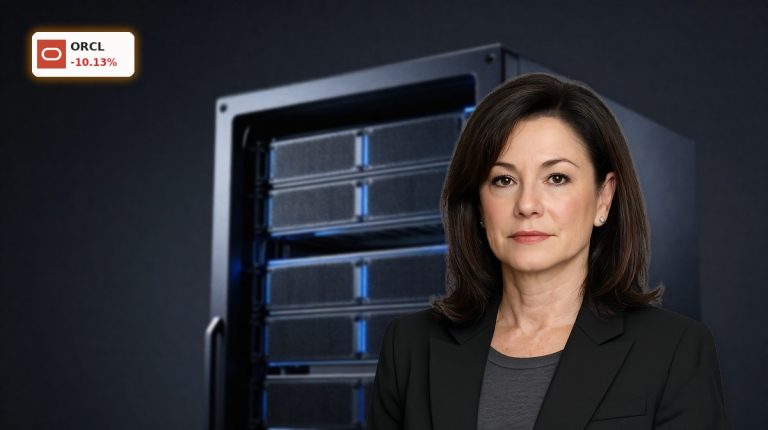

Will Oracle’s aggressive $70 billion AI expansion pay off, or will the mounting debt burden crush the tech giant’s stock?

Why is Oracle Debt raising alarms on Wall Street?
The primary catalyst for the recent sell-off is the massive capital intensity required to build out artificial intelligence infrastructure. Oracle Corporation has committed a staggering $70 billion to AI expansion, a figure that has severely squeezed its balance sheet. Unlike larger hyperscale competitors such as Amazon or Microsoft, which possess massive cash reserves, Oracle has had to rely heavily on leverage. Over the weekend, S&P Global Ratings lowered the company’s debt rating, highlighting the increased financial risk associated with this aggressive borrowing strategy.
To fund its ambitious initiatives, the database pioneer has been issuing more debt and equity, a move that is actively diluting existing shareholders. This rising Oracle Debt has also impacted the credit markets, where five-year credit default swap (CDS) spreads widened by 13% to 15% in just one month. This widening reflects growing anxiety among bondholders regarding the company’s long-term liquidity and leverage profile. While the massive capital expenditure is aimed at capturing a slice of the lucrative AI training market, Wall Street is questioning whether the near-term dilution and interest burden are worth the gamble.
How do analysts view the current valuation?
Despite the immediate balance sheet pressures, several major investment firms maintain a constructive view on the long-term potential of the enterprise software provider. Following its recent corporate updates, Bernstein raised its price target to $325.00 with an Outperform rating. Similarly, TD Cowen maintains a Buy rating with a price target of $300.00. However, not all firms are unconditionally bullish; RBC Capital Markets maintains a Sector Perform rating with a more conservative price target of $190.00, reflecting caution over near-term execution risks.
Technically, the stock is testing critical support levels, hovering just above its 52-week low of $134.57. With the stock trading 30% below its 200-day simple moving average, momentum indicators like the Relative Strength Index (RSI) have plunged to 29.52, signaling deeply oversold conditions. While some traders view this as a potential bounce candidate, others fear that a head-and-shoulders chart pattern could trigger further technical breakdowns if the stock fails to stabilize around the $135 level.
Can remaining performance obligations offset the leverage?
A central point of debate among institutional investors is the structure of Oracle’s Remaining Performance Obligations (RPO). While the company boasts a substantial backlog of $638 billion—with over $300 billion tied to its partnership with OpenAI—only about 12% of this total is scheduled to be recognized as revenue over the next nine to ten months. This delayed revenue realization means that the massive Oracle Debt will remain a prominent concern on the balance sheet for several quarters before the cash flows from these high-profile AI contracts actually begin to materialize.
Furthermore, this capital-intensive cycle is affecting the broader tech sector. The combined free cash flow of major hyperscalers, including Amazon, Alphabet, Meta, Microsoft, and Oracle, is projected to turn negative for the first time on record, representing a dramatic reversal from their peak of $260 billion in 2024. For Oracle, which operates with a much smaller revenue base than its megacap peers, the pressure to deliver a high return on these investments is exceptionally high.
Related Coverage
Everyone knows there’s a lot more coming, and so I think there’s been a hesitancy to jump in with both feet here.— Travis King, Voya Investment Management
For a deeper dive into how the company is funding its infrastructure, read about Oracle AI Financing: Why $40B Is Testing ORCL Bulls, which analyzes whether the massive $40 billion funding push will unlock a new growth phase or serve as a debt-fueled warning sign for investors. The analysis explores how the enterprise software giant is balancing its end-to-end AI stack across databases with high-interest obligations.