Can Oracle AI Infrastructure turn a record backlog into durable profits before its massive spending spree tests investor patience?

Is Oracle AI Infrastructure Driving Real Margin Power?
Oracle Corporation reported record quarterly revenue of $19.18 billion in its fiscal Q4 2026 results — up 21% year-over-year and ahead of consensus — with Cloud Infrastructure revenue exploding 93% to $5.8 billion. That segment now delivers 30% of total cloud revenue and operates at 97.5% GPU utilization, according to co-CEO Clayton Magouyrk. Crucially, the company’s remaining performance obligations (RPO) — a forward-looking proxy for contracted revenue — swelled to $638 billion, the highest in its history. Yet operating margins held steady at 36.3%, and return on equity reached 53.4%, underscoring the scalability of its AI infrastructure stack. Unlike lower-margin infrastructure plays, Oracle’s integrated software layer — including Oracle Health AI Data Platform and Oracle AI Database@AWS — allows for premium pricing and cross-sell leverage, especially in regulated sectors like healthcare and finance.
Why Is Oracle Borrowing $50B While Generating $24B Negative FCF?
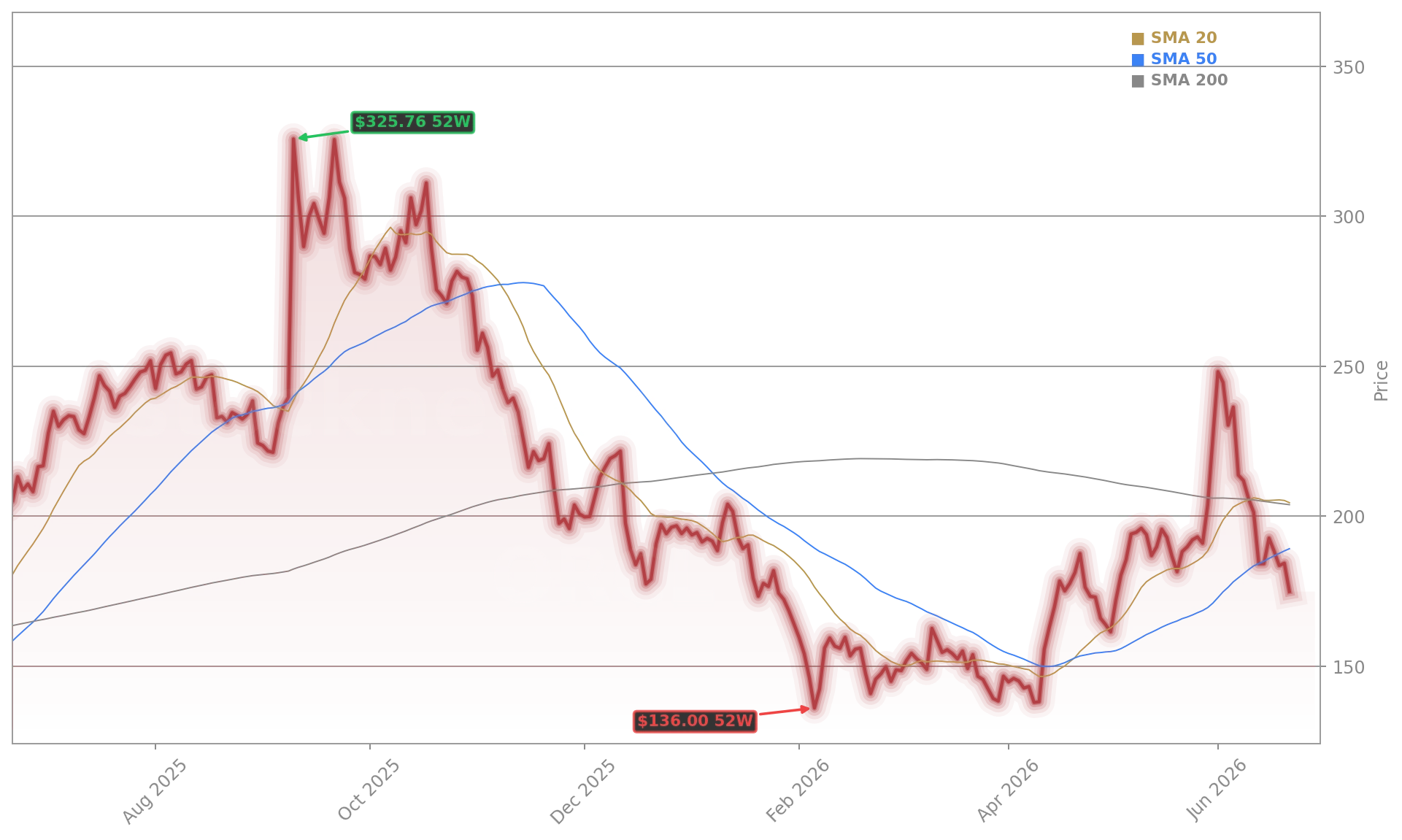
Fiscal 2026 free cash flow plunged to -$23.69 billion as capex hit $55.66 billion — more than double the prior year. Oracle plans to raise up to $50 billion in 2026 via debt and equity, with an additional $40 billion flagged for fiscal 2027. That brings its total capex guidance for FY27 to $70 billion net cash — the highest among major software firms and approaching levels seen at Amazon and Meta. While Bloomberg reports Oracle’s debt now exceeds $100 billion, Mizuho reiterated its Outperform rating and $320 price target, citing the company’s ‘bring-your-own-cloud’ model and prepayment structure as self-funding mechanisms over time. Morningstar, however, trimmed its fair value to $207, citing near-term cash flow stress. The divergence reflects Wall Street’s split view: long-term optionality versus near-term balance sheet risk.
How Does Oracle Stack Up Against Microsoft and NVIDIA?
With aggregate hyperscaler capex for 2026 now topping $452 billion — including $200 billion from Amazon, $185 billion from Alphabet, and $175 billion from Microsoft — Oracle’s $70 billion commitment places it firmly in the top tier of AI infrastructure spenders. Yet unlike NVIDIA, whose chips power virtually all AI data centers, Oracle is building the full-stack infrastructure: compute, networking, power, and AI-native software. Its recent $2.6 billion master agreement with Nebius Group and fuel-cell-powered Project Jupiter in New Mexico signal vertical integration beyond traditional cloud providers. RBC Capital Markets notes Oracle’s AI infrastructure strategy ‘creates defensible moats in high-compliance verticals’ — a contrast to the broader market’s focus on raw compute scale. Still, Oracle’s 20x forward P/E — cheap versus peers — masks a beta of 1.655, amplifying volatility during broader tech selloffs.
What’s Next for Oracle’s Healthcare and Energy Partnerships?
Oracle Health’s expanded collaboration with Baystate Health — including AI-powered EHR, Clinical AI Agent, and Patient Accounting — highlights a critical vector: monetizing AI infrastructure in mission-critical, high-margin verticals. The deal supports Baystate’s integration of Mercy Medical Center and underscores Oracle’s ability to embed AI infrastructure into core operational workflows. Separately, Oracle’s agreements with Energy Transfer and Bloom Energy to supply natural gas and fuel cells for AI campuses show how Oracle AI Infrastructure is reshaping energy demand. As AI data centers consume power equivalent to small countries, Oracle’s infrastructure partnerships are becoming strategic assets — not cost centers. That nexus of AI infrastructure, healthcare digitization, and energy transition is now central to its growth narrative for U.S. institutional investors.
Related Coverage
Everything we see shows this market size is in the trillions of dollars per year.— Clayton Magouyrk, Co-CEO, Oracle Corporation
A $3 billion cloud deal reportedly collapsing sent Oracle shares down 2.8% last week — raising questions about execution risk in its AI infrastructure rollout — as detailed in Oracle Cloud Deal $3B Shock Sends ORCL Down 2.8%. Meanwhile, valuation concerns are mounting across the AI software space: Palantir’s uncertainty in France has triggered a 6.9% selloff and broader questions about premium multiples — explored in Palantir France Contract -6.9%: Valuation Warning Grows.