Can Oracle’s massive AI backlog outweigh the cash burn and debt fears now rattling Wall Street?

What Did Oracle Earnings Reveal?
Oracle Corporation reported fiscal Q4 2026 results on June 10, 2026—its final quarter before transitioning fully to a cloud-first fiscal calendar. Revenue rose 21% year-over-year to $19.2 billion, while non-GAAP EPS landed at $2.11, topping the $1.97 consensus. The cloud segment surged 47% to $9.9 billion, now constituting 52% of total revenue. Crucially, Oracle Cloud Infrastructure (OCI) revenue exploded 93% to $5.8 billion, reflecting deepening adoption by AI-native firms. Remaining Performance Obligations (RPO)—a key forward-looking metric—soared 363% to $638 billion, including $300 billion tied to OpenAI and other hyperscale AI customers. Yet the GAAP EPS of $1.45 exposed $0.66 in non-cash and restructuring charges, underscoring the accounting complexity behind the headline beat.
Why Did Wall Street Sell Off Oracle?
Investors didn’t react to earnings—they reacted to financing. Oracle Corporation announced plans to raise $40 billion in new debt and equity in fiscal 2027, including a $20 billion at-the-market equity program. Net capex guidance jumped to $70 billion—up from $55.7 billion in FY2026—while operating cash flow of $32 billion was entirely consumed by infrastructure buildout. The result: negative free cash flow of $23.7 billion. That’s not a blip—it’s structural. Oppenheimer analyst Timothy Horan reaffirmed an Outperform rating and raised the price target to $275.00, implying 50% upside from Thursday’s close. Bank of America’s Tal Liani reiterated a Buy with a $240 target, calling the selloff ‘noise’ relative to OCI’s 93% growth. Goldman Sachs’ Gabriela Borges lifted her target to $239, citing strong prepayment coverage and contracted margins. But the market’s focus shifted from margins to balance sheets—especially as Oracle’s total debt now exceeds $153 billion, with $130 billion in outstanding borrowings and $135 billion in long-term data center leases.
How Does Oracle Compare to AI Infrastructure Peers?
Unlike NVIDIA, which posted $80 billion in AI chip revenue and announced an $80 billion share buyback, Oracle Corporation is spending aggressively to *consume* AI hardware—not sell it. While Tesla and Apple face scrutiny over AI execution timelines, Oracle is on the opposite end: over-delivering infrastructure capacity but under-delivering cash flow. The contrast with Micron Technology (MU), whose 74.4% gross margins and $23.9 billion revenue reflect spot-market AI memory demand, highlights Oracle’s structural divergence: its $638 billion RPO represents multi-year, contracted, subscription-based revenue—not cyclical hardware sales. Yet that very strength creates execution risk: 211 cloud regions and 72 multicloud data centers must be built on time, within budget, and powered—amid growing constraints on land, grid capacity, and construction labor. When Bloomberg reported that Crusoe Energy, Oracle’s key infrastructure partner, faced delays in its Wyoming AI campus, investor nerves tightened further.
Oracle Earnings and the Broader Software Sector
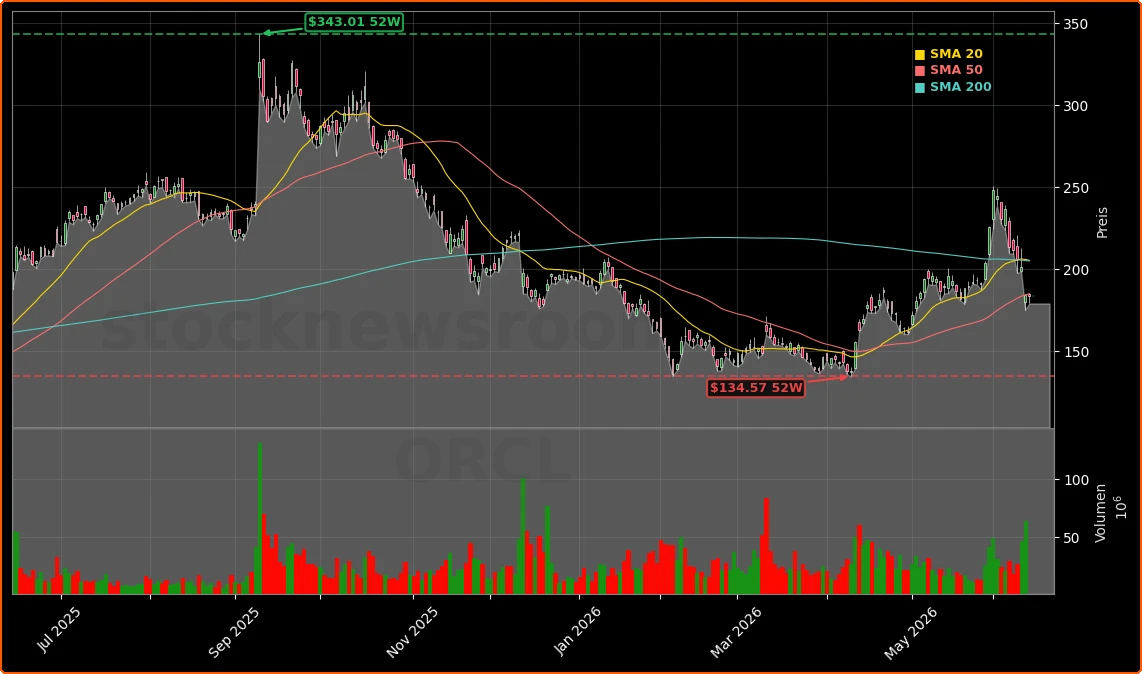
Oracle Earnings didn’t just move ORCL—it rattled the entire software ecosystem. Adobe (ADBE) dropped over 7% after its CFO announced departure for Marvell Technology, a chipmaker powering AI data centers. Autodesk (ADSK) and Intuit (INTU) followed lower, dragging the iShares Expanded Tech-Software ETF down for its ninth straight session. Barron’s noted that software stocks have fallen 37% from their September 2025 peak, as AI agents threaten user-based pricing models and in-house development erodes license revenue. Oracle’s legacy software segment fell 2.1%—a drag even as its cloud business soared. That duality mirrors Microsoft’s own struggle: cloud infrastructure wins, but legacy software faces headwinds. The market now distinguishes sharply between ‘pickaxes’ (NVDA, TSM, MU) and ‘mines’ (Oracle, Palantir)—rewarding cash flow, not just contracts.
What’s Next for Oracle Corporation?
Fiscal 2027 guidance confirms $90 billion in revenue and $8.05 in non-GAAP EPS—18% growth. Cloud revenue growth is guided at 58%–64% for Q1, with OCI expected to generate ~40% of total company revenue this year and potentially 75% by 2030. Co-CEO Clay Magouyrk confirmed all 211 cloud regions are ‘already contracted at a very profitable rate.’ Oracle declared a $0.50 quarterly dividend, signaling confidence in long-term cash generation. But the path to profitability remains steep: analysts project positive free cash flow only by 2030. The immediate test is execution—not earnings. If OCI delivers on its $638 billion backlog without further cost overruns or power constraints, the current selloff may prove a generational entry point. If delays mount, pressure on the balance sheet intensifies.
Related Coverage: For deeper analysis of Oracle’s AI capex warning and its implications for institutional investors, see Oracle Earnings -10% After Hours: AI CapEx Warning Hits. For context on how AI strategy risks are playing out across the sector, read Palantir AI Strategy -2.2%: Growth Meets Political Risk.
Oracle’s RPO growth is astonishing—but converting $638 billion of backlog into profitable revenue requires flawless execution, disciplined capital allocation, and grid-scale power. This isn’t just cloud—it’s infrastructure at nation-state scale.— Timothy Horan, Oppenheimer
Oracle Corporation remains the most consequential AI infrastructure play outside the chipmakers—a company whose Oracle Earnings are now less about quarterly profit and more about the credibility of its multi-decade capital deployment. For long-term investors, the risk-adjusted opportunity lies in the gap between its $638 billion contracted future and its $250 billion market cap. The next quarterly earnings will test whether Wall Street begins pricing in execution—not just ambition.