
Can Oracle’s AI-fueled cloud boom justify a $70 billion spending plan, or is Wall Street right to punish the stock?

What Did Oracle Earnings Reveal?
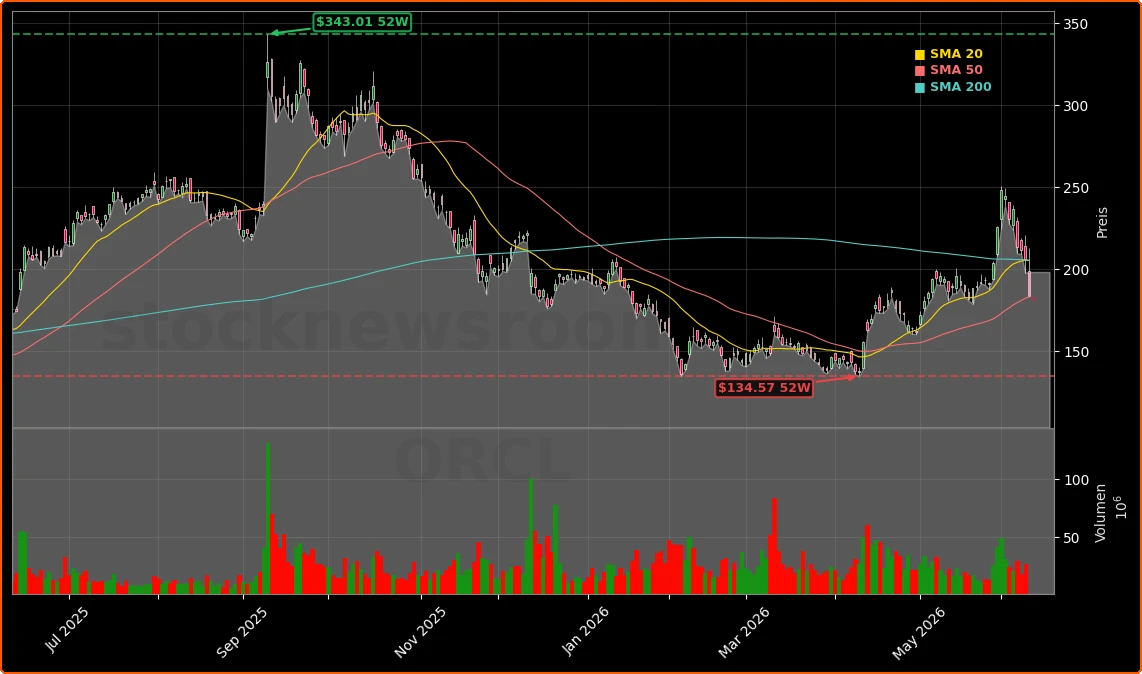
Oracle Corporation reported fiscal Q4 2026 results that beat consensus on both top and bottom lines: revenue of $19.18 billion (vs. $19.09 billion expected) and non-GAAP EPS of $2.11 (vs. $1.97 expected). Cloud infrastructure revenue surged 93% year-over-year to $5.79 billion, while total cloud revenue rose 47% to $9.91 billion. Yet the market reacted negatively — shares dropped sharply to $180.88 after hours — as investors focused on the $55.7 billion in fiscal 2026 capital expenditures, $5.7 billion above Oracle’s own $50 billion guidance. CFO Hilary Maxson confirmed $70 billion in net CapEx for fiscal 2027, with an additional $20–25 billion in customer-funded or prepaid components. This scale of spending — approaching 100% of projected revenue — pressured gross margins and raised concerns about near-term free cash flow, which came in at a negative $1.87 billion for the quarter.
Why Is Wall Street Doubting Oracle’s AI Play?
Unlike Amazon, Microsoft, or Meta, Oracle Corporation entered the AI infrastructure race without a fortress balance sheet. It raised $43 billion in debt and $5 billion in equity in fiscal 2026 — making it one of the largest non-financial corporate borrowers in the U.S. bond market. Analysts at JPMorgan, led by Arti Vula, acknowledged accelerating currency-adjusted growth and the record $638 billion RPO but flagged the absence of upward guidance for full-year revenue — still held at $90 billion — as a near-term headwind. Meanwhile, Jefferies’ Brent Thill maintained a ‘Buy’ rating with a $320 price target, calling the selloff ‘overdone’ but conceding that revenue conversion remains a watchpoint. Deutsche Bank’s Brad Zelnick echoed this, retaining a ‘Buy’ at $300, citing ‘durable organic growth ahead’ despite CapEx concerns.
How Does Oracle Earnings Compare to Hyperscaler Peers?
Oracle Corporation’s AI infrastructure model diverges sharply from the self-funding hyperscalers. While NVIDIA supplies the chips and Tesla builds AI training clusters for its own autonomy stack, Oracle is building, leasing, and monetizing the infrastructure — a capital-intensive, low-margin, high-risk/high-reward path. Its $75 billion in large AI contracts with prepaid or customer-supplied GPUs — including the landmark Stargate project with OpenAI — mitigates some funding pressure, but doesn’t eliminate execution risk. Competitors like SAP face less infrastructure exposure but are now feeling ripple effects: SAP shares dropped 4.5% on Thursday as investors repriced enterprise software valuations amid Oracle’s cloud-apps slowdown (SaaS growth slowed to 10% YoY) and margin compression. UBS affirmed its ‘Buy’ rating on Oracle at $285, noting ‘the peak of investments appears near.’
What Does This Mean for the S&P 500 and NASDAQ?
Oracle Corporation’s earnings reaction reflects broader stress in the AI trade. The iShares Expanded Tech-Software Sector ETF is down 13% year-to-date, while the S&P 500 is up 8% — highlighting investor rotation from high-CAPEX, low-cash-flow AI enablers toward more balanced tech and value names. Oracle’s 10% after-hours drop contributed to a 0.4% decline in the NASDAQ 100 premarket, reinforcing concerns about valuation sustainability in the AI infrastructure subsector. Guggenheim’s John DiFucci — who maintains a $400 price target and ‘Buy’ rating — argues the selloff is ‘for no apparently good reason,’ positioning Oracle as a ‘Best Idea’ for multi-year investors. Yet with CapEx-to-sales approaching parity and debt/lease liabilities now exceeding $417 billion, the path to that $400 target hinges on flawless execution and rapid margin recovery.
Oracle Earnings: The Verdict for U.S. Portfolios
AI infrastructure makes the existing cloud infrastructure market look small. Everything we see shows this market size is trillions of dollars per year.— Clay Magouyrk, Co-CEO, Oracle Corporation
For U.S. investors, Oracle Earnings represent a critical stress test for AI infrastructure exposure. The $638 billion RPO validates long-term demand, but the $70 billion fiscal 2027 net CapEx forecast confirms this is not a cash-generative business — yet. D.A. Davidson’s Gil Luria raised his price target to $225, citing accelerating infrastructure delivery, while CFRA’s Angelo Zeno maintains a ‘Hold’ at $194, citing ‘more burdensome’ CapEx versus ‘better capitalized hyperscalers.’ With Oracle Corporation now a top-10 holding in major AI ETFs — including the Xtrackers Artificial Intelligence & Big Data UCITS ETF — its earnings directly impact broad-based investor exposure to the AI theme. The key question isn’t whether AI demand exists — it’s whether Oracle can convert its $638 billion in backlog into profitable, scalable infrastructure without overextending its balance sheet.