
Can PepsiCo Earnings still justify a staples premium when U.S. consumers are pulling back faster than management expected?

Why Did PepsiCo Earnings Trigger a Sell-Off?
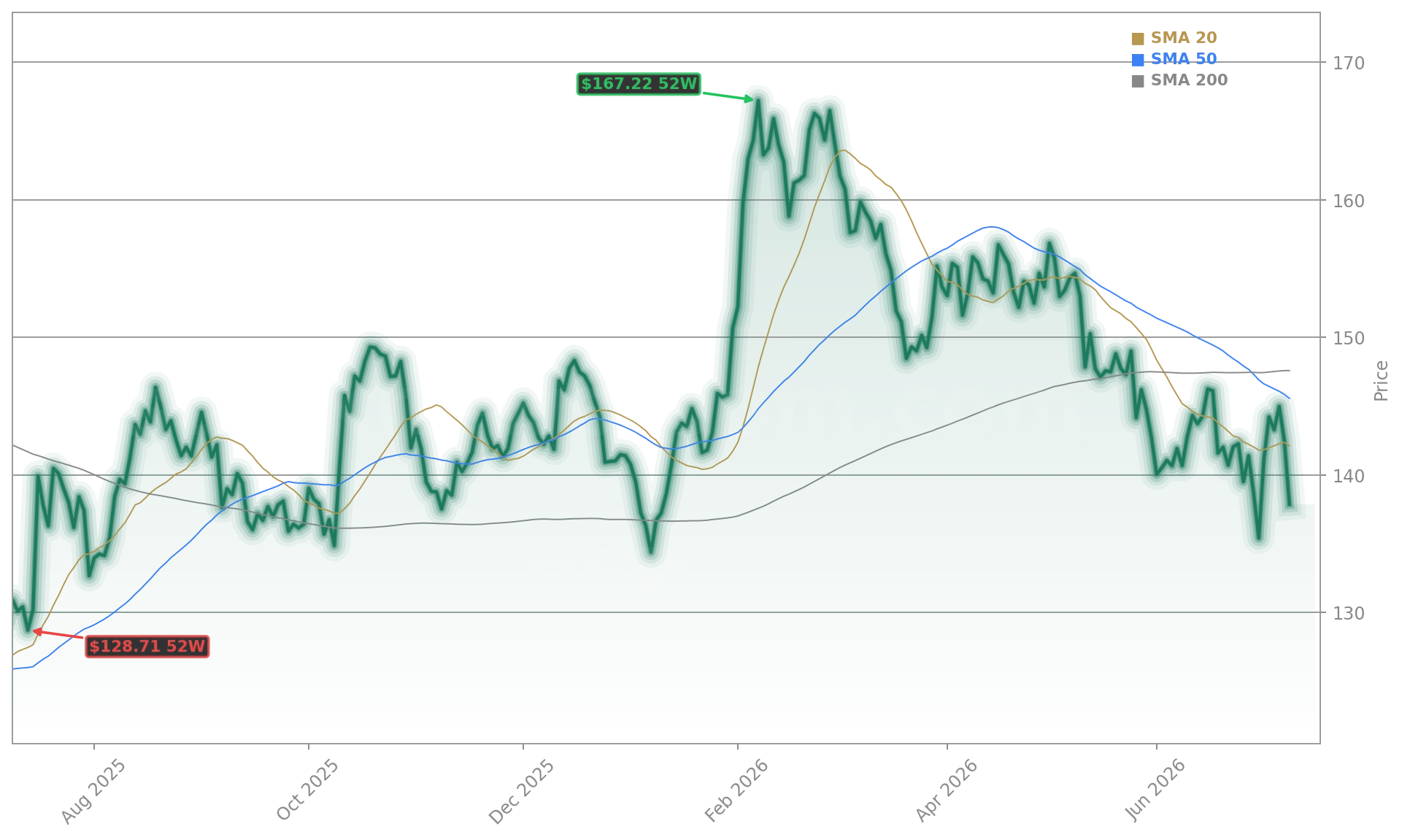
PepsiCo shares fell 3.3% to $137.80 on Friday, July 10, following the release of its Q2 2026 results. While net revenue rose 6.4% year-over-year to $24.18 billion—beating the $23.95 billion consensus—adjusted EPS of $2.20 narrowly missed the Bloomberg Consensus estimate of $2.21. The miss wasn’t driven by weak margins or operational chaos, but by lower-quality earnings: J.P. Morgan analysts labeled the beat ‘of lower quality,’ citing below-the-line items and modest organic sales growth of just 2.4%. North America—contributing over 55% of total revenue—reported flat volume in food and a 4% decline in beverage volume, even after aggressive 15% price cuts on Lay’s, Doritos, and Tostitos earlier this year. As CEO Ramon Laguarta stated, ‘the consumer is worse than we had anticipated,’ pointing to elevated gas prices tied to U.S.-Iran tensions and persistent inflationary pressure on lower-income households.
How Is PepsiCo Earnings Impacting Wall Street’s Staples Strategy?
For S&P 500 investors relying on consumer staples as ballast, PepsiCo Earnings underscore a structural shift: resilience no longer means uniform strength. While PepsiCo outperformed peers like Coca-Cola—whose shares fell 0.8%—it underperformed the broader index, which rose 0.8% on Thursday. The divergence is stark versus Molson Coors Beverage (TAP), which trades at a forward P/E of 8.1x versus PepsiCo’s 16.6x—yet faces steeper volume headwinds in beer. Morgan Stanley maintains an Equal-weight rating, citing ‘OK results given the lower bar,’ while J.P. Morgan retains its Overweight stance but urges caution on North America’s path to recovery. Notably, the company’s debt-to-equity ratio remains elevated at 2.5x, and free cash flow of $7.7 billion in FY 2025—though healthy—must now fund $7.9 billion in shareholder payouts and $1 billion in buybacks. That tight balance sheet leaves little room for error in a slowing U.S. retail backdrop.
What’s Driving the International Lift in PepsiCo Earnings?
Global markets delivered the bright spot in PepsiCo Earnings. International beverages posted 11% reported revenue growth (9% organic), with volume up 5%. Asia Pacific and Latin America foods surged 15% and 12% in reported revenue, respectively—entirely organic and unburdened by acquisition noise. This contrasts sharply with North America’s food unit, where revenue fell 2% and volumes were flat. The strength reflects successful localization—World Cup-themed Gatorade launches in Mexico, protein-enriched Lay’s in India—and a deliberate pivot away from reliance on U.S. retail giants like Walmart, which accounts for 14% of net revenue. Still, international growth alone won’t offset U.S. softness: North America remains the profit engine, generating the bulk of operating income. As UBS analyst Peter Grom noted, ‘the print more or less played out as expected but was still disappointing on the surface,’ especially with gross margin and operating profit margin both below expectations.
How Do PepsiCo Earnings Compare to Broader Consumer Trends?
PepsiCo Earnings align with mounting evidence of U.S. consumer fatigue. A Jefferies chart cited by food retail analyst Scott Marks shows SNAP benefits per participant declining sharply—mirroring the company’s observation that ‘budget tightening’ is hitting impulse categories hardest. That trend dovetails with GLP-1 medication adoption, which is shifting demand toward savory, high-protein snacks and away from sugary beverages—benefiting PepsiCo’s Frito-Lay and Quaker segments but pressuring its core soda portfolio. Meanwhile, Costco’s 4% stock decline on weak June sales and the S&P 500’s 0.8% gain highlight how selectively investors are rewarding consumer exposure. Unlike NVIDIA or Apple, which benefit from AI-driven capex cycles, PepsiCo’s growth is tethered to disposable income—now under strain from $3.80/gallon average gas prices and 4.54% 10-year Treasury yields. The company’s pivot toward zero-sugar beverages and fiber-enriched snacks is real, but monetization remains gradual.
What Does PepsiCo Earnings Mean for Dividend Investors?
Results were tempered in the quarter as U.S. food and beverage category performance moderated with consumer budgets tightening due to rising inflationary pressures.— Ramon Laguarta, CEO of PepsiCo
PepsiCo remains a Dividend King—51 consecutive years of annual increases—and its 4.15% forward yield is compelling, especially versus Molson Coors’ 4.95%. But yield alone isn’t enough. With a payout ratio of 87% of cash flow and shares flirting with a one-year low, the dividend signals stability, not strength. Analysts at Citigroup caution that ‘tariff refunds allocated to PBNA in Q3 will offset higher COGS—not fund growth,’ meaning reinvestment in advertising and innovation remains constrained. Still, Resona Asset Management and Greenwood Capital Associates both increased stakes in Q1, betting on long-term brand power. For income-focused portfolios, PepsiCo Earnings confirm the dividend is safe—but not the catalyst for capital appreciation investors need in today’s 5%+ rate environment.