

Are Realty Income Earnings strong enough to turn a -3.5% stock drop into a long-term dividend opportunity?

How do Realty Income Earnings look under higher rates?
Realty Income, known as “The Monthly Dividend Company,” has been navigating the higher-for-longer rate environment with a mix of disciplined acquisitions and tight cost control. In its latest reported quarter, revenue rose about 12.3% year over year to roughly $1.55 billion, significantly ahead of Wall Street estimates. Funds from operations (FFO) increased from $937.7 million to $993.6 million, a gain of nearly 6%, underscoring that the core cash engine behind the dividend is still growing despite macro headwinds.
Adjusted funds from operations (AFFO) came in at $1.13 per share, while reported FFO per share was $1.06, only a penny higher than a year earlier. Net income attributable to shareholders reached approximately $311.8 million, or $0.33 per share. These Realty Income Earnings metrics show a company absorbing higher financing costs yet still expanding its cash flows, largely thanks to a high occupancy rate of 98.9% and rent recapture of about 104.9% on re-leased space.
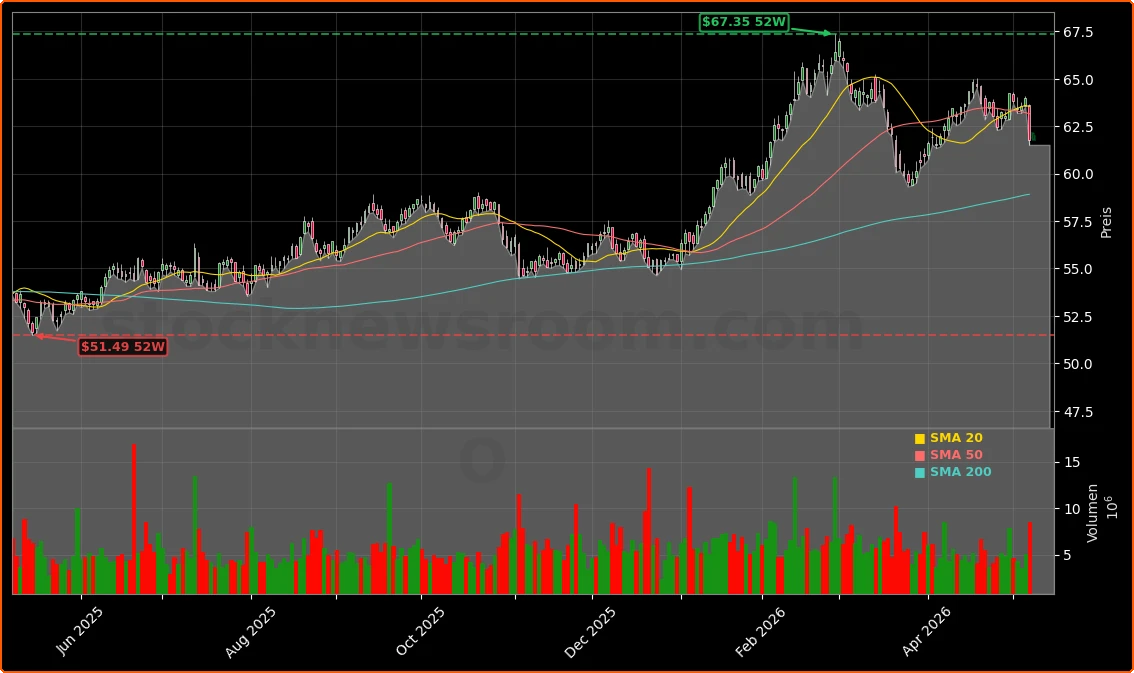
The stock closed Thursday at $61.79, down about 3.5% on the day, with a slight rebound to $62.14 in after-hours trading. At these levels, the shares offer a yield near 5%, positioning Realty Income as a potential anchor holding for dividend investors comparing it with alternatives in the S&P 500 and long-term Treasuries.
What is driving guidance and portfolio strategy at Realty Income?
A key highlight of the latest Realty Income Earnings update was management’s decision to raise full-year AFFO guidance. The REIT now expects AFFO between $4.41 and $4.44 per share, up from a prior range of $4.38 to $4.42. Even at the low end, that comfortably covers the current annualized dividend of about $3.240 per share, leaving room for continued incremental raises.
Capital allocation is shifting more aggressively toward international opportunities. Management boosted its capital expenditure guidance by roughly $1.5 billion to about $9.5 billion, with a strong focus on Europe. There, lower benchmark interest rates relative to the U.S. are supporting higher risk-adjusted acquisition yields. In the prior quarter, the company completed around $950.7 million of European deals at an attractive yield of roughly 7.2%, and it also expanded into Mexico with about $200 million of investments, widening its geographic diversification.
Even as the total property count has inched lower for two consecutive quarters to about 15,571 assets, revenue continues to rise. That reflects a deliberate move toward higher-quality properties with stronger capitalization rates and more defensive tenants, particularly in essential retail and necessity-based formats. For investors, this signals that Realty Income is prioritizing portfolio quality and long-term stability over sheer asset count growth.
How secure is the dividend for income-focused investors?
Realty Income’s appeal ultimately comes down to its monthly dividend. The most recent increase lifted the payout to $0.2705 per share per month, translating into a yield of roughly 5.0%–5.1% at current prices. That raise marked the 113th consecutive quarterly dividend increase, one of the longest running streaks among U.S. REITs. With AFFO guidance for 2026 in the $4.38 to $4.42 range and the updated current-year outlook at $4.41 to $4.44, coverage remains robust.
On a valuation basis, management’s targets imply a price-to-FFO multiple around 14.4 to 14.5 times for 2026, which sits roughly 10% below the sector average for net lease REITs. The payout ratio stays within a disciplined band that leaves a buffer against potential tenant issues or refinancing costs. For comparison, other income plays like Enterprise Products Partners, Verizon, and Altria all offer yields in the mid-5% range, but without Realty Income’s monthly cadence and REIT tax structure.
With the 10-year Treasury yield recently around 4.4%, the income spread of Realty Income still appeals to many retirees and conservative investors. The REIT’s long-term leases, diversified tenant mix, and historically high occupancy give it a more defensive profile than mortgage REITs or highly leveraged property players. That’s a key reason Realty Income Earnings are closely watched as a barometer for the health of the broader net-lease space.
How does Realty Income compare to other income names?
For U.S. investors, Realty Income sits in the “moderate yield” bucket with a roughly 5% payout, alongside pipeline operator Enterprise Products Partners, telecom giant Verizon, and tobacco group Altria. While names like NVIDIA and Apple dominate headlines for growth and AI, Realty Income offers a different proposition: steady, predictable monthly checks tied to brick-and-mortar real estate.
Unlike more volatile mortgage REITs such as AGNC Investment, which recently reported losses tied to widening mortgage spreads, Realty Income has stuck to triple-net leases and necessity-based retail tenants. That business model has allowed it to keep occupancy near 99% and maintain its record of dividend growth. For investors rotating some gains out of high-flying tech or EV names like Tesla, the Realty Income Earnings profile can act as a stabilizing counterweight within a diversified portfolio.
On the Street, large banks such as Citigroup, Goldman Sachs, and Morgan Stanley continue to track the stock closely, focusing on the balance between its acquisition pace, cost of capital, and dividend safety. While specific target changes have been limited recently, the raised AFFO guidance and expanded European pipeline should factor into future valuation models and ratings updates.
Related Coverage: How does the strategy hold up?
Investors who want a deeper dive into the sustainability of the 5% yield can look to the analysis in Realty Income Dividend Strategy: 5% Yield Under the Microscope. That piece examines how the company’s long-term lease structure and conservative payout ratio position it as a defensive anchor in a higher-rate world. Together with the latest Realty Income Earnings trends, it provides a fuller picture of whether the stock can continue to serve as a core holding for income-focused portfolios.
In summary, the latest Realty Income Earnings confirm that the REIT remains one of the most dependable dividend payers on Wall Street, with raised AFFO guidance and a fortified balance sheet supporting its monthly checks. For long-term investors, the combination of a 5% yield, disciplined international expansion, and below-average valuation multiples keeps the stock firmly on the radar. The next Realty Income Earnings release will be crucial in showing whether management can sustain this momentum as the rate cycle evolves and capital markets potentially loosen.