
Can the Regeneron Melanoma Trial setback derail the biotech’s oncology growth story, or will upcoming data flip the narrative?

How is the Regeneron Melanoma Trial moving the stock?
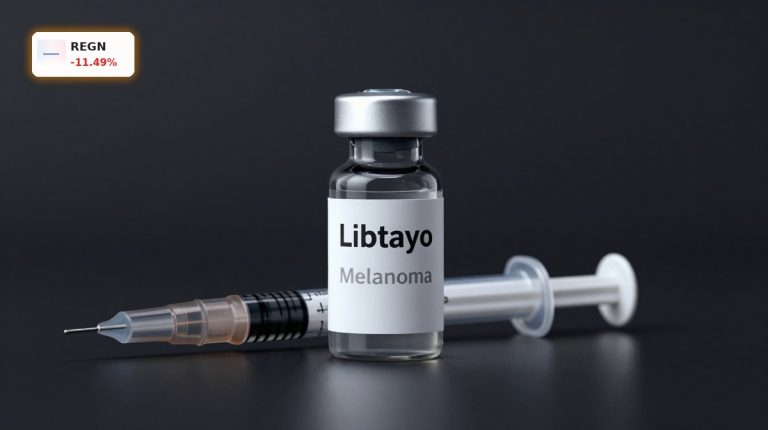
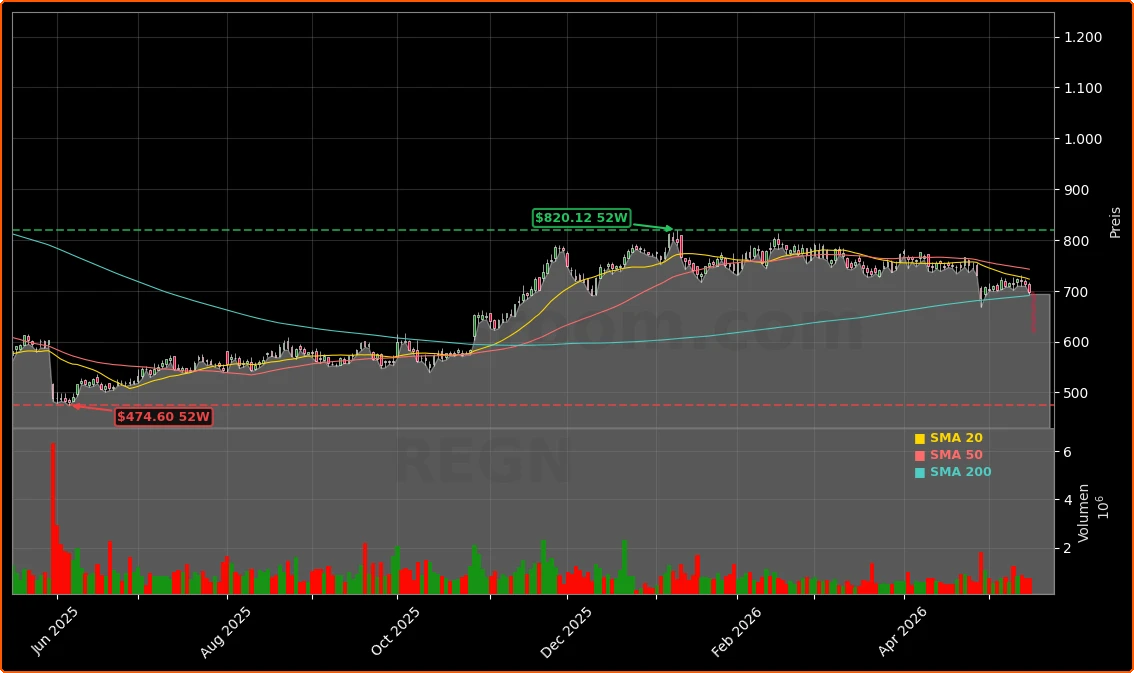
Regeneron Pharmaceuticals closed Friday at $698.25, down 2.05%, already under pressure ahead of the highly watched data readout. Before the U.S. open on Monday (ET), the stock is quoted around $618.00, implying an additional drop of roughly 11.5%. That move pulls REGN further away from its 52‑week high of $821.11, though it remains well above the 52‑week low of $476.49. For NASDAQ investors, the slide in REGN stands out against a relatively stable broader market and illustrates how binary late‑stage trial outcomes can be for large‑cap biotech names.
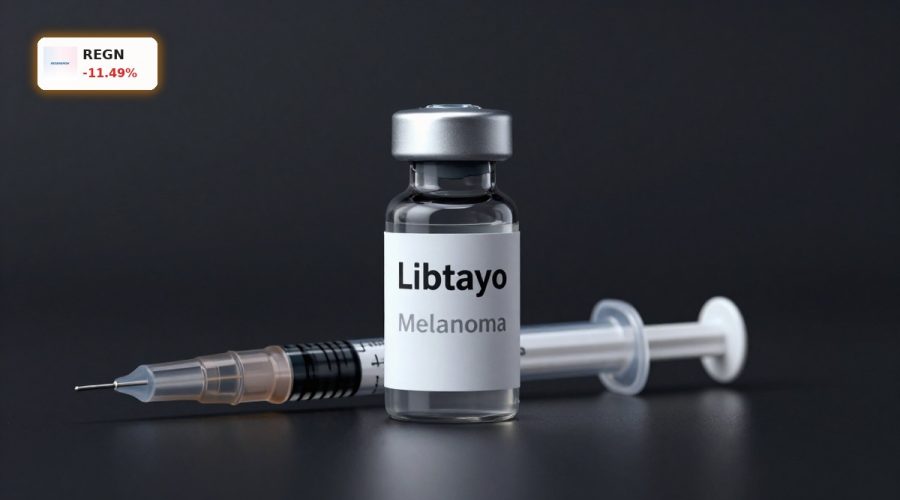
The Regeneron Melanoma Trial evaluated high‑ and low‑dose fianlimab, a LAG‑3 inhibitor, in combination with Libtayo as first‑line treatment for unresectable or metastatic melanoma in more than 1,500 patients. While the high‑dose combo showed a numerical improvement of 5.1 months in median progression‑free survival versus pembrolizumab (Keytruda), the difference did not reach statistical significance, meaning the study formally failed its primary endpoint.
Importantly for long‑term holders, the company reported no new safety signals, reducing the risk of a broader read‑through to other immuno‑oncology or antibody programs in its pipeline. Still, the inability to clearly beat Keytruda in this pivotal setting weakens a key growth pillar that some investors had built into their models.
What does this mean for Regeneron’s oncology ambitions?
The Regeneron Melanoma Trial was designed to elevate Regeneron’s position in the highly competitive checkpoint inhibitor landscape, dominated by Merck’s Keytruda and Bristol Myers Squibb’s Opdivo and Opdualag combinations. By failing to demonstrate statistically superior progression‑free survival, Regeneron loses a high‑profile opportunity to position the fianlimab‑Libtayo regimen as a new standard of care in first‑line advanced melanoma.
Still, management is not exiting the space. A separate Phase 3 head‑to‑head trial is ongoing, testing high‑dose fianlimab plus Libtayo directly against Bristol Myers Squibb’s Opdualag (nivolumab + relatlimab) in the same first‑line setting. That study now takes on outsized importance. If it can show clinically meaningful and statistically significant benefits, it could partially repair the damage from the initial Regeneron Melanoma Trial failure and re‑ignite interest in Regeneron’s melanoma franchise.
For U.S. investors who follow oncology leaders such as Apple‑like bellwethers in tech or NVIDIA in AI, the message is that even established large‑cap biotechs remain vulnerable when trying to unseat entrenched blockbuster therapies. Merck’s Keytruda continues to set the benchmark across multiple tumor types, and the latest data suggest that surpassing it on key endpoints remains a formidable challenge.
How are Wall Street analysts reacting?
Sell‑side firms have moved quickly to adjust their views on REGN following the Regeneron Melanoma Trial results. Citigroup downgraded Regeneron Pharmaceuticals from “Buy” to “Neutral” and cut its price target from $900 to $700, citing the disappointing Phase 3 outcome and the loss of a major prospective growth driver in metastatic melanoma. Wells Fargo also reduced its target, trimming it to $700 from $800 while maintaining an “Equalweight” rating, signaling a more balanced risk‑reward profile at current levels.
On the other hand, several institutional investors had recently been adding to positions ahead of the news, relying in part on strong fundamentals. Funds such as Leuthold Group, L & S Advisors, Dana Investment Advisors, and Lockheed Martin Investment Management all increased or initiated positions in REGN in the last reported quarter, encouraged by double‑digit revenue growth, a quarterly EPS beat around $9.47, and a $0.94 per‑share dividend. Independent valuation work from some research boutiques has argued that REGN remains undervalued relative to long‑term earnings power, even after factoring in pipeline risk.
This clash between robust current earnings and pipeline disappointments leaves Wall Street split. Some investors see the pullback as an opportunity to accumulate a proven large‑cap biotech at a discount, while others fear the Regeneron Melanoma Trial may be a sign that future oncology upside is less certain than previously assumed.
What should investors watch next?
For U.S. and global portfolios, REGN now presents a classic risk‑reassessment moment. The core business, driven by ophthalmology and immunology assets, remains profitable and cash‑generative, supporting ongoing R&D and shareholder returns. At the same time, the Regeneron Melanoma Trial outcome underlines that oncology expansion will not be a straight line.
Key catalysts to monitor include the upcoming detailed data presentation for the fianlimab‑Libtayo study at a major medical meeting, which will allow investors to dig into subgroups, response rates, and durability of benefit beyond the headline progression‑free survival miss. Equally important will be updates on the head‑to‑head Opdualag comparison trial and broader commentary on the company’s development strategy and capital allocation.
Against a backdrop where growth leaders like Tesla and NVIDIA dominate S&P 500 headlines, REGN reminds investors that healthcare innovation carries distinct binary risks. Position sizing, diversification, and close attention to late‑stage clinical milestones remain critical for anyone holding or considering exposure to Regeneron Pharmaceuticals and similar biotech names.