
Is the latest bearish Salesforce Forecast from Bank of America a contrarian buy signal or the start of a deeper rerating?

Is Bank of America’s call a turning point for Salesforce Forecast?
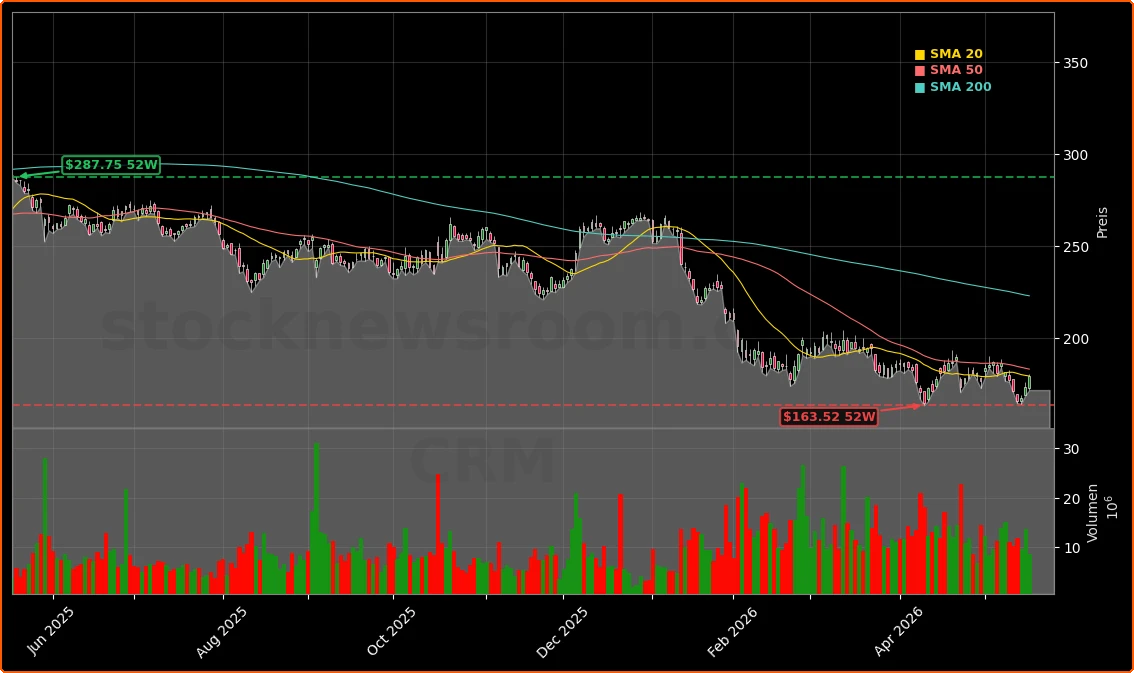
Shares of Salesforce Inc. rose about 3.3% to $179.27 on Monday, but the bounce came on the same day Bank of America’s Tal Liani resumed coverage at Underperform with a $160 target. That level sits below the current price and even under Salesforce’s 52-week low of $163.52, signaling that one of Wall Street’s biggest banks expects more pain despite the recent slide. The new Salesforce Forecast from Bank of America stands in stark contrast to a still-bullish consensus, which pins the average target near $268, implying significant disagreement about the stock’s fair value.
Salesforce remains a heavyweight in the S&P 500 technology cohort, yet its shares trade far beneath the 52-week high of $286.30 as investors reassess how traditional software business models will adapt to agentic AI. Liani argues that Salesforce faces muted net new customer additions, limited upsell opportunities, and an “underwhelming” path to AI monetization. For portfolio managers on Wall Street, that thesis challenges the idea that large-cap software will automatically be long-term winners of the generative AI wave.
How does Salesforce’s AI strategy stack up?
The bearish Salesforce Forecast arrives just as management is betting heavily on Agentforce, its flagship AI agent platform built around the company’s CRM data stack. Salesforce ended fiscal 2026 with $41.5 billion in revenue, up 10% year over year, and guided fiscal 2027 sales to $45.8–$46.2 billion. Agentforce generated roughly $800 million in annual recurring revenue across 29,000 deals in its first 15 months, which bulls see as early proof of product-market fit. CEO Marc Benioff is backing that ramp with a planned $300 million commitment for Anthropic AI tokens in 2026, underlining how central AI has become to Salesforce’s growth narrative.
At the same time, management is layering new AI capabilities across its portfolio, including Slack. Benioff recently described how Slack’s AI can analyze employee messages and channels to surface brewing concerns, key decisions, and operational blind spots. That kind of enterprise-wide intelligence is designed to keep Salesforce embedded at the core of modern workflows, alongside names like NVIDIA and Apple that also power AI-centric architectures. Yet Bank of America worries that such innovation may not translate into a durable monetization engine if AI agents replace human “seats” instead of expanding them.
What risks does the Salesforce Forecast highlight?
The crux of Liani’s Salesforce Forecast is business model pressure. Salesforce historically monetized via per-seat subscriptions across sales, service, and marketing clouds. Agentic AI fundamentally changes that dynamic: if a single AI agent can perform the work of multiple human users, the traditional licensing structure could face compression. In that scenario, AI becomes less of a pure growth driver and more of a margin and pricing challenge, even if it improves customer outcomes.
Another concern is slowing net new customer growth, which limits the ability to offset any pricing pressure with volume. While Salesforce still commands $72.4 billion in remaining performance obligations and a strong balance sheet, bears argue that a market maturing around AI-first platforms like ServiceNow and Tesla-like automation could erode Salesforce’s competitive edge. Shares now trade at about 22 times trailing earnings and 14 times forward earnings, levels that already bake in skepticism — yet Bank of America’s $160 target suggests that valuation may not be fully reset.
How does Salesforce compare to ServiceNow and other AI peers?
Bank of America’s research team highlighted the contrast between Salesforce and ServiceNow, reinstating ServiceNow with a Buy rating and a $130 price target on the same day it put Salesforce at Underperform. The firm argues that ServiceNow’s “system of action” workflow moat makes it a clearer long-term beneficiary of agentic AI than Salesforce’s CRM-centered Agentforce approach. On Monday, both stocks traded higher, with Salesforce up about 3% and ServiceNow gaining roughly 6.5%, underscoring how AI optimism can still lift software even amid downgrades.
Beyond direct rivals, Salesforce is advancing a hybrid AI strategy similar to HP, blending predictive AI with large language models to boost security and reliability. Salesforce data scientist Millie Huang recently outlined work on detecting when AI agents “go rogue” inside the enterprise, using unsupervised learning to flag risky behavior before it becomes a breach. That research-heavy stance keeps Salesforce in the conversation with larger AI ecosystems anchored by NVIDIA hardware and consumer platforms from Apple, but the open question for investors is whether the company can convert that innovation into margin-accretive revenue at scale.
Related Coverage
For a deeper dive into how AI is reshaping Salesforce’s product suite and numbers, readers can review the analysis in Salesforce AI Reporting +169% Surge Puts Agentforce in Focus, which examines whether a revamped reporting stack and rapid Agentforce adoption are enough to recast the company as a true AI platform. Together with the latest Salesforce Forecast from Bank of America, that piece helps frame the full bull–bear spectrum now confronting CRM investors.
We can tell you more about your business than you know.— Marc Benioff, CEO of Salesforce
In summary, the new Salesforce Forecast from Bank of America reinforces a cautious view on a stock still wrestling with AI-era growing pains and a stretched legacy model. For US investors, the split between an Underperform at $160 and a consensus target near $268 underscores how polarized expectations have become. The next few quarters of Agentforce adoption and AI monetization trends will likely decide whether Salesforce can regain its former growth premium and reassert itself as a core long-term compounder in tech portfolios.