
Is the SanDisk Forecast finally catching up with AI-driven NAND demand, or has this rally already priced in perfection?

Why Is SanDisk Forecast So Aggressive?
Wall Street’s bullishness isn’t speculative — it’s anchored in hard supply-demand math. Susquehanna lifted its SanDisk Forecast price target to $3,250, citing persistent NAND capacity shortages and AI infrastructure’s insatiable appetite for high-bandwidth flash. Morgan Stanley followed with a $1,750 target, while Cantor raised its view to $2,900 and Mizuho to $2,200 — all affirming a Buy or Overweight stance. Bank of America’s $2,100 target underscores a key thesis: SanDisk (Western Digital) now commands pricing power unseen since the 2017 NAND supercycle — but this time, demand is AI-sustained, not PC- or smartphone-led.
How Does SanDisk Compare to Micron and Dell?
While Micron Technology (MU) rose 8% Monday on mean-reversion trading, SanDisk (Western Digital) outperformed with sharper earnings leverage: MU’s EPS guidance jumped to $19.15, but SanDisk’s leapt from $1.22 to $30–$33 — a 2,350% increase in under a year. Dell Technologies (DELL), recently hailed for 17x returns, posted explosive AI-server growth — yet SanDisk’s datacenter segment growth (645% YoY) dwarfs Dell’s hardware margins. Unlike Dell or Apple, SanDisk (Western Digital) is a pure-play NAND enabler — meaning every exabyte of AI training data flows through its flash. That makes its SanDisk Forecast uniquely sensitive to AI infrastructure buildouts at Meta, Microsoft, and Amazon.
Is the Rally Just Technical — or Fundamentally Justified?
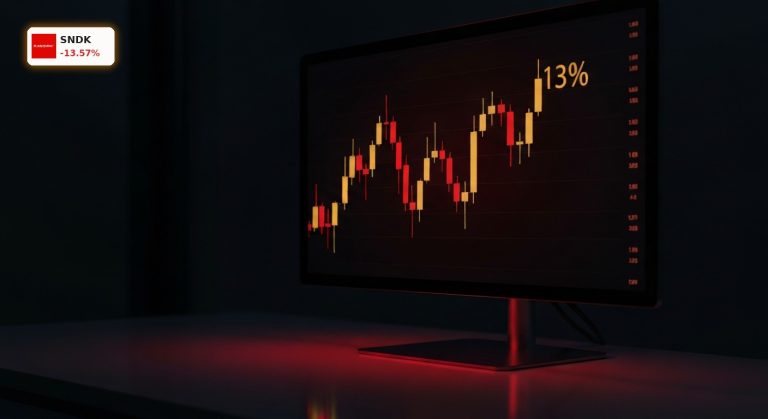
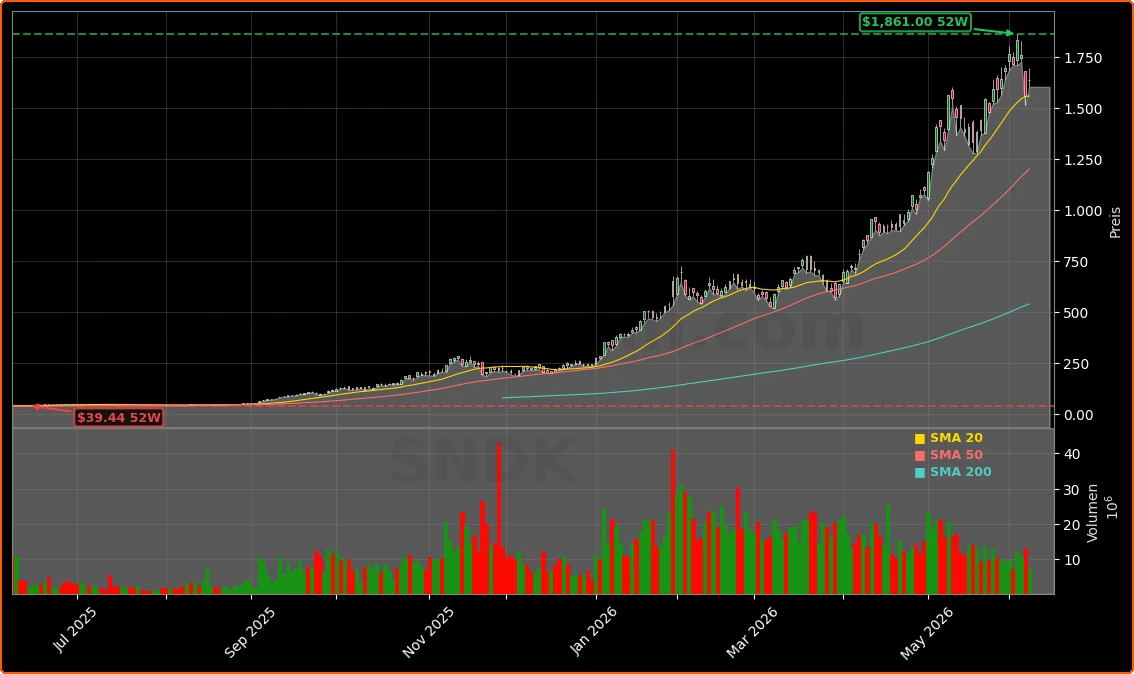
Friday’s 11.4% selloff — part of the ‘Parabolic 7’ unwind that erased $1 trillion from semiconductor market cap — was sentiment-driven, not fundamentals-based. SanDisk (Western Digital) reported Q3 2026 revenue growth of 58% and gross margin expansion to 62%, driven by multi-year supply agreements with hyperscalers. Analysts stress that NAND supply won’t meaningfully increase until 2028 or 2029 — a timeline confirmed by industry capex reports. That scarcity, combined with AI’s memory-hungry workloads, makes the SanDisk Forecast not just optimistic, but increasingly conservative.
What Do Insider Trades Signal?
Recent insider activity — including sales by Chief Legal Officer Bernard Shek (600 shares) and CTO Alper Ilkbahar (2,000 shares) — has raised eyebrows. However, all transactions were executed under pre-arranged Rule 10b5-1 plans, with no open-market purchases flagged in over 12 months. Crucially, SanDisk (Western Digital)’s insider ownership remains above 4.2% — well above the semiconductor sector median of 1.8%. The price-earnings ratio of 59.66 reflects growth expectations, not froth: earnings are accelerating faster than the stock price — a rare dynamic in today’s market.
SanDisk Forecast: What’s Next for Investors?
The SanDisk Forecast now centers on Q4 2026 guidance ($30–$33 EPS), High-Bandwidth Flash (HBF) product ramp in Q3, and participation in the Mizuho Technology Conference this week. With shares up 557% year-to-date and nearly 4,573% over the last 52 weeks, valuation is stretched — but not disconnected. The S&P 500’s tech sector is up only 18% YTD; SanDisk (Western Digital) is delivering earnings growth that redefines scale. For investors, the SanDisk Forecast signals a rare convergence: AI infrastructure tailwinds, supply discipline, and earnings acceleration — all converging in one stock.
Related Coverage: The recent SanDisk Pullback: AI Memory Leader Drops 11.3% on Fed Fears article analyzed whether the June 5 selloff represented a structural risk or a tactical entry point — and today’s rebound validates the latter view. That piece highlighted how SanDisk (Western Digital) remains the most direct play on AI’s memory stack, a thesis now reinforced by Susquehanna’s $3,250 target and Morgan Stanley’s upgraded rating. The pullback wasn’t a warning — it was a reset before the next leg up.
SanDisk (Western Digital) is no longer just a memory supplier — it’s the foundational storage layer for the AI era. With NAND supply locked until 2029 and hyperscalers signing multi-year contracts, this is the most durable pricing power we’ve seen in semiconductors since the early 2000s.— Susquehanna analyst team
SanDisk Forecast remains the most compelling narrative in semiconductor equities — not because of hype, but because of math: constrained supply, exponential AI demand, and earnings growth that is outpacing even NVIDIA’s historic ramp. For portfolios exposed to AI infrastructure, SanDisk (Western Digital) isn’t optional — it’s essential. The next quarterly earnings will confirm whether HBF adoption meets expectations — and whether the SanDisk Forecast holds up as the definitive benchmark for AI storage value.