
Is the SanDisk Pullback a warning that AI’s hottest memory trade has run too far, too fast?

What triggered the SanDisk Pullback?
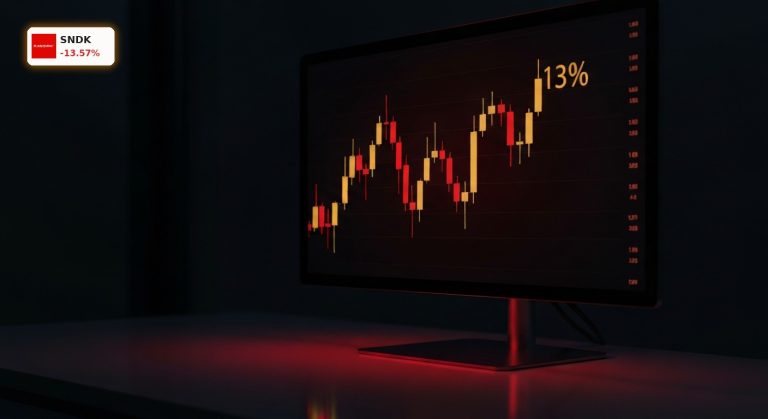
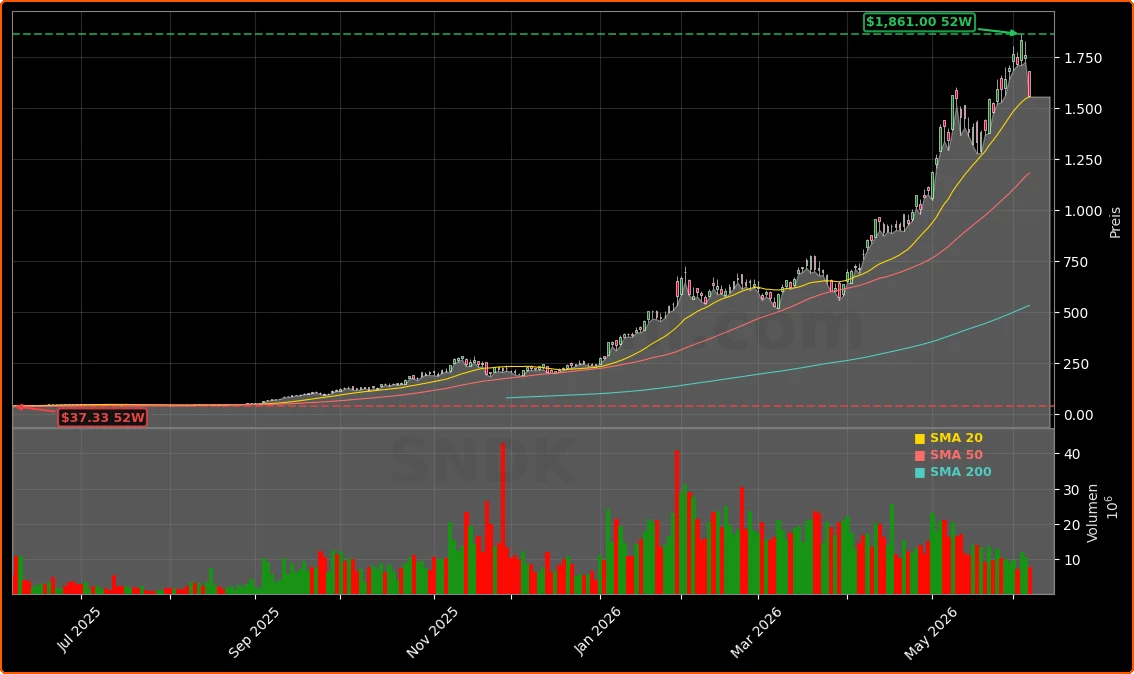
The SanDisk Pullback was catalyzed by the May BLS jobs report — 172,000 nonfarm payrolls, nearly double consensus — which reignited fears of a Federal Reserve rate hike in Q3 2026. At 11:50 a.m. ET, SanDisk (Western Digital) was down 7.4%, outpacing the Nasdaq Composite’s 2.4% decline and the S&P 500’s 1.4% loss. The sell-off wasn’t isolated: Micron Technology fell 5%, Marvell Technology slid 6%, and Super Micro Computer dropped 7.7%. Strategist Ben Emons of Highline Asset Management flagged the ‘Parabolic 7’ cohort — including SanDisk, Micron, Marvell, Intel, Dell Technologies, AMD, and Broadcom — as mathematically vulnerable after extended momentum. His warning of a ‘nearly 100% crash’ probability in one name gained traction as options flow revealed elevated retail leverage.
Is SanDisk’s AI demand story still intact?
Absolutely — and that’s what makes this SanDisk Pullback so telling. SanDisk’s datacenter segment revenue exploded 645% year over year in Q1 2026, with gross margins soaring to 78.4% from 22.5% — a direct result of AI-driven NAND pricing power. CEO guidance confirms order books stretching into 2027, mirroring Micron’s $18.7 billion Q2 revenue midpoint. Unlike cyclical memory peers, SanDisk (Western Digital) has repositioned as a pure-play AI infrastructure enabler, securing multi-year supply agreements with all major hyperscalers. Its recent High-Bandwidth Flash (HBF) roadmap — timed to coincide with NVIDIA’s next-gen CPU rollout — remains fully funded and on schedule. Still, valuation remains stretched: at a P/E of 59.66, SanDisk trades well above both sector and historical medians, per GuruFocus analysis.
How do insiders and analysts view the pullback?
Insider activity adds nuance. Alper Ilkbahar, EVP and CTO of SanDisk (Western Digital), sold 2,000 shares on June 1 and gifted 2,694 more — part of a broader trend of zero insider buys over the past 12 months. Meanwhile, Morgan Stanley upgraded SanDisk in early June, citing ‘structural NAND supply constraints’ and raising its price target to $1,920. RBC Capital Markets maintains a ‘Sector Perform’ rating but notes ‘near-term technical overextension’. ChartMill’s Minervini Trend Template screen confirms SanDisk meets all eight technical criteria for Stage 2 strength — but flags its 42% distance from the 200-day moving average as a modest setup for entry only on pullback. The Roundhill Memory ETF (DRAM), which holds SanDisk as a minor weight, saw only $0.25 million in assets at launch — underscoring how little institutional exposure currently exists to this name outside direct stock ownership.
Where does this leave SanDisk in the broader AI portfolio?
SanDisk (Western Digital) remains the highest-beta memory stock in the NASDAQ — more volatile than Micron, more leveraged than Marvell, and far more exposed to AI datacenter capex than legacy storage peers like Seagate or Western Digital. Its YTD outperformance — 623% vs. Micron’s 273% and Marvell’s 243% — reflects investor conviction in its NAND-centric AI thesis. Yet Friday’s SanDisk Pullback reveals a critical vulnerability: when macro risk rises, the most extended names get hit first. That dynamic matters for U.S. portfolios heavily weighted in AI infrastructure — especially those holding SanDisk alongside Tesla or Apple in aggressive growth allocations. With the S&P 500 trading near all-time highs and the SOX semiconductor index up 89% YTD, the SanDisk Pullback may be less about fundamentals and more about portfolio rebalancing ahead of the June 12 FOMC meeting.
Related Coverage
Parabolic moves are reaching extremes — SanDisk.— Ben Emons, Highline Asset Management
For context on what preceded this move, investors should review SanDisk Record +6.3% After Morgan Stanley AI Upgrade, which details how the stock’s all-time high was fueled by a major analyst upgrade and hyperscaler contract wins. That momentum reversal underscores the speed at which sentiment shifts in AI memory — and why disciplined position sizing remains essential. Another critical read is Jim Cramer Discusses Missing the Massive SanDisk and Peers Rally, where the CNBC host reflects on the generational opportunity in AI storage — and cautions against selling winners too early. Finally, Is SanDisk Stock Outperforming the S&P 500? offers a quantitative lens on SanDisk’s dominance across multiple timeframes — a reminder that even sharp pullbacks occur within powerful secular trends.