Will the latest multi-billion ServiceNow Acquisition spree in security finally justify the stock’s battered valuation and spark a lasting rerating?

How is ServiceNow, Inc. trading after the deals?
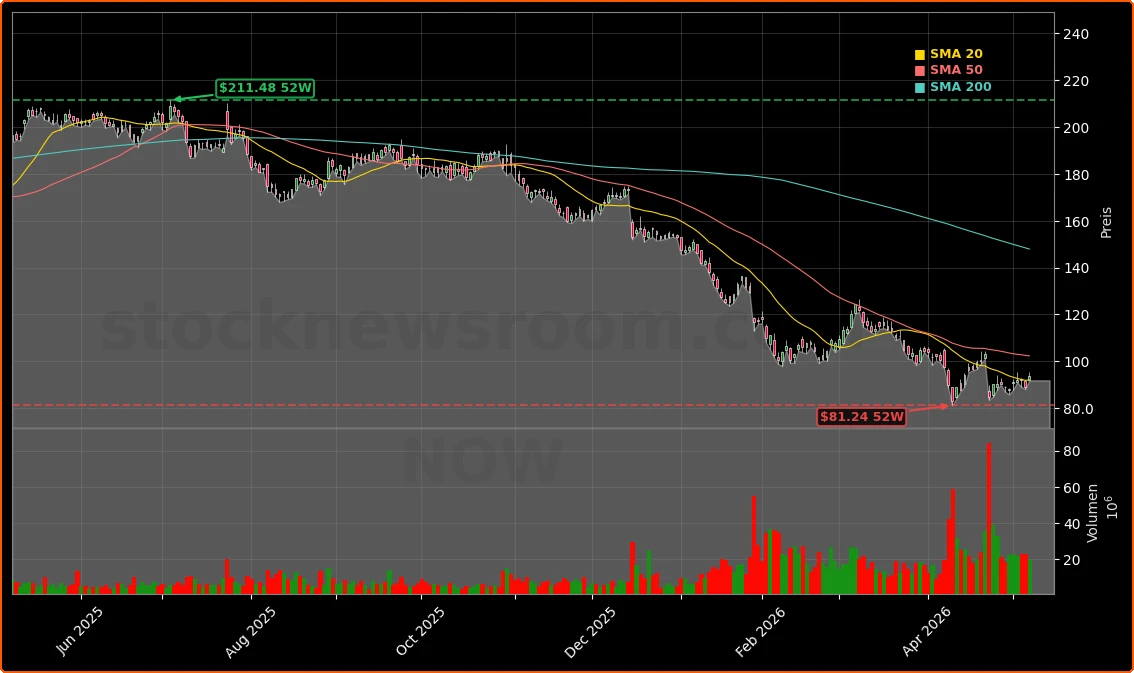
Shares of ServiceNow, Inc. (NOW) climbed about 5.37% to $93.83 on Thursday, up from a previous close of $89.04, as buyers returned to beaten‑down cloud and software names. The move came alongside a broader bid for enterprise software, though peers such as Snowflake rallied even more strongly. Despite today’s bounce, ServiceNow remains sharply lower year to date, reflecting 2026’s violent re‑pricing of high‑multiple SaaS and AI stocks across the NASDAQ and S&P 500 technology universe.
The stock’s rebound follows better sentiment around AI‑driven software platforms and renewed focus on the strategic impact of the ServiceNow Acquisition spree. With a market cap near the $100 billion mark, ServiceNow still ranks among the heavyweight cloud platforms, but investors are increasingly scrutinizing how each transaction contributes to growth, margins, and competitive positioning versus names like NVIDIA in AI infrastructure and Apple in device ecosystems.
Why does the ServiceNow Acquisition of Armis matter?
The most consequential recent ServiceNow Acquisition is Armis, a cyber exposure management specialist focused on connected assets and operational technology. ServiceNow closed the deal on April 20, paying roughly $7.75 billion in cash after announcing the transaction in December 2025. Armis provides real‑time, contextual visibility into the cyber risk of devices and systems that traditional endpoint and network tools often miss, such as IoT hardware, industrial control systems, and medical devices.
Management believes the Armis purchase could roughly triple ServiceNow’s market opportunity in security and risk solutions, transforming the company from primarily an IT service management (ITSM) vendor into a broader security operations and risk platform. That thesis fits with CEO Bill McDermott’s push to brand the company as an “AI control tower” for enterprise operations, where threat signals, asset data, and workflows are orchestrated from a single cloud‑based platform.
Amit Zavery, president, chief operating officer, and chief product officer, framed the rationale clearly: Armis delivers the risk signal on every connected asset, and when combined with identity intelligence, that signal can feed directly into ServiceNow’s Context Engine and AI Control Tower. For investors, the key question is whether this ServiceNow Acquisition can meaningfully accelerate subscription revenue beyond the roughly 20% growth range currently implied for the next couple of years.
How does Veza strengthen ServiceNow’s AI security stack?
In March, another important ServiceNow Acquisition quietly closed: Veza, an AI‑driven identity security platform reportedly acquired for about $1 billion. Veza focuses on understanding which users and identities have access to which data and systems across complex, multi‑cloud environments. That capability is increasingly critical as enterprises embrace zero‑trust architectures and grapple with sprawling SaaS and data footprints.
By integrating Veza’s identity intelligence with Armis’ asset and exposure data, ServiceNow aims to offer end‑to‑end visibility from user to device to application. That combined data stream is designed to power automated, policy‑driven workflows: for example, automatically revoking access, opening remediation tasks, or triggering incident response playbooks when abnormal behavior or exposure is detected.
The strategy aligns with ServiceNow’s long‑standing focus on intelligent automation and AI‑embedded workflows. The company has invested heavily in natural language processing, machine learning, and virtual agents that sit on top of its cloud platform to reduce manual work. For CIOs and CISOs, the pitch is compelling: consolidate vendors, centralize data, and use a single workflow layer to orchestrate security, IT, and business processes.
What are analysts saying about ServiceNow, Inc.?
Wall Street’s view on the stock remains mixed but generally constructive. On April 19, J.P. Morgan analyst Mark Murphy reaffirmed a Buy rating on ServiceNow and set a $195 price target, implying more than 100% upside from current levels. Murphy highlighted growing trends in large deal activity, expanding AI product usage, and a wider platform footprint among enterprise customers.
By contrast, TD Cowen maintained its Buy rating but cut its target from $185 to $140, underscoring uncertainty around software spending and competitive dynamics in AI. The bank’s channel checks still pointed to healthy demand, yet the steep target reduction reflects how sensitive valuation is to even small changes in growth assumptions. Bernstein recently took a more measured stance as well, lifting its target to $236 but noting that investors are still divided on how quickly AI monetization will show up in ServiceNow’s numbers.
Underlying fundamentals remain solid. The company delivered Q4 FY2025 revenue of $3.57 billion, up about 21% year over year, with current remaining performance obligations (cRPO) rising 25% to $12.85 billion. Management has guided to subscription revenue growth in the low‑20% range through FY2026, which, if achieved, would support the bullish case that the ServiceNow Acquisition strategy is bolstering durable top‑line momentum.
How does ServiceNow stack up against key competitors?
On Thursday, Snowflake surged roughly 9% intraday to around $152, outpacing ServiceNow’s 5% move and reminding investors that data‑platform names can still command faster‑growing narratives. Snowflake’s FY2027 product revenue outlook of about $5.66 billion implies growth in the 20% range, comparable to ServiceNow’s own subscription growth targets, yet the two companies occupy different layers of the cloud stack.
Meanwhile, Atlassian has been gaining traction in ITSM and workflow tools, with management pointing to record competitive wins against ServiceNow in some enterprise segments. Yet ServiceNow still benefits from deep integrations and incumbent status at many large organizations, especially in complex IT operations and service management. On a broader AI and cloud stage, investors often weigh ServiceNow against infrastructure titans like NVIDIA and platform ecosystems like Apple and Tesla when allocating capital across the technology sector.
For now, today’s tape suggests that fast money is gravitating first to higher‑beta growth leaders such as Snowflake, while ServiceNow is viewed as a high‑quality, but more mature, workflow and security platform. The upcoming July 24 earnings report will be a key catalyst for testing whether the ServiceNow Acquisition of Armis and Veza is already influencing pipeline, deal sizes, and net retention.
Related Coverage
Investors who want a deeper dive into valuation risk and AI optionality around the latest ServiceNow Acquisition moves should read this detailed ServiceNow Forecast analysis on AI ambition versus crash risk. The piece examines whether current growth, margins, and competitive pressures can justify a premium multiple after the stock’s sharp 2026 drawdown.
Armis gives us real-time, contextual awareness into the cyber risk of every connected asset, and combined with Veza’s identity intelligence, that signal flows into ServiceNow’s Context Engine and AI Control Tower.— Amit Zavery, President, COO and CPO of ServiceNow
In conclusion, the twin ServiceNow Acquisition deals for Armis and Veza mark a decisive bet on AI‑driven security and identity as core growth engines for the workflow giant. For investors, the combination of mid‑20% cRPO growth, supportive analyst ratings, and a sharply expanded security addressable market makes the stock a high‑beta but potentially rewarding play on enterprise AI adoption. The next earnings report and early integration proof points will be crucial in showing whether the ServiceNow Acquisition strategy can translate into sustained revenue acceleration and a durable rerating on Wall Street.