Will Snap Restructuring and a bold CFO shake-up finally turn years of heavy losses into a sustainable path to real profitability?

How is Snap Inc. trading into earnings?
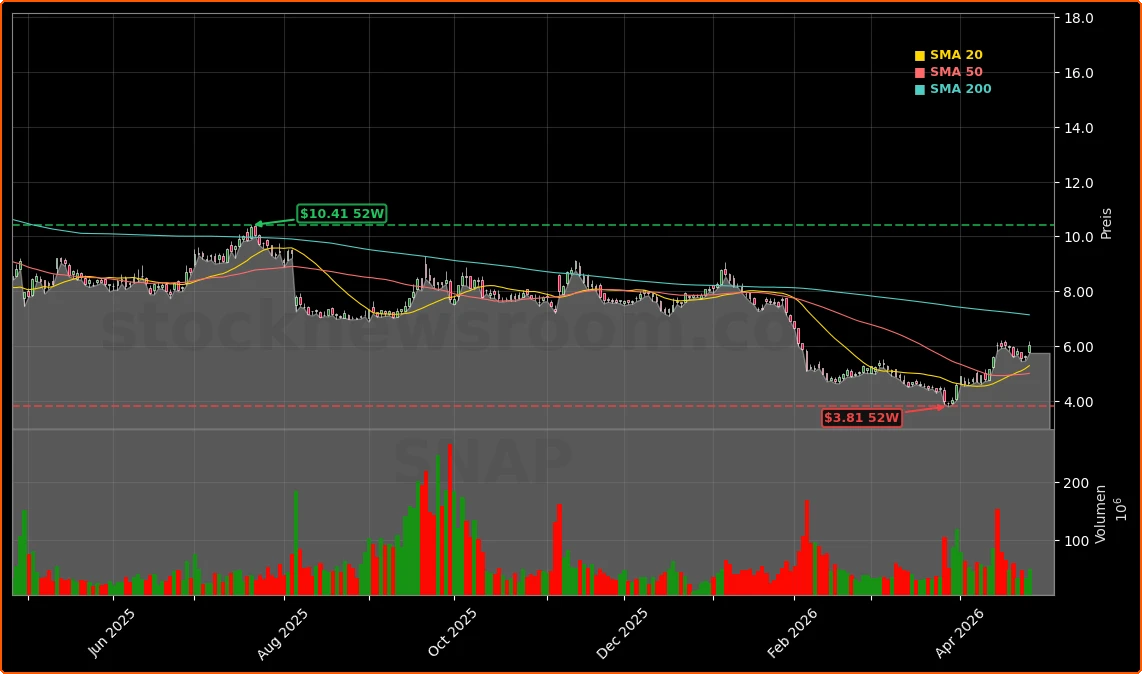
Snap Inc. (SNAP) outperformed the broader tech space on Monday, with the stock rallying more than 7% intraday while mega-cap ad peers like Meta Platforms and Alphabet posted far smaller gains. At $6.06, Snap sits comfortably off its 52-week low near $3.81 but remains well below the $10.41 high, underscoring how much damage the past year’s drawdown has done to long-term holders. Technically, shares now trade about 14.5% above the 20-day simple moving average yet still roughly 17% below the 200-day, a combination that points to improving short-term momentum but an intermediate trend that is not fully repaired.
Traders are clearly positioning ahead of the May 6 earnings release, where Wall Street is looking for Q1 revenue of about $1.53 billion, up from $1.36 billion a year ago, and a loss of $0.07 per share versus a $0.08 loss in the prior-year quarter. The stock’s 56% one-month surge shows momentum money flowing back in, but with SNAP still down more than 20% year to date and roughly 30% over 12 months, expectations around the Snap Restructuring narrative will need to be met – or beaten – to sustain the move.
What is changing in Snap Inc.’s leadership?
Central to investor debate is the ongoing finance leadership shake-up. Longtime CFO Derek Andersen is set to participate in his final earnings call on May 6 and will leave the company on May 8, handing the reins to incoming finance chief Doug Hott. Management is framing the transition as part of a broader profitability reset, with a clear goal of reaching net income profitability in the coming years rather than relying on adjusted metrics alone.
The CFO change is paired with updated expense targets that aim to bring 2026 operating expenses down to about $2.75 billion, with stock-based compensation trimmed toward $1.05 billion. That tighter discipline is at the heart of the Snap Restructuring effort, which also includes significant workforce reductions and a more focused capital allocation approach. For U.S. portfolio managers, the question is whether this is a cosmetic leadership change or the start of a durable culture shift toward shareholder returns.
How deep do Snap Restructuring cost cuts go?
The current Snap Restructuring plan is aggressive by any Big Tech standard. Snap is cutting around 1,000 jobs, or roughly 16% of its workforce, and eliminating more than 300 open roles. Management expects these moves to generate more than $500 million in annualized savings by the second half of 2026, offset by $95 million to $130 million in near-term restructuring charges. From a margin perspective, these cuts are designed to unlock operating leverage if revenue can continue to grow in the mid-teens or better.
At the same time, the company is leaning into growth levers like its Snapchat+ subscription product and augmented reality initiatives, including new AR glasses work tied to Qualcomm’s platforms. Activist investor Irenic Capital, which has built about a 2.5% stake, is pushing for an even sharper playbook that includes deeper headcount reductions, AI automation, and a potential spin-off or shutdown of the Specs hardware business. That creates a tug-of-war between cost discipline and long-term product bets that will likely define how far the Snap Restructuring can go without impairing growth.
How are analysts and insiders reacting to Snap Inc.?
Analyst sentiment is cautiously constructive. Rothschild & Co Redburn upgraded Snap to Buy from Neutral and doubled its price target to $10 from $5, citing expectations that Snap can turn GAAP profitable for the first time this year, a potential breakout in its core ad business and ongoing subscription momentum. Elsewhere, Stifel recently maintained a Hold rating but nudged its target to $5.25, Guggenheim reiterated a Neutral stance with a $6.50 target, and BMO Capital Markets remains more bullish with an Outperform rating and a $15 target. The consensus target around the upper-$7 range still implies meaningful upside from current levels, but opinions differ sharply on how sustainable that upside is.
On the insider front, selling has been active but mostly tied to pre-set plans and tax obligations. Chief Business Officer Ajit Mohan disposed of about 28,000 shares to cover RSU-related taxes while retaining more than 5.1 million shares, and General Counsel Zachary Briers sold roughly 11,400 shares under a 10b5‑1 plan, keeping a stake of over 2.7 million shares. An irrevocable trust linked to CEO Evan Spiegel also sold 1 million shares earlier in April, though Spiegel still directly owns in excess of 25 million Class A shares. The net effect is a mixed but not panicked insider picture, which investors must weigh against the activist pressure and the Snap Restructuring roadmap.
How does Snap compare to larger ad players?
For U.S. investors building exposure to digital advertising, the risk-reward profile at Snap looks very different from giants like Meta and Alphabet. Over the past year, Alphabet’s stock has more than doubled and Meta has posted solid double-digit gains, powered by scale advantages in AI, video and commerce. Snap, by contrast, remains a sub-$10 billion company navigating intense competition from TikTok, Reels and Shorts, with a narrower monetization engine and less room for error.
Yet that smaller size is precisely why some funds see asymmetric upside if the Snap Restructuring delivers. With a consensus Hold rating but several vocal bulls, the stock could re-rate quickly if management proves it can grow revenue, control costs and reach GAAP profitability. For comparison, investors often look at how turnarounds in names like NVIDIA or Tesla were rewarded once fundamentals inflected, even though Snap operates in a very different industry. The upcoming quarter, and management’s commentary on ad trends and AI tools, will be critical in determining whether SNAP remains a tactical trade or evolves into a more durable NASDAQ growth story.
Related Coverage
Investors who want a deeper dive into Snap’s AI ambitions and capital commitments should read this detailed look at Snap’s $400 million AI partnership shock and the associated turnaround risks. That analysis explores how a large-scale AI deal intersects with activist pressure, cost cuts and product strategy, and how those forces could reshape the company’s long-term trajectory.
In summary, the Snap Restructuring effort, CFO transition and activist backdrop have turned SNAP into one of the more speculative but potentially rewarding stories in U.S. digital advertising. The stock’s recent rebound shows that Wall Street is willing to give management another chance if execution improves and profitability milestones are hit. The May 6 earnings call and the next phases of the Snap Restructuring plan will now decide whether this is just another bounce – or the start of a more convincing turnaround for American investors.