Can Snap Restructuring and an aggressive AI pivot finally turn Snapchat’s scale into durable profits, or is this just another reset?

How is Snap reshaping the P&L with AI?
Snap plans to eliminate about 1,000 jobs, or roughly 16% of its global headcount, and cancel around 300 open roles, targeting annualized savings of about $500 million in the second half of the year. CEO Evan Spiegel framed the move as a direct response to rapid advances in artificial intelligence and rising competitive pressure from larger platforms such as Meta, TikTok and emerging AR players like Apple. Internal AI agents already generate more than 65% of new code at the company, allowing management to argue that productivity gains make a smaller engineering workforce feasible without slowing product delivery.
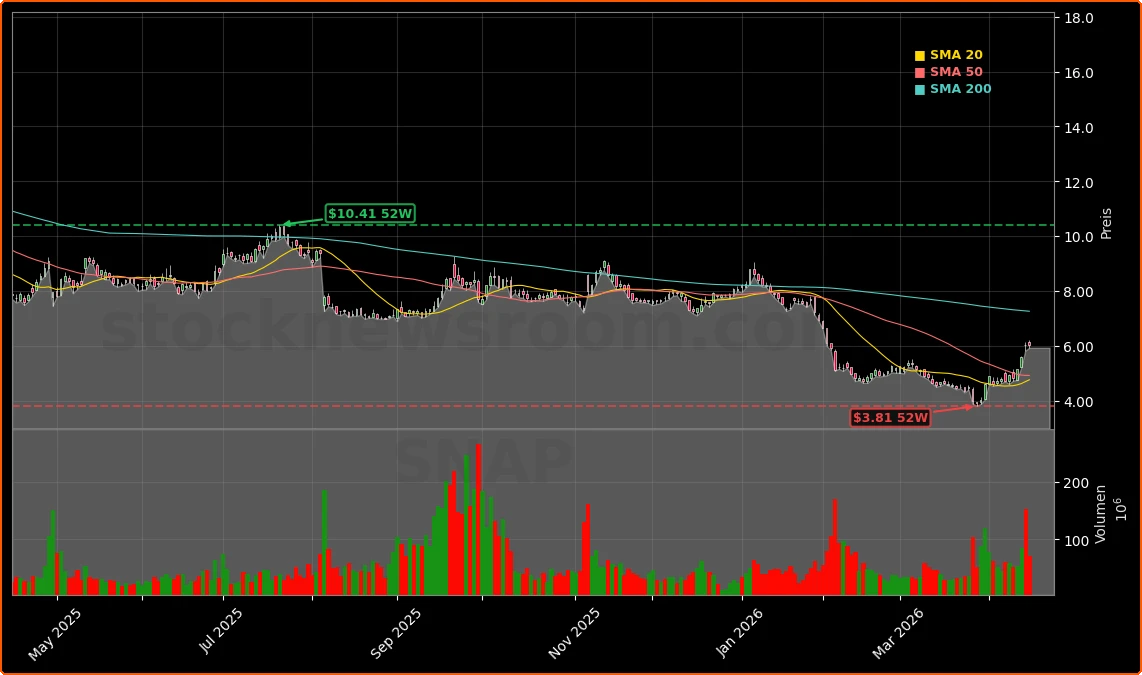
The immediate market reaction was positive: the stock has climbed roughly 28% since the initial Snap Restructuring announcement and recently traded around $6.03, marginally below the previous close of $6.04. While that remains far below its 52‑week highs and more than 90% off its five‑year peak, the rebound signals that investors are willing to reward credible cost discipline and a tighter focus on monetization. For portfolio managers benchmarking to the NASDAQ and S&P 500, Snap’s volatile reaction highlights how sensitive smaller social media names are to structural profitability headlines.
Does Snap Restructuring fix the profitability problem?
Financially, Snap is at a crossroads. Revenue grew about 11% last year to $5.9 billion, and the company recently delivered its first profitable quarter with Q4 2025 revenue of $1.716 billion and earnings per share of $0.03, beating expectations for a loss. The Snapchat+ subscription product, which has reached roughly 24 million subscribers and grown 71% year over year, offers an important revenue stream beyond advertising. Yet full‑year results still showed a net loss of roughly $460 million, underscoring how narrow the margin for error remains.
Management has outlined a long‑term gross margin target of around 60%, a level that would move Snap closer to more mature digital advertising peers, though still below software‑like margins seen in segments at companies such as NVIDIA. Achieving that goal rests heavily on Snap Restructuring and on making AI and augmented reality investments pay off in more efficient ad delivery and higher returns on marketing spend for brands. That is especially crucial as Snapchat remains a mid‑tier platform by scale, ranking only ninth among global social networks and trailing well behind giants operated by Meta and ByteDance.
What are analysts and activists saying about Snap?
On Wall Street, sentiment is starting to shift, but remains cautious. BMO Capital’s Brian Pitz recently raised his price target on Snap shares to $15 from $13, maintaining an Outperform rating and arguing that the $500 million cost‑reduction plan and higher Q1 revenue guidance add credibility to management’s profitable growth narrative. Consensus, however, is still more restrained: the average analyst target hovers around $7.87, with only 10 Buy ratings out of 41 overall calls, leaving plenty of skeptics who want to see several quarters of clean execution before re‑rating the stock.
Simultaneously, activist investor Irenic Capital Management, which holds an economic interest of roughly 2.5% of Snap’s Class A shares, has been pushing hard for change. Irenic argues that the company could be worth at least $26.37 per share if it fully monetizes AI in its ad stack, tightens costs, improves corporate governance and rethinks or even exits its Specs smart‑glasses business, which may have consumed more than $3.5 billion. The activist’s pressure has elevated questions about board oversight and the concentrated voting control that Spiegel and co‑founder Robert Murphy hold—more than 99% of total voting power—which sharply limits outside influence despite public listing on the NYSE.
How does Snap stack up against U.S. tech peers?
From a U.S. investor’s perspective, Snap’s risk‑reward profile looks very different from mega‑cap platforms like Meta or diversified tech leaders such as Tesla and NVIDIA. While those names benefit from scale, diversified revenue and entrenched moats in AI infrastructure or EVs, Snap is still fighting for durable relevance in a crowded social‑media and AR ecosystem. Its user base of 946 million monthly active users is sizable, but monetization per user trails far behind larger players, limiting operating leverage.
At the same time, the company’s bet on consumer AR devices through Specs, with a planned broader launch in 2026, places it in a competitive set with hardware‑driven ecosystems built by Apple and others. Activists question whether this is the best use of capital when the core ad business still underperforms. For investors constructing tech allocations, Snap Restructuring and the AI shift may justify a speculative position for those comfortable with governance risk and execution uncertainty, but the name clearly sits in a higher‑beta, turnaround bucket rather than in the stable compounder camp.
Related Coverage
For a deeper dive into whether this wave of Snap Restructuring and the 16% headcount reduction can truly flip the company toward lasting profitability, readers can explore the analysis at Snap Restructuring Soars as 16% Job Cuts Aim at Profitability, which examines the financial modeling and market reaction in more detail.
In sum, Snap Restructuring has become a critical test of whether AI‑driven efficiency gains and a leaner cost base can finally unlock the value in Snapchat’s large but under‑monetized user base. For U.S. investors, the stock offers high upside if management delivers on its 60% gross margin and growth ambitions, but also carries outsized governance and competitive risks compared with larger tech peers. The next few quarters of execution on cost cuts, ad performance and AR strategy will show whether this restructuring marks a durable turning point or just another brief rally in a volatile story.