Are the latest Snap Earnings a temporary ad wobble or a warning that the platform’s growth story is running out of time?

Is Snap Inc. losing its ad momentum?
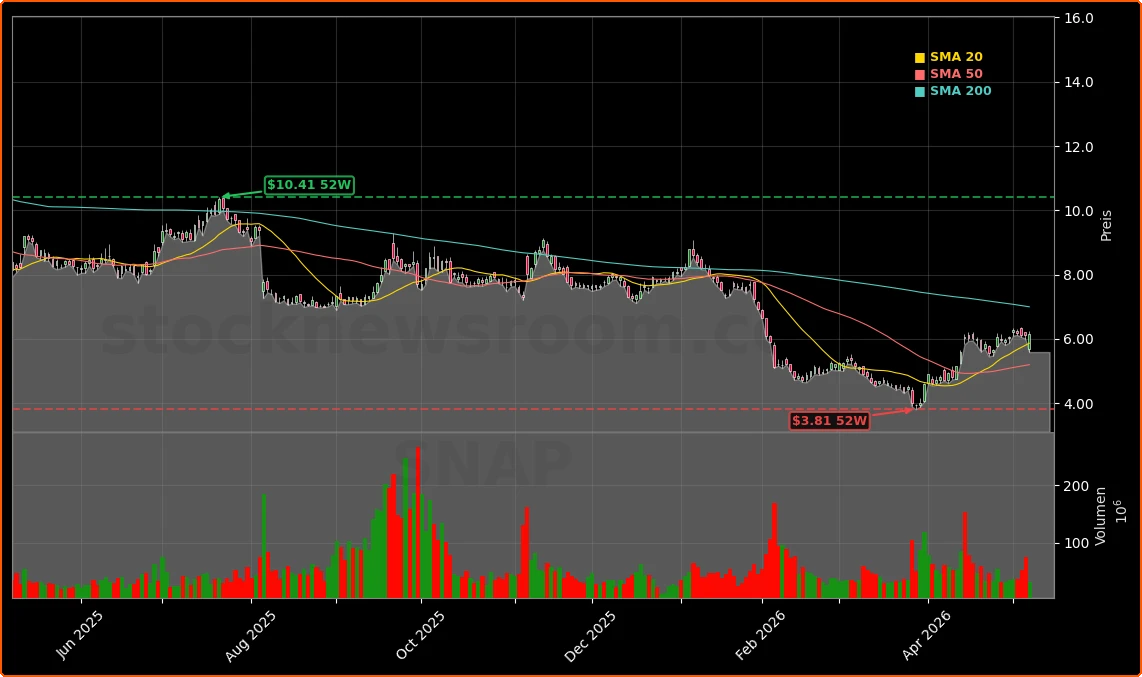
Snap Inc. (SNAP) was recently indicated almost 10% lower in pre‑market trading, even though the latest quote of $6.17 is modestly above the prior close of $5.53, up about 0.9%. The pressure follows management’s warning that its ad business has been heavily affected by the ongoing war in the Middle East, including Iran, with large North American retailers cutting back spend and brand budgets turning more cautious. Jefferies analysts argue the stock is unlikely to re‑rate meaningfully until ad revenue growth re‑accelerates, underscoring how dependent Snap remains on a single, cyclical income stream.
That fragility sits awkwardly beside the user metrics. In its most recent reported quarter, Snap delivered revenue of $1.53 billion, up 12% year on year, and trimmed its net loss to $89 million from roughly $140 million a year earlier. Daily active users rose to 483 million, a 5% increase. Those headline Snap Earnings numbers looked constructive on paper, yet the stock dropped in post‑close trading after the release and has remained volatile since, highlighting investor skepticism about the durability of the ad rebound.
What did the last Snap Earnings really show?
The latest Snap Earnings report offered a nuanced picture. Top‑line growth returned to double digits and Snap+ subscriptions surged 87% year over year, adding a small but rapidly growing revenue stream beyond ads. At the same time, management guided for Q2 revenue of $1.52 billion to $1.55 billion, implying only modest sequential growth and suggesting that macro and geopolitical headwinds are still biting into ad budgets.
Compared with larger social platforms such as Meta and Alphabet’s YouTube, Snap’s ad stack is still viewed as less mature and less data‑rich. Morningstar recently described Snap as a small fish in a vast digital advertising pond, pointing to weaker targeting algorithms and intense competition for brand dollars from giants like Apple’s iOS ecosystem, NVIDIA‑powered AI ad tools, and the creator economies on TikTok and Instagram. That competitive backdrop makes the latest slowdown in North American retailer spending particularly problematic, given it was expected to be one of the more resilient ad verticals.
Why did Snap and Perplexity walk away from AI search?
A key theme around recent Snap Earnings was the surprise unraveling of its high‑profile AI search partnership with Perplexity. Announced last November, the deal had been pitched as a $400 million, 12‑month arrangement combining cash and equity, with Perplexity’s AI search engine embedded directly into Snapchat’s Chat interface. Snap previously suggested the financial impact would become meaningful in 2026, helping diversify revenue beyond traditional ads.
Instead, the partnership was quietly rolled back after only a limited user rollout. Both companies ultimately concluded the implementation was not the right product fit, and the agreement has now been terminated on confidential terms. Importantly, Snap’s latest outlook no longer includes any revenue contributions from the Perplexity deal. A spokesperson for Perplexity has indicated it still plans to use Snap’s ad products, but for investors counting on AI search as a fresh monetization lever, this is a clear setback.
The termination raises broader strategic questions. Rivals from Meta to Tesla and Apple are racing to integrate generative AI deeply into their ecosystems, often with custom silicon and tight control of the user experience. Snap, by contrast, is still experimenting: it has rolled out AI Sponsored Snaps in Chat, where branded agents interact directly with users, but it lacks a flagship, scaled AI product that can shift the revenue mix in the near term.
Can cost cuts and activists offset ad volatility?
Beyond the Snap Earnings narrative, the company is leaning heavily on cost discipline and activist pressure to shore up confidence. In April, Snap announced that it would cut roughly 1,000 employees—about 16% of its full‑time workforce—and close more than 300 open roles. CEO Evan Spiegel expects these moves to reduce annualized expenses by over $500 million in the second half of this year, effectively resetting the company’s cost base after years of aggressive hiring.
Activist investor Irenic Capital has built about a 2.5% stake in Snap and is pushing for a sweeping turnaround plan it labels “6 Steps to 7X,” arguing the stock could reach the mid‑$20s if management executes. The blueprint emphasizes deeper AI automation, sharper ad monetization, and a potential spin‑off or shutdown of the company’s AR hardware, including Spectacles. Recent reports of insider share sales by senior executives, including Snap’s chief business officer and general counsel, have added another layer to the Wall Street debate, though these trades were conducted under pre‑set 10b5‑1 plans and still leave them with sizable holdings.
Related Coverage
For a deeper dive into how restructuring and leadership changes could influence future Snap Earnings, readers can review the analysis in “Snap Restructuring +7.3% Surge: Can Cost Cuts Stick?”. That piece explores whether recent layoffs, a CFO shake‑up, and activist pressure are enough to shift Snap from a story of chronic losses to a credible path toward sustainable profitability.
In summary, recent Snap Earnings highlight a company that is slowly improving its financial profile but still heavily exposed to a choppy ad market and now searching for a new AI strategy after the Perplexity breakup. For U.S. investors, the balance between user growth, cost cuts, and ad recovery will determine whether today’s single‑digit share price becomes a buying opportunity or a value trap. The next Snap Earnings update and any concrete AI product launches will be the key catalysts to watch on NASDAQ in the coming quarters.