Can Snap Restructuring and a 16% headcount cut finally flip the company from chronic losses to a credible path to profit?

How is Snap Restructuring hitting the stock today?
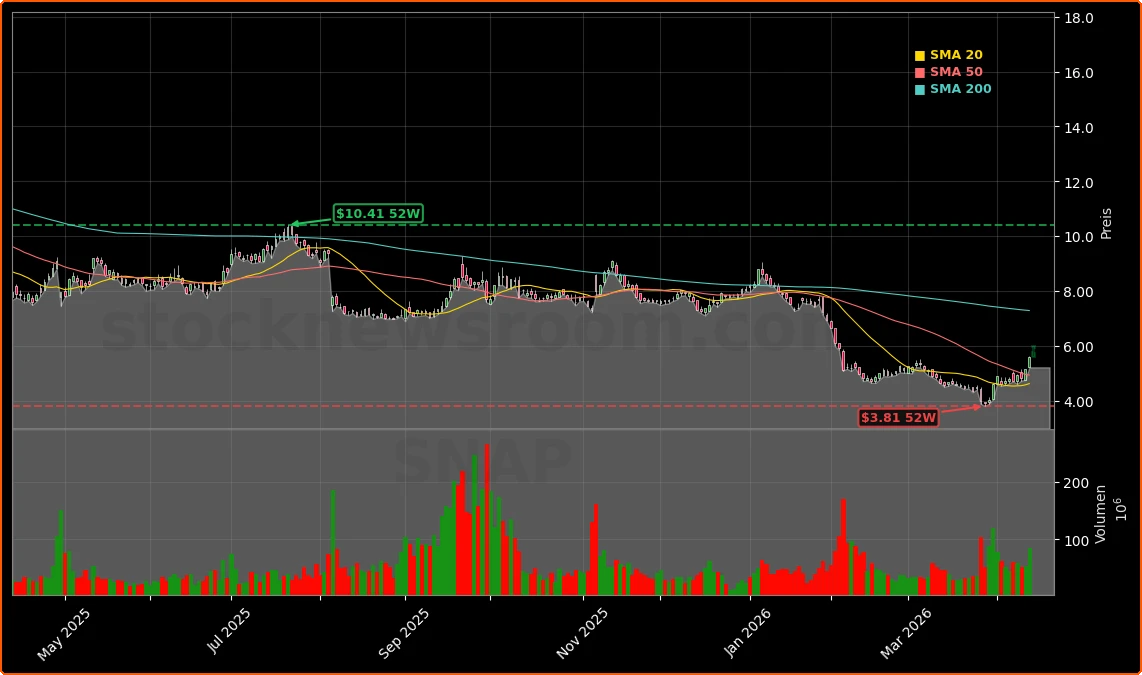
Snap Inc. (SNAP) traded at $5.60 on the NYSE on Tuesday, up 8.74% on the day, with pre-market indications around $5.99 (+6.96% ET) after the company unveiled a sweeping cost-cut plan. While the share price remains far below its 52‑week high and deep in bear-market territory after a more than 30% slide year-to-date, the latest Snap Restructuring announcement is being read as a clear attempt to reset expectations and narrow losses.
The company said it will reduce global headcount by approximately 16%, affecting about 1,000 full-time employees based on the 5,261 staff reported at year-end 2025. More than 300 open roles will be eliminated, signaling that management wants to lock in a structurally leaner cost base rather than relying on hiring freezes alone.
For U.S. tech investors used to similar moves at peers like Meta Platforms and Block, the move underscores how even mid-cap social platforms are now following the same playbook: prioritize margins, redirect capital toward AI and core ad products, and pull back from expensive side bets.
What does Snap Restructuring cost and save?
The Snap Restructuring plan will not be cheap upfront. Management expects pretax charges between $95 million and $130 million, mainly for severance, related benefits, contract terminations, and other impairments. Of that, $75 million to $100 million are expected to be future cash outflows, with the majority hitting the income statement in Q2 2026. Depending on local labor law, some reductions may extend into Q3 or later, particularly outside the U.S.
In return, CEO Evan Spiegel is targeting more than $500 million in annualized cost savings by the second half of 2026. That scale of savings is meaningful relative to Snap’s current size and could be the difference between persistent net losses and a credible path to net-income profitability. Management explicitly framed Snap Restructuring as a way to accelerate that path by reallocating resources to “highest-priority initiatives” and leveraging AI to reduce repetitive work.
This puts Snap on a similar trajectory to larger social media rivals that have already undergone multiple layoff rounds, with Meta and other Nasdaq tech names widely praised by Wall Street for aggressive cost resets. Whether Snap can replicate that rerating remains uncertain, given its smaller scale and weaker profitability profile.
How strong is Snap’s latest guidance?
Alongside Snap Restructuring, the company updated its outlook for Q1 2026. Management now expects revenue of about $1.529 billion, representing roughly 12% year-over-year growth and landing at the high end of prior guidance. Adjusted EBITDA is projected around $233 million, comfortably ahead of the roughly $185 million consensus estimate tracked by FactSet, signaling better operating leverage even before most restructuring savings kick in.
The company continues to emphasize adjusted EBITDA rather than GAAP net income, arguing that the metric better reflects underlying operating performance by excluding stock-based compensation, depreciation, and other non-cash or non-recurring items. Still, equity investors will ultimately want to see these improvements translate into sustainable net-income profitability and positive free cash flow, especially as capital becomes more selective across growth tech.
Investor sentiment around SNAP remains mixed. Trading ideas on platforms like TradingView highlight both long-term bulls who see undervaluation relative to Snap’s large engaged user base and bears focused on ongoing monetization and legal challenges, including a recently disclosed investigation by the Portnoy Law Firm over potential securities issues and platform safety concerns. That legal overhang adds another variable to the risk profile compared with mega-cap peers such as Meta or Apple.
What role do activists and AI play in Snap Restructuring?
The timing of Snap Restructuring is not coincidental. In recent weeks, activist investor Irenic Capital Management, which holds roughly 2.5% of Snap’s Class A economic interest, has publicly pressed management to cut costs, boost buybacks, and consider options for its loss-making smart-glasses business, Specs. Irenic has argued that the stock could be worth over $26 per share—far above current levels—if Snap fully monetizes AI opportunities and tightens its cost structure.
While Snap’s dual-class share structure gives co-founder Evan Spiegel and other insiders substantial voting control, limiting activists’ direct power, the restructuring hits several of Irenic’s suggested points: headcount reduction, focus on higher-return initiatives, and an explicit AI-led transformation of ad performance and operations. Management has not detailed the future of Specs in this announcement, but prior activist presentations estimate that the project has absorbed billions of dollars in capital that could be redeployed elsewhere.
Spiegel, in a letter to employees, emphasized that rapid advances in artificial intelligence should allow smaller teams to “increase velocity” and better serve users, advertisers, and partners. For investors watching the broader AI trade—dominated by names like NVIDIA and Tesla on the hardware and auto side—the question is whether Snap can harness AI to materially lift ad yield and engagement without overspending on experimental hardware and long-shot initiatives.
How does this fit into Snap’s broader turnaround?
The Snap Restructuring plan is the latest in a series of job cuts: around 20% of staff were laid off in 2022, followed by another roughly 10% in 2024. This third major round suggests earlier efforts did not go far enough to align the cost base with growth realities in a highly competitive ad market dominated by large-cap Nasdaq names. It also arrives as insider selling, including a recent 1 million-share sale by a trust linked to Spiegel under a 10b5‑1 plan, keeps governance and alignment questions in focus even as he retains a substantial stake.
Analyst sentiment remains cautious after years of underperformance and volatile execution. Many Wall Street firms have shifted to more neutral stances, often highlighting competitive pressure from Apple’s privacy changes, TikTok, and Meta’s Reels as structural headwinds for Snap’s ad business. For now, there are no fresh upgrades tied directly to the restructuring, but investors will be watching whether banks like Goldman Sachs, Morgan Stanley, or RBC Capital respond if the cost cuts translate into steadier margins and clearer profitability milestones over the next few quarters.
Related Coverage
For a deeper dive into Snap’s hardware and augmented reality ambitions, including its partnership with Qualcomm, recent analysis on stocknewsroom examines whether those bets can coexist with tight cost controls. The article “Snap AR Partnership: -3.7% Plunge Tests Turnaround Hopes” looks at how investors are weighing the risks of continued AR investment against the company’s need to deliver a sustainable turnaround story.
While these changes are necessary to realize Snap’s long-term potential, we believe that rapid advancements in artificial intelligence enable our teams to reduce repetitive work, increase velocity, and better support our community, partners, and advertisers.— Evan Spiegel, CEO and Co-Founder of Snap Inc.
In sum, the latest Snap Restructuring marks a decisive, activist-influenced pivot toward leaner operations, stronger margins, and an AI-focused product roadmap. For U.S. investors, the combination of sizeable cost savings and better-than-expected Q1 guidance offers a clearer—though still unproven—route to net-income profitability. The next few quarters will show whether this restructuring is enough to rebuild confidence in SNAP on Wall Street and turn a struggling social media player into a sustainably cash-generative business.