Can hyperscaler spending still justify SOXX’s AI premium, or is this week’s sharp drop the start of a deeper reset?

What’s Driving SOXX’s Whipsaw?
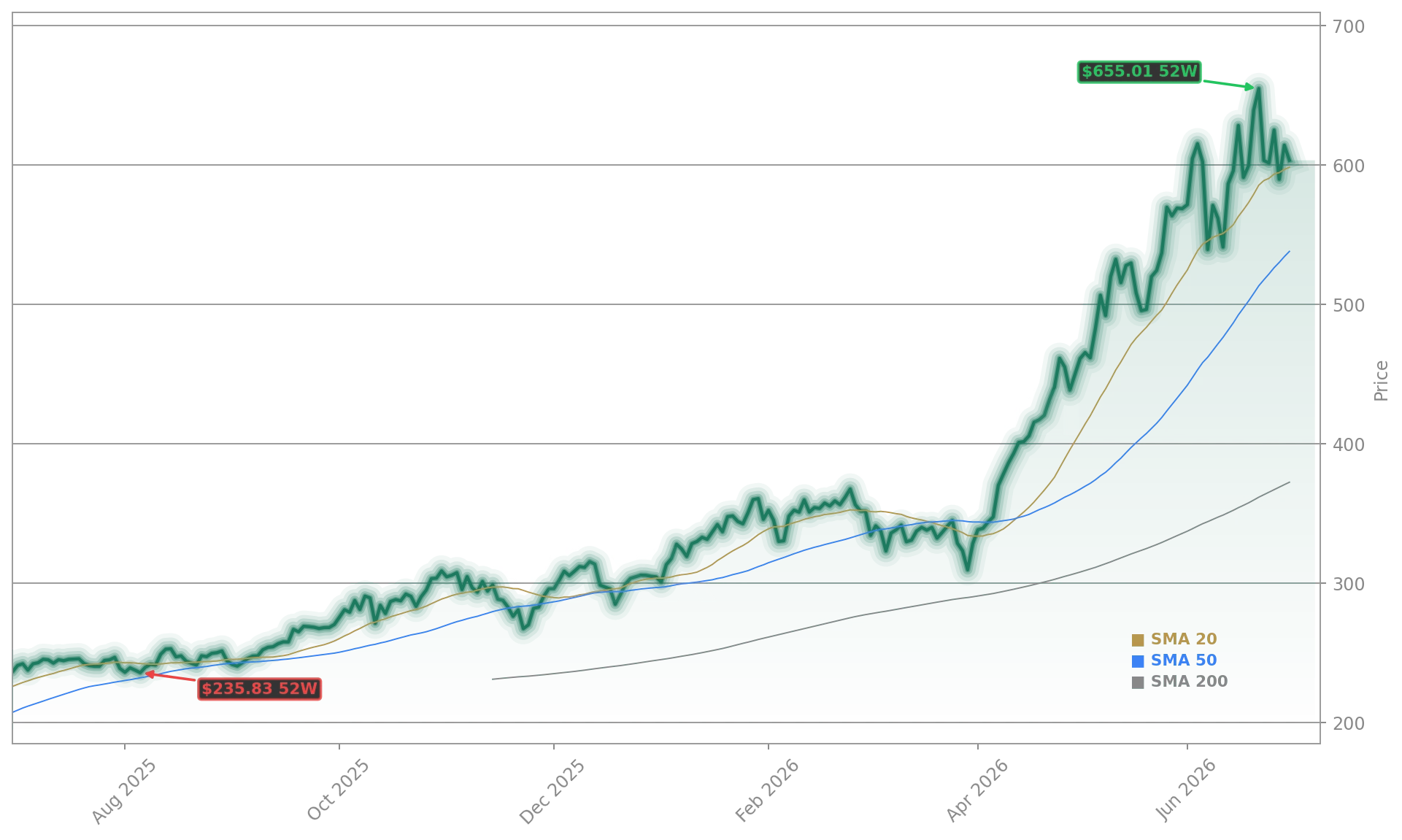
The iShares Semiconductor ETF (SOXX) has delivered one of the most volatile performances on Wall Street in 2026 — up 96% year-to-date, then down nearly 8% in one week. That reversal wasn’t triggered by macro shifts or Fed policy, but by two precise, company-specific signals: Broadcom’s downward revision to its AI chip revenue outlook and SK Hynix’s decision to slow AI memory capacity expansion. Unlike broader tech indices, SOXX’s structure — weighted toward equipment suppliers like Applied Materials and memory makers like Micron — magnifies the impact of booking cancellations across multiple top holdings simultaneously. The fund’s 0.34% expense ratio and 30-stock composition make it a concentrated barometer for AI infrastructure build-out, not just chip design.
How Hyperscaler Capex Guides SOXX AI Forecast
The SOXX AI Forecast is now anchored less in chip architecture breakthroughs and more in hard capex commitments from Microsoft, Meta, Alphabet, Amazon, and Oracle. Collectively, these five hyperscalers account for over half of SOXX’s revenue exposure — directly through AI accelerator orders to NVIDIA and AMD, and indirectly via memory demand for Micron and SK Hynix, plus equipment orders to Applied Materials and Lam Research. With the 10-year Treasury yield at 4.4% and the Fed funds rate unchanged at 3.75%, interest rate sensitivity has receded. Instead, Wall Street is laser-focused on whether full-year 2026 hyperscaler capex guidance holds above $1 trillion — the threshold underpinning SOXX’s current 28x forward P/E. A single guide-down from Broadcom, paired with SK Hynix’s memory throttle, was enough to trigger a 4.7% SOXX selloff — with Micron Technology (MU) falling 8.2% and dragging three top SOXX weights lower in tandem.
Why Equipment Suppliers Are Now the Weak Link?
SOXX’s divergence from the S&P 500 and NASDAQ isn’t about chip design — it’s about the equipment layer. While the SMH ETF is NVIDIA-heavy, SOXX allocates nearly 35% to semiconductor capital equipment firms. That tilt makes SOXX uniquely exposed to order cancellations and lead-time compression. Applied Materials and Lam Research — both top-five SOXX holdings — reported softening tool bookings in late June. RBC Capital Markets downgraded Applied Materials to ‘Sector Perform’ last week, citing ‘increasing capex volatility among AI infrastructure buyers.’ Meanwhile, Citigroup cut its 12-month price target on Lam Research to $920 from $1,050, noting ‘a growing risk of hyperscaler capex deferral beyond Q3 2026.’ That shift matters: equipment orders typically lag chip demand by one to two quarters — meaning capex guidance revisions now will hit SOXX’s earnings trajectory by Q4.
Is SOXX’s Premium Still Justified?
SOXX trades at a 22% premium to its 5-year average P/E — a valuation that assumes uninterrupted AI infrastructure build-out through 2027. But hedge fund manager Michael Burry has taken a $330 put position on SOXX expiring in January 2027, betting that hyperscaler capex falls below $1 trillion. Goldman Sachs analysts recently affirmed SOXX’s ‘strategic allocation value’ but added: ‘The ETF’s upside is fully priced to sustained $1.1T+ annual capex — any sustained miss below $950B would pressure valuations meaningfully.’ With Meta reporting earnings on July 25 and Microsoft on July 30, the next two weeks will test whether the SOXX AI Forecast remains intact — or whether the fund enters a valuation reset phase.
SOXX AI Forecast: What’s Next for Investors?
Investors should treat SOXX not as a passive semiconductor play, but as a real-time capex derivative. The next catalyst isn’t earnings — it’s capex line items disclosed in each hyperscaler’s 10-Q and earnings call transcripts. Watch for Meta’s AI infrastructure spend disclosure, Microsoft’s Azure CapEx guidance, and Alphabet’s data center investment footnote. If two or more hyperscalers revise 2026 capex downward in their Q2 reports, SOXX’s premium could compress rapidly. Conversely, strong guidance from Meta and Microsoft could reignite momentum — especially if paired with positive inventory data from Micron and SK Hynix. The SOXX AI Forecast remains the single most actionable metric for U.S. portfolios with semiconductor exposure.
The ETF’s upside is fully priced to sustained $1.1T+ annual capex — any sustained miss below $950B would pressure valuations meaningfully.— Goldman Sachs analysts
Related Coverage: For deeper analysis of SOXX’s technical setup and near-term price targets, see SOXX Semiconductor Analysis: +4.7% Surge, Buy or Wait?. Investors also increasingly compare SOXX to broader AI infrastructure ETFs like BOTZ and ROBO — a trend explored in our exclusive report AI ETF Comparison 2026: SOXX vs. BOTZ vs. ROBO. Finally, for insights on how chip shortages are reshaping automotive supply chains, read our latest deep dive Tesla Supply Chain: Chip Shortage Impacts and 2026 Outlook.