Has SOXX’s latest surge confirmed semiconductor leadership, or is the AI trade getting too crowded to chase now?

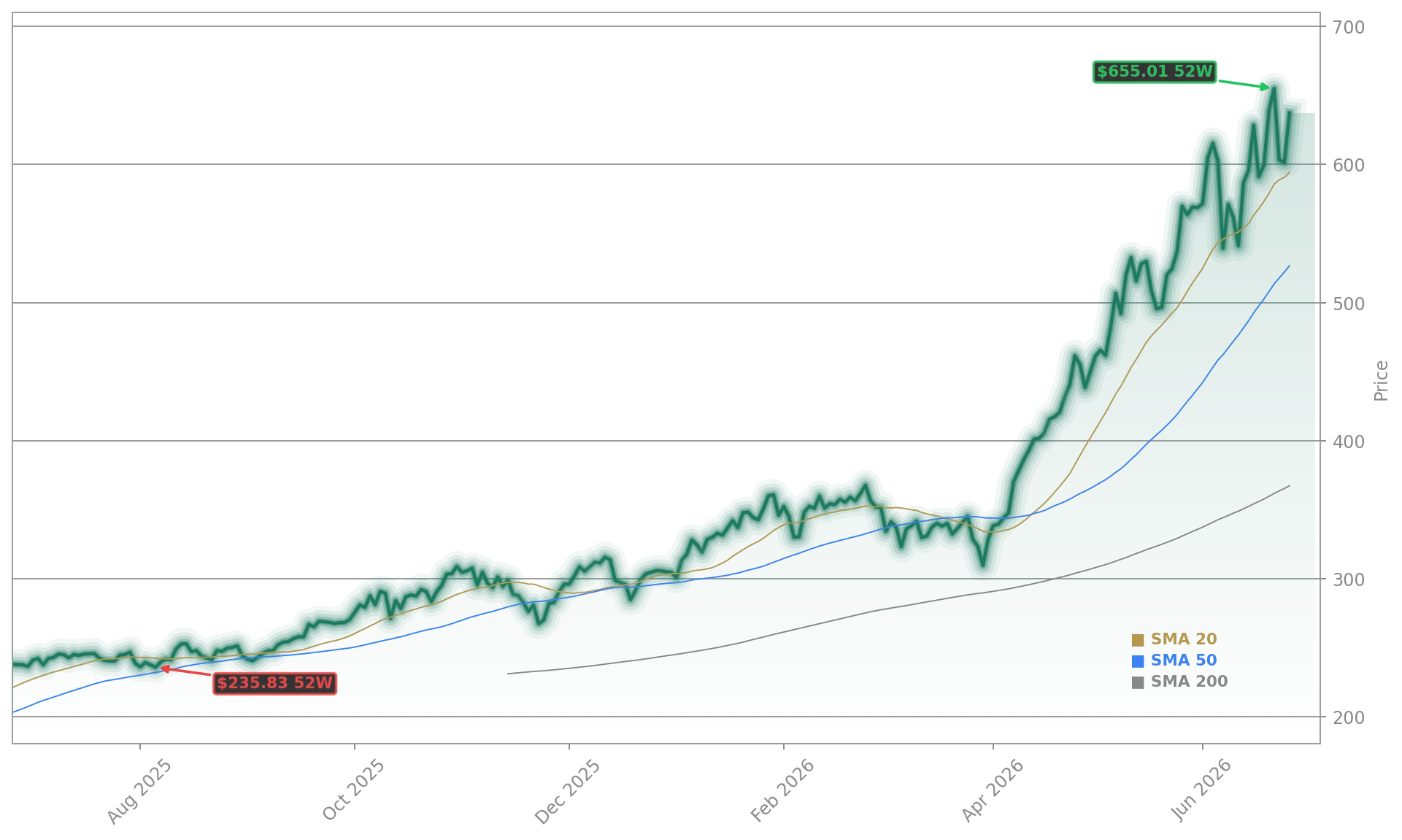
SOXX Semiconductor Analysis: What’s Driving the 108% Surge?
The iShares Semiconductor ETF’s extraordinary 2026 performance isn’t random — it’s a direct reflection of structural AI infrastructure acceleration. Global data center spending is projected to exceed $1 trillion this year, per The Globe and Mail, with chip demand exploding across design (Nvidia, AMD), manufacturing (TSMC), and equipment (Applied Materials, Lam Research). Unlike broad tech ETFs, SOXX captures the entire semiconductor value chain: 30 companies, with top 10 holdings — including NVIDIA, Advanced Micro Devices, and Micron — accounting for 59.2% of assets. That concentration has paid off: SOXX’s YTD return dwarfs the S&P 500’s 9%, and its 3-year annualized gain of 58.7% underscores its role as a high-beta AI proxy on Wall Street.
How Does SOXX Compare to Competitors Like SMH?
VanEck Semiconductor ETF (SMH) remains SOXX’s most cited benchmark — and the contrast is revealing. While SMH leans heavily into mega-cap design leaders (NVIDIA alone is ~25% of SMH), SOXX tilts toward equipment and foundry exposure, with Applied Materials, KLA, and TSMC comprising over 13% combined. According to 24/7 Wall St., SOXX outperformed SMH in 2026 due to broader market participation, but SMH holds a superior 10-year CAGR (38.1% vs. 35.4%). For U.S. investors seeking diversification beyond chip design — and mitigating single-stock risk — SOXX’s structure offers strategic balance, though not without trade-offs in long-term compounding.
Is SOXX’s 0.34% Expense Ratio Justified?
Yes — but only in context. At 0.34%, SOXX costs more than 10x the average S&P 500 ETF (e.g., SPY at 0.094%). NAI500 notes this fee is reasonable given SOXX’s targeted exposure and active supply-chain positioning — especially as cloud providers boost capex. Yet as growth moderates, that fee compounds more meaningfully. RBC Capital Markets recently affirmed SOXX’s structural relevance but flagged expense ratio sensitivity in lower-volatility regimes. For buy-and-hold investors, the cost is manageable. For tactical traders rotating in and out, it erodes margins — particularly if a correction aligns with earnings revisions at key holdings like Intel or Micron.
What Do Analysts Say About SOXX’s Underlying Holdings?
While SOXX itself isn’t rated, its top components are actively covered. Citigroup recently raised its price target on Advanced Micro Devices to $225, citing AI inference growth and data center design wins. Goldman Sachs maintains a ‘Buy’ on NVIDIA with a $1,450 target, emphasizing its dominance in training chips and expanding software moat. Meanwhile, Morgan Stanley downgraded Intel to ‘Underweight’, citing execution risk in foundry and AI chip timelines — a reminder that SOXX’s 6.07% Intel stake introduces asymmetric risk. Analysts broadly agree: the AI tailwind remains intact, but earnings quality and margin sustainability — especially at equipment makers facing potential capex pullbacks — will define SOXX’s next phase.
Can SOXX Maintain Leadership Amid Rising Volatility?
SOXX’s 2026 run has come with elevated volatility — its 30-day beta versus the NASDAQ is 1.32. With the S&P 500 trading near all-time highs and interest rate uncertainty persisting, SOXX’s sensitivity to macro shifts is acute. The Motley Fool cautions that current returns are unlikely to repeat, citing saturation risks in AI chip demand and rising power/cooling constraints in data centers. Still, the ETF’s diversified exposure across design, manufacturing, and equipment provides a structural hedge against single-node failure. For U.S. investors, SOXX remains a high-conviction, high-impact satellite holding — not a core allocation — in portfolios targeting AI infrastructure exposure.
SOXX offers investors an effective way to participate in the AI infrastructure wave by diversifying holdings across key chip companies and equipment suppliers, avoiding over-reliance on a single stock.— NAI500
The iShares Semiconductor ETF remains a critical vehicle for capturing semiconductor-driven AI growth, with robust fundamentals underpinning its 108% rally. For long-term investors, its diversified supply-chain exposure and leadership in the AI infrastructure wave justify continued strategic allocation. The next quarterly earnings cycle — especially from equipment makers and memory leaders — will test whether momentum holds or recalibrates. For disciplined investors, SOXX Semiconductor Analysis confirms it’s not too late — but timing, position sizing, and expense awareness matter more than ever.