
Will SpaceX’s massive pivot into AI infrastructure justify its premium valuation, or are staggering capital expenditures about to trigger a reality check?

What Will the First SpaceX Earnings Report Reveal?
Wall Street analysts are closely watching the upcoming August 4 release. Benzinga Pro estimates that the company will report a loss of 25 cents per share on quarterly revenue of $6.98 billion. This is a crucial milestone for Space Exploration Technologies as it seeks to justify its premium valuation. In the first quarter of 2026, the company generated $4.7 billion in total revenue, primarily driven by its satellite internet segment, Starlink, which contributed $3.26 billion. The market’s anticipation is further heightened by Tesla disclosing a roughly $2 billion equity investment in the company during the first quarter of 2026, creating a vertically integrated AI-industrial stack. However, the focus of this SpaceX Earnings report will likely shift toward its rapidly growing artificial intelligence infrastructure business.
How Does Space Exploration Technologies Scale AI?
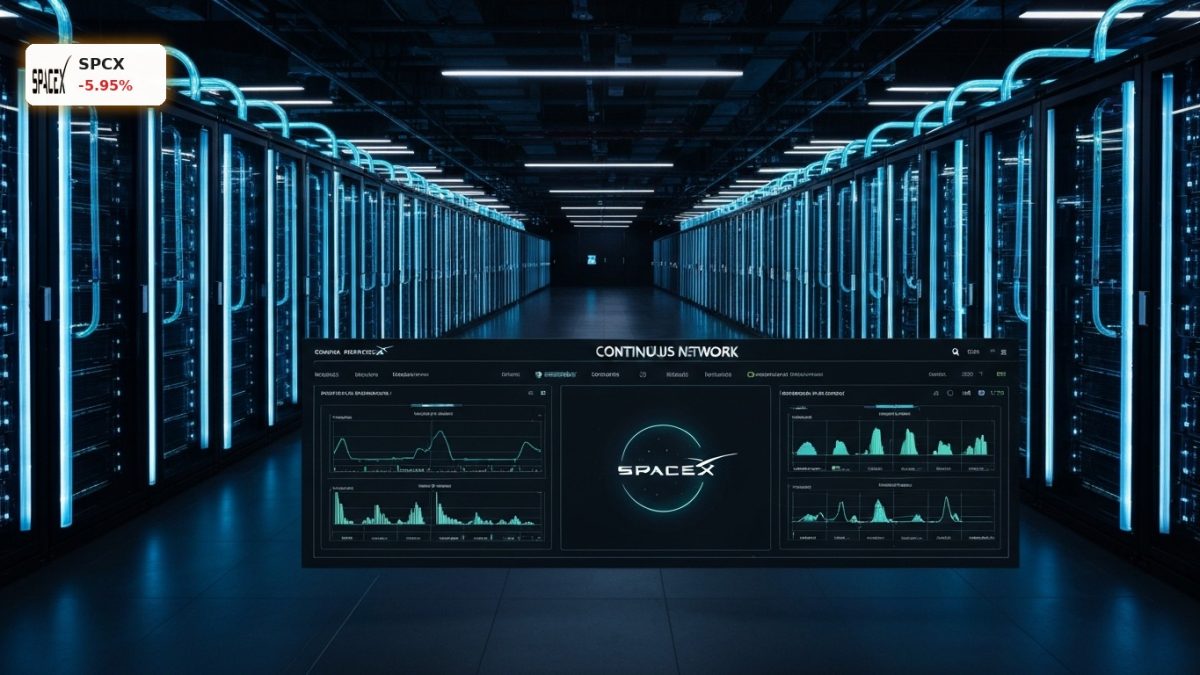
The integration of Elon Musk’s xAI startup, acquired in January, has transformed the company into a dual space and AI powerhouse. By renting out computing capacity from its massive Colossus data centers, the firm is securing lucrative contracts. In May, a deal was signed to rent $1.25 billion in monthly capacity to Anthropic, followed by a $920 million monthly agreement with Alphabet starting in October, and a $150 million monthly contract with Reflection AI. While these deals point to massive future revenue, the capital expenditures are staggering. In 2025, AI capital expenditures reached $12.7 billion, contributing to a net loss of $4.9 billion. In the first quarter of 2026 alone, capital expenditures hit $10.1 billion, resulting in a $4.2 billion net loss. Morgan Stanley, which remains structurally bullish on the long-term outlook, projects that company-wide annual revenue will hit $45 billion this year, though the firm does not expect free cash flow to turn positive until 2035.
Can Starship Support the Long-Term Growth Narrative?
Beyond the upcoming SpaceX Earnings figures, investors are looking to the sky. On July 23, the company is scheduled to conduct the thirteenth test flight of its Starship megarocket. Successful commercialization of Starship is critical because it lowers the cost of deploying the next-generation V3 Starlink satellites, which promise ten times more bandwidth. Furthermore, Starship is the key to Musk’s vision of launching solar-powered orbital data centers. This massive $28.5 trillion total addressable market has drawn mixed reactions from analysts. Raymond James holds a highly bullish target of $800, and John Godyn of Citigroup placed a long-term price target of $900 on the stock. Macquarie also reiterated an Outperform rating with a $250 price target, viewing the firm as a premier AI asset. Conversely, Morningstar remains cautious, setting a fair value of just $62, citing the heavy capital requirements.
Related Coverage
For investors tracking the broader market dynamics, there is significant interest in how these capital-intensive projects are funded. Our related coverage explores these trends in detail. Read about the immediate market reaction in SpaceX Earnings Report Drops -3% as Massive Lock-Up Threat Looms, which analyzes the upcoming post-IPO share unlock pressure. Additionally, the immense power requirements of modern computing infrastructure are driving new energy solutions; learn more in NuScale Power SMR: Will a $15B Boom Power the AI Revolution?.
SpaceX has a first mover advantage. It will be difficult. It has a ten year lead and the key has been reusable rockets.— Cathie Wood
Ultimately, the upcoming SpaceX Earnings on August 4 will serve as a vital reality check for an incredibly ambitious business model. While short-term volatility and post-IPO lock-up expirations may pressure the stock, the company’s dual-moat in reusable rockets and orbital AI infrastructure provides an unparalleled long-term runway. For patient investors, this temporary market turbulence could represent a compelling entry point into the future of space-based technology.