Are the latest Starbucks Earnings enough to prove its Back-to-Starbucks turnaround is finally gaining real traction with investors?

How are Starbucks Earnings moving the stock?
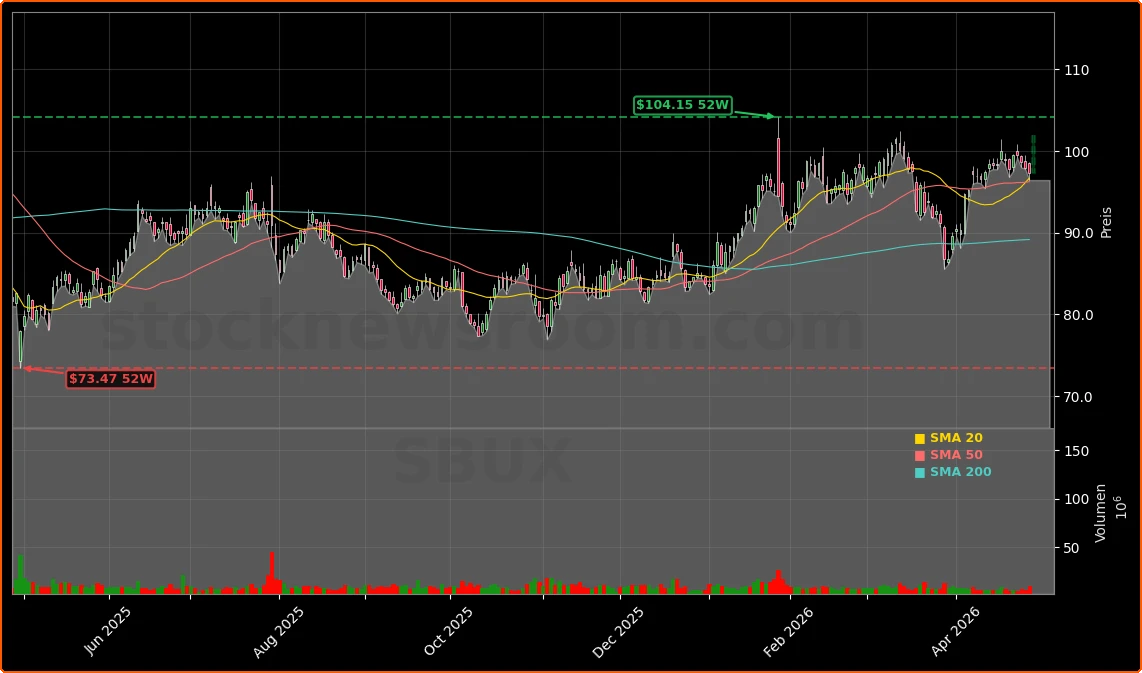
Starbucks Corporation (SBUX) ended Tuesday’s session at $97.28, down 0.62% from the prior close of $98.02, but the story shifted sharply after the bell. In late trading the shares climbed to about $101.98, a gain of nearly 5%, as traders reacted to stronger-than-expected Starbucks Earnings and a more confident full-year outlook. That move extends a roughly 15% advance over the past 12 months, although the stock still trails the broader S&P 500, which has gained close to 29% in the same period.
For U.S. and global investors, the post-close jump underscores that the latest Starbucks Earnings are being interpreted as a confirmation that the company’s Back-to-Starbucks turnaround strategy is bearing fruit. The stock’s trading range between roughly $75 and $105 this year had reflected uncertainty about execution risk, high coffee prices, and consumer sentiment, but the latest numbers suggest the risk-reward profile is improving.
What did Starbucks deliver this quarter?
In its most recent reported quarter, Starbucks posted comparable sales growth of about 6.2% worldwide, easily ahead of consensus estimates near 3.7%. U.S. comparable sales were even stronger at roughly 7.1%, with more orders and higher average tickets driving the beat. On the bottom line, adjusted earnings per share (EPS) came in at $0.50, also above Wall Street expectations and up more than 20% year over year in that period.
Management used the momentum from those Starbucks Earnings to lift its guidance. For the current fiscal trajectory, the company is now targeting global comparable sales growth of about 5% or better and adjusted EPS in a corridor around $2.25 to $2.45, up from a prior range that had been closer to $2.15 to $2.40. Operating margin expanded to roughly 9.4%, an improvement of about 110 basis points from the prior year, helped by better labor efficiency and higher sales volumes.
These improvements mark a reversal from an earlier quarter in which revenue of about $8.8 billion grew modestly but EPS slipped to $0.41 and operating margin compressed to 8.2% as Starbucks poured money into labor and store upgrades. Executives have been clear that short-term EPS is not the sole focus; instead, they are prioritizing sustainable growth and returns on invested capital as the turnaround scales.
Is the turnaround working in the U.S. and abroad?
CEO Brian Niccol has framed the Back-to-Starbucks plan around winning back the morning daypart, building the afternoon business, and modernizing digital engagement. In the strong Q2 period, North America and the U.S. led the way, with comparable sales up more than 7% and transaction growth contributing over four percentage points of that increase. Delivery sales grew more than 30% year to date, and the revamped Starbucks Rewards loyalty program has begun to resonate with more value-conscious customers.
International performance is more nuanced. Revenue outside North America climbed nearly 8%, and all of the company’s top 10 international markets posted flat or positive comparables for the first time in nine quarters. Markets such as the UK and Japan recorded positive comparable sales, with Japan extending a long streak of growth. China, however, remains a soft spot. Comparable sales there were essentially flat in one recent quarter and rose only about 0.5% in the stronger Q2 period, well below expectations of roughly 3.4%, reflecting intense competition and a more cautious consumer.
Starbucks has been reshaping its footprint and capital allocation abroad, moving toward franchise and licensed models in some regions to lighten the balance sheet and focus more resources on the U.S. core. At the same time, it continues to add net new stores globally—about 213 in a recent quarter—while temporarily slowing the pace of expansion to refine store design and cost structures.
How do Starbucks Earnings compare with rivals?
From a Wall Street perspective, investors are comparing Starbucks Earnings and guidance with other big consumer and restaurant names. Fast-food leaders such as McDonald’s and Apple-like ecosystem players in tech have leaned into simple bundled offers and integrated digital experiences to keep customers engaged in a choppy macro backdrop. Starbucks, by contrast, still leans on a long list of customization options, echoing the approach seen at companies like NVIDIA and Tesla in their respective sectors, where product breadth and premium tiers help drive pricing power.
That strategy comes with complexity costs but can pay off in brand loyalty. Starbucks has invested heavily in labor, digital menu boards, and equipment like Clover Vertica brewers to streamline complicated beverage orders, while also simplifying the menu by removing slower sellers. Early signs are encouraging: partner turnover in the U.S. has dropped below 50%, shift completion rates have reached record highs, and social-media engagement on platforms like TikTok has climbed sharply, all supportive of stronger traffic trends.
Compared with the consumer discretionary cohort in the S&P 500, Starbucks now sits in the middle of the pack on valuation, with investors weighing its durable brand and dividend profile against near-term margin volatility and lingering questions around China. For long-term portfolios, the company’s updated EPS range and mid-single-digit same-store growth ambitions are key inputs into discounted cash flow and total-return models.
Analyst coverage from major Wall Street banks remains active. Firms such as Goldman Sachs, Morgan Stanley, Citigroup, and RBC Capital Markets have highlighted Starbucks as a core global brand, with differing views on how quickly margins can rebuild as investments moderate and traffic normalizes, but broad agreement that execution in the U.S. will be critical to justifying higher price targets.
Our Back-to-Starbucks strategy is gaining traction as we win the morning, build the afternoon, and deliver better experiences for our partners and customers.— Brian Niccol, CEO of Starbucks Corporation
Ultimately, the latest Starbucks Earnings reinforce the narrative of a high-quality consumer franchise navigating a challenging macro environment by leaning into operational upgrades, digital loyalty, and selective international expansion. For investors, the raised outlook, improving U.S. trends, and strong after-hours reaction suggest that Starbucks remains a relevant, resilient holding in diversified equity portfolios, with the next set of results poised to show whether the turnaround can extend into sustained double-digit EPS growth.