Is the latest wave of Airbnb insider selling just routine diversification or a warning signal at current valuations?

How large is the new Airbnb Insider Selling wave?
The newest filings show that the Blecharczyk Nathan 2015 GRAT registered 65,386 restricted Airbnb shares for potential sale, while the Blecharczyk Nathan 2020 Remainder Trust filed to sell 130,772 shares. A separate Nathan Blecharczyk Revocable Trust added another 10,777 shares. All three filings were lodged on April 21, 2026, with Fidelity Brokerage Services listed as the broker and April 21 as the approximate first sale date.
Form 144 filings notify the SEC of an insider’s intent to sell restricted or control securities and give a 90‑day window during which any or all of the registered shares can be sold. There is no guarantee the entire amount will be placed, but the combined 206,935‑share capacity stands out against recent trading volumes, especially coming from a co‑founder who still holds a significant economic stake.
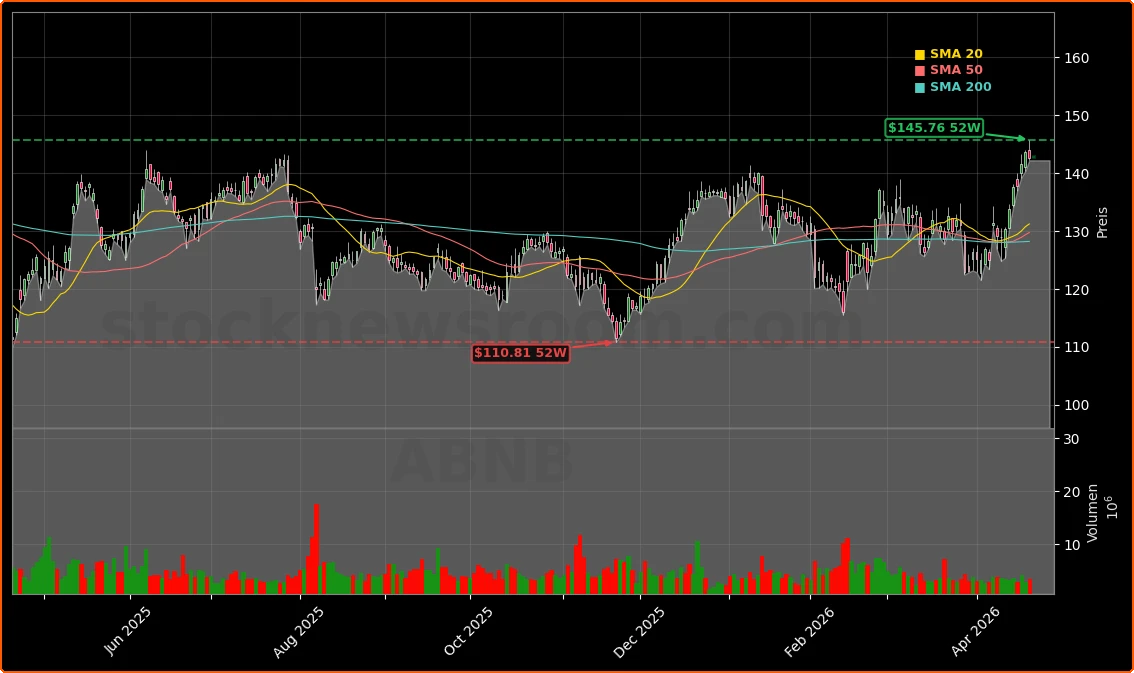
At the latest close of $142.65 (after-hours $142.89, +0.17% at 7:30 p.m. ET), the potential gross value of these newly registered shares is roughly $29.5 million, assuming full execution near current prices. While that is modest relative to Airbnb’s multi‑billion‑dollar market capitalization on the NASDAQ, the optics of continued Airbnb Insider Selling from senior figures may weigh on sentiment among short‑term traders.
What pattern is emerging at Airbnb?
The new notices follow a string of earlier transactions this year. Multiple Form 144 records show Blecharczyk and related trusts already selling smaller blocks of 3,846 and 7,692 Class A shares across various dates from mid‑January through early April, with proceeds reported for each trade. Those shares were identified as founder stock originally acquired in July 2008, underlining just how long the insiders have been invested.
Blecharczyk is not the only Airbnb insider tapping the market. In April, CFO Elinor Mertz sold 3,750 Class A shares at an average price of about $130.99 under a pre‑arranged Rule 10b5‑1 plan adopted in May 2025, leaving her with just under 395,000 shares. Director Joseph Gebbia recently disposed of about $7.3 million worth of stock via a trading plan, with sale prices between roughly $124.75 and $127.02; the shares were sold into strength, as the stock moved higher afterward.
These moves reinforce a narrative of steady, programmatic selling by early shareholders and executives as Airbnb’s stock has recovered from earlier volatility. For some investors, the wave of Airbnb Insider Selling is seen as routine diversification after years of wealth concentration. For others, the clustering of sales near the upper end of recent trading ranges raises caution flags about risk‑reward at current levels.
How does Airbnb stack up in the tech landscape?
Airbnb now sits firmly among high‑profile Nasdaq names that attract global capital flows alongside travel‑adjacent tech and consumer platforms such as Apple, Tesla and NVIDIA. While Airbnb is not in the S&P 500’s mega‑cap league, its valuation multiple and growth profile place it squarely in the conversation for US growth portfolios that also hold leading platform businesses.
Technical traders on platforms like TradingView have been divided, highlighting both bearish patterns such as potential head‑and‑shoulders setups and bullish reversal formations after earnings‑driven breakouts. Some of that debate explicitly cites insider activity as a factor, with bears pointing to insider selling as a reason to fade rallies, and bulls arguing that liquidity from founders is a normal part of the maturation process for Silicon Valley‑style listings.
Beyond individual stock dynamics, ETF products have begun to target Airbnb specifically. The YieldMax ABNB Option Income Strategy ETF, for instance, continues to pay a rich stream of option‑derived distributions to investors, recently declaring a weekly payout of about $0.38 per share. For income‑seeking investors, such wrappers offer another way to express a view on Airbnb while potentially muting some volatility tied to insider headlines.
What are analysts and global investors watching?
Airbnb’s fundamentals and valuation remain in focus for Wall Street firms like Goldman Sachs, Morgan Stanley, Citigroup and RBC Capital Markets, which have periodically updated price targets and ratings as travel demand normalizes and competition from hotels and alternative platforms intensifies. Some analysts have argued that the stock looks stretched relative to traditional lodging peers, while others emphasize its asset‑light, platform‑based economics and strong cash generation as reasons to stay constructive.
International demand has also been building. Indian brokerage platforms that track US equities highlight Airbnb as a popular name among domestic investors looking beyond local markets. They emphasize metrics such as price‑to‑earnings ratios, cash flow, and institutional ownership, signaling that Airbnb has become a core holding for many global growth portfolios despite the overhang of Airbnb Insider Selling.
For US investors, the key question is whether insider transactions will ultimately align with changing fundamentals. If profitability and free cash flow continue to trend positively, the market may absorb founder and executive sales without much difficulty. But if growth falters or regulatory risks around short‑term rentals escalate, repeated insider disposals could amplify downside pressure.