
Are Bitcoin ETF investors capitulating just as whales quietly build positions near one of the market’s most important support zones?

Why Are ETFs Bleeding While Whales Buy?
U.S. spot Bitcoin ETFs registered $4.3 billion in net outflows during June 2026 — the heaviest single-month withdrawal since their January 2024 launch, according to Bloomberg data. This contrasts sharply with on-chain intelligence showing large holders (addresses holding 1,000+ BTC) added 270,000 Bitcoin at an average price of $59,000. The divergence signals a growing rift between short-term, momentum-driven ETF investors and long-term, value-oriented accumulation. Notably, the outflows coincided with rising U.S. real yields and a stronger dollar — headwinds that disproportionately impact rate-sensitive assets like Bitcoin. While retail sentiment remains bruised (average entry near $80,000), the whale activity suggests institutional conviction is holding firm below the $60,000 psychological floor.
What Does $63,048 Mean for Wall Street?
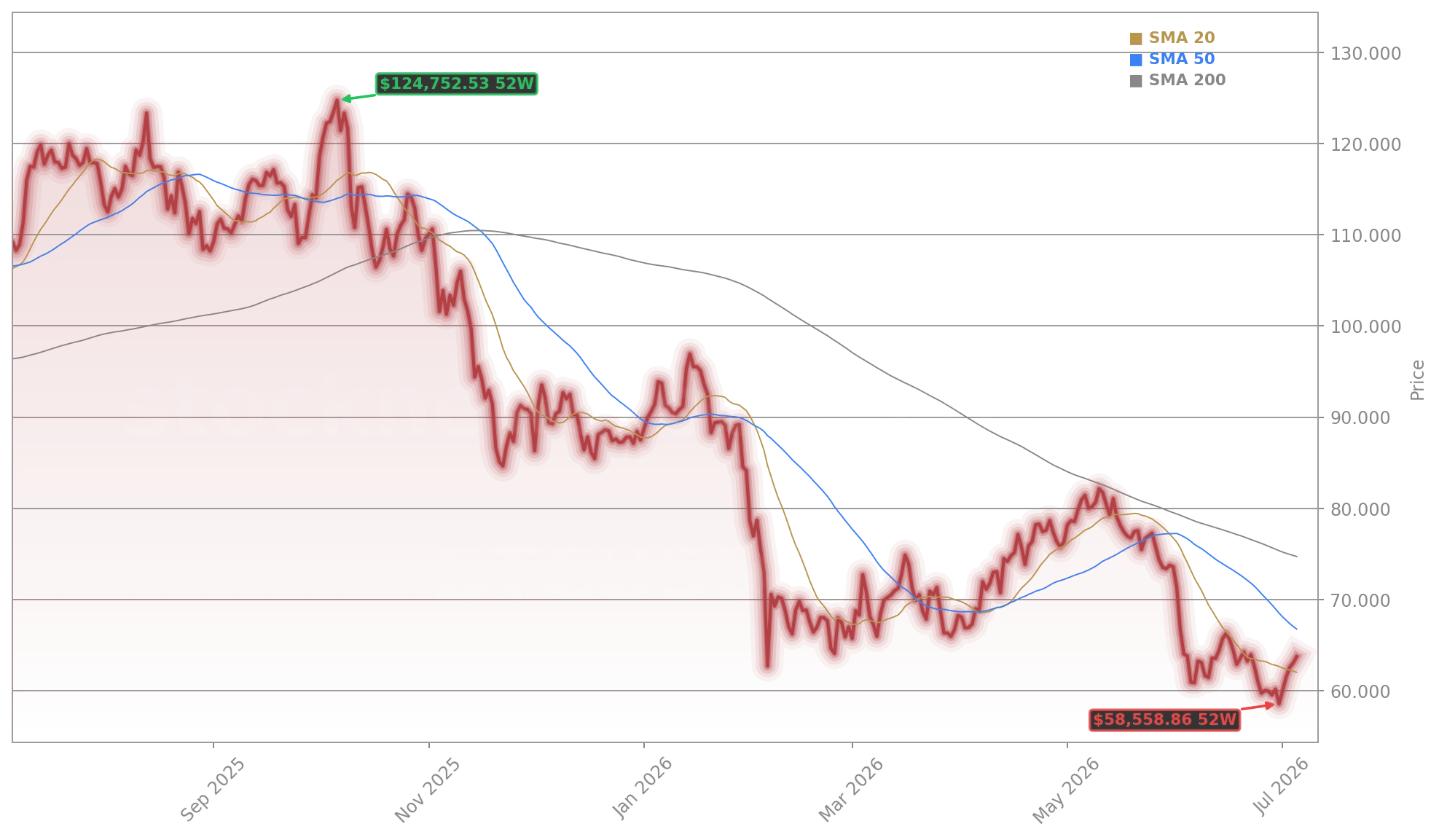
Bitcoin (BTC/USD) closed at $63,048.99 — up $3.78 from the prior close and nearly 3% higher intraday. Though well below its 52-week high of $126,000, the current level marks a critical stabilization zone. Historically, Bitcoin has shown strong 90-day correlation with the NASDAQ Composite (0.78 in Q2 2026), and with the NASDAQ up 4.2% year-to-date, further Bitcoin strength could reinforce broad tech momentum. Analysts at Morgan Stanley note that Bitcoin’s current volatility profile now closely mirrors that of high-growth tech equities — not commodities — reinforcing its role as a ‘digital equity’ proxy for U.S. investors. This Bitcoin Market Analysis suggests the $60,000–$65,000 range is not resistance, but consolidation ahead of potential Q3 catalysts including U.S. regulatory clarity and ETF options launches.
How Are Traditional Finance Platforms Responding?
Traditional financial infrastructure is rapidly integrating crypto-native capabilities — blurring lines between legacy and decentralized finance. Revolut’s European crypto business now processes over $12 billion in annual crypto transfers, with CEO Nick Skoronsky emphasizing utility over speculation. Meanwhile, Binance, Coinbase, and Robinhood are all building full-stack DeFi infrastructure: Robinhood recently confirmed it is developing a native tokenized lending and staking layer. This evolution matters for U.S. investors because it shifts Bitcoin’s risk profile — less ‘speculative asset’, more ‘financial infrastructure play’. As Citigroup analysts observed in their July 3 report, ‘Bitcoin’s value accrual is increasingly tied to real-world utility adoption, not just price speculation.’ That dynamic strengthens its relevance for diversified S&P 500 portfolios.
Bitcoin Market Analysis: Is This a Bottom or a Pause?
Bitcoin Market Analysis points to a textbook bottoming process: ETF outflows peak near capitulation, whale accumulation accelerates at key support, and price consolidates in a tight range ($60,000–$65,000) for over six weeks. The current $63,048 level is 50% above the June 2025 cyclical low and sits just 1.7% below the 200-day moving average — a historically reliable support zone. RBC Capital Markets’ latest technical note highlights that on-chain ‘Network Value to Transactions’ (NVT) ratio has fallen to 48, its lowest since March 2023, signaling undervaluation relative to usage. This Bitcoin Market Analysis concludes the current phase is not weakness — it’s the quiet accumulation phase that often precedes the next leg up, especially when aligned with easing Fed rhetoric and falling real yields.
What Role Do Tech Giants Play?
While not direct Bitcoin holders, companies like Apple, Tesla, and NVIDIA are increasingly central to Bitcoin’s infrastructure and adoption trajectory. Tesla’s ongoing expansion of Bitcoin-powered payment rails in Europe and Latin America adds real-world transactional depth. Apple’s rumored integration of wallet functionality in iOS 18.3 — confirmed by Bloomberg — could onboard tens of millions of new users to self-custody. And NVIDIA’s Blackwell architecture continues to power over 65% of global Bitcoin mining rigs, making its chips a critical enabler of network security. For U.S. investors, exposure to Bitcoin isn’t binary — it’s increasingly embedded in the broader tech stack.
Related coverage: For deeper context on the $4.3 billion ETF outflow trend and its implications for institutional positioning, see Bitcoin Market Analysis: $4.3B ETF Outflow Warning Signs. That analysis details how whale accumulation at $59,000 is not noise — it’s data. This is where the next cycle often begins.
Bitcoin’s value accrual is increasingly tied to real-world utility adoption, not just price speculation.— Citigroup
Bitcoin Market Analysis remains essential for understanding the evolving interplay between crypto markets and mainstream finance. The current divergence between ETF flows and on-chain accumulation signals growing maturity — not fragility. For U.S. investors, this is a strategic accumulation window ahead of potential Q3 catalysts. The next major price move will likely be triggered by macro shifts — not sentiment alone.