Is the Dell Forecast still an AI growth story or now a valuation trap after its latest downgrade and sharp pullback?

Is the Dell Forecast now constrained by valuation?
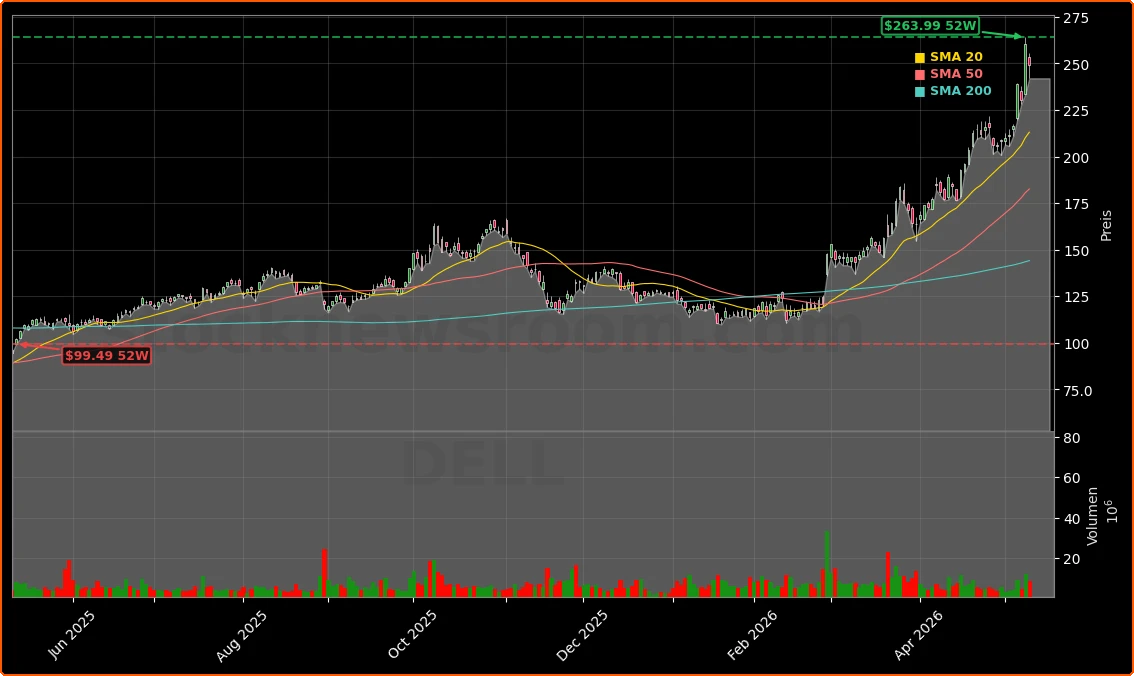
UBS shifted Dell Technologies Inc. to Neutral from Buy, arguing that the risk/reward looks more balanced after the stock’s powerful rally. Paradoxically, the bank raised its target from $167 to $243, signaling that the underlying business has improved but that the current price already bakes in much of that upside. At about $249, Dell trades slightly above the new UBS target, helping explain Monday’s roughly 4.4% slide.
UBS now models potential earnings per share of $17 in 2027, versus Dell management’s own FY27 midpoint guidance of $12.90. That elevated bar illustrates why the Dell Forecast has become more about entry point than business quality: buy-side expectations are already leaning toward aggressive upward revisions. After a roughly 157–170% move over the last year and a recent run to record highs highlighted by TechStock², even strong franchises typically pause to consolidate.
Other banks have taken a more constructive stance on AI beneficiaries, with Mizuho recently lifting price targets across several chip and infrastructure names including Dell. Yet consensus Street targets still sit well below the current quote, underscoring the growing valuation tension around the stock.
How strong is Dell’s AI engine?
Behind the changing Dell Forecast lies a business firing on most AI cylinders. Dell closed fiscal 2026 with revenue of $113.54 billion, up 19% year over year. The standout driver was its AI-optimized server segment, which booked $64 billion in orders and exited the year with a hefty $43 billion backlog. In Q4 FY26 alone, AI-optimized server revenue hit $8.95 billion, soaring 342% from the prior year.
Management is guiding FY27 revenue to $138–$142 billion, with AI server revenue projected near $50 billion. Large deals like the Pangea 5 supercomputer project with TotalEnergies and NVIDIA position Dell as a key supplier of high-performance, energy-efficient AI infrastructure in regulated industries. Meanwhile, a multi-year, $1.44 billion supply agreement with Boost Run underscores Dell’s relevance in hyperscale-style cloud AI deployments.
However, that AI mix comes with a trade-off. GAAP gross margin has compressed to about 20% from 24% as lower-margin servers powered by NVIDIA and AMD make up a larger slice of the pie. For value-conscious investors, the question is whether unit growth and backlog strength can offset structurally lower margins and still justify Dell’s expanded valuation multiples.
How does Dell stack up against AI infrastructure peers?
In the current Dell Forecast, investors are increasingly comparing the stock to other AI infrastructure plays. Pure-play server makers like Super Micro Computer and traditional enterprise vendors like Hewlett Packard Enterprise are facing similar valuation pressure after huge AI-driven advances. Dell’s advantage lies in its scale, global channel, and integrated stack of servers, storage, and networking that helps it win complex data center builds.
On the demand side, commentators such as Jim Cramer have placed Dell in the same “AI factory” toolkit as infrastructure names like Vertiv and networking suppliers that enable hyperscalers’ capex plans. At the same time, mega-cap platform providers from Apple to cloud titans are racing to deploy and monetize AI, reinforcing the need for the physical infrastructure Dell sells, even if the market debates how much of that demand is already priced into the stock.
Despite the pullback, Dell still trades at a trailing P/E around 30x and a forward multiple near 20x—well above where it spent much of its post-IPO life. Insider activity has tilted toward net selling, consistent with profit-taking after a massive run, another factor that makes short‑term upside less certain.
What does the Dell Forecast mean for U.S. portfolios?
For U.S. investors who rode the rally, the Dell Forecast now looks more nuanced than the straight-up AI bet it appeared to be a year ago. The bull case centers on AI server orders continuing to outstrip expectations, Dell converting its $43 billion backlog into higher earnings, and capital returns—like its $10 billion buyback authorization and a recent 20% dividend hike—supporting total shareholder return.
The bear case mirrors the UBS view and earlier caution from Citigroup: after a huge appreciation and fresh record highs, valuation leaves limited room for positive surprises. Any slowdown in AI orders, further margin pressure, or rotation out of high-multiple infrastructure names could weigh on the stock, even if fundamentals remain solid.
Related Coverage
For a deeper dive into how Dell became a favored AI infrastructure play earlier this year, readers can review Dell AI Servers Surge +5.7% as Supermicro Stumbles, which explores why some investors saw Dell as a steadier alternative to more volatile peers and how that perception helped fuel its rally.
In summary, the Dell Forecast has shifted from “undervalued AI sleeper” to “high‑quality leader with a full price tag.” For long-term investors, Dell’s entrenched position in AI data centers, combined with robust backlog and shareholder returns, remains compelling. The next few quarters of order trends, margins, and capital allocation will show whether today’s consolidation is a buying opportunity or an early sign that AI expectations have finally outrun reality.