Can Eli Lilly Orforglipron justify Lilly’s trillion-dollar valuation as GLP-1 growth accelerates and pricing pressure starts to bite?

What does Eli Lilly Orforglipron mean for Wall Street?
Eli Lilly Orforglipron—marketed as Foundayo—represents the first commercially viable oral GLP-1 receptor agonist to clear FDA review in 2026, a watershed moment for patient adherence and payer adoption. Unlike injectables requiring cold-chain logistics and clinical administration, Foundayo enables daily at-home dosing without dietary restrictions—a key differentiator versus Novo Nordisk’s oral semaglutide, which remains under EMA review and lacks U.S. approval. In ATTAIN-1 and ATTAIN-2 trials, patients lost up to 14.4% body weight at 72 weeks, with no meaningful drop-off in efficacy among diabetic subgroups. That dual indication—obesity and Type 2 diabetes—positions Eli Lilly Orforglipron to capture overlapping commercial and Medicare Part D formularies, a structural advantage that Citigroup highlights in its recent upgrade to ‘Buy’ with a $1,275 price target.
How does Q1 2026 performance redefine Eli Lilly’s earnings trajectory?
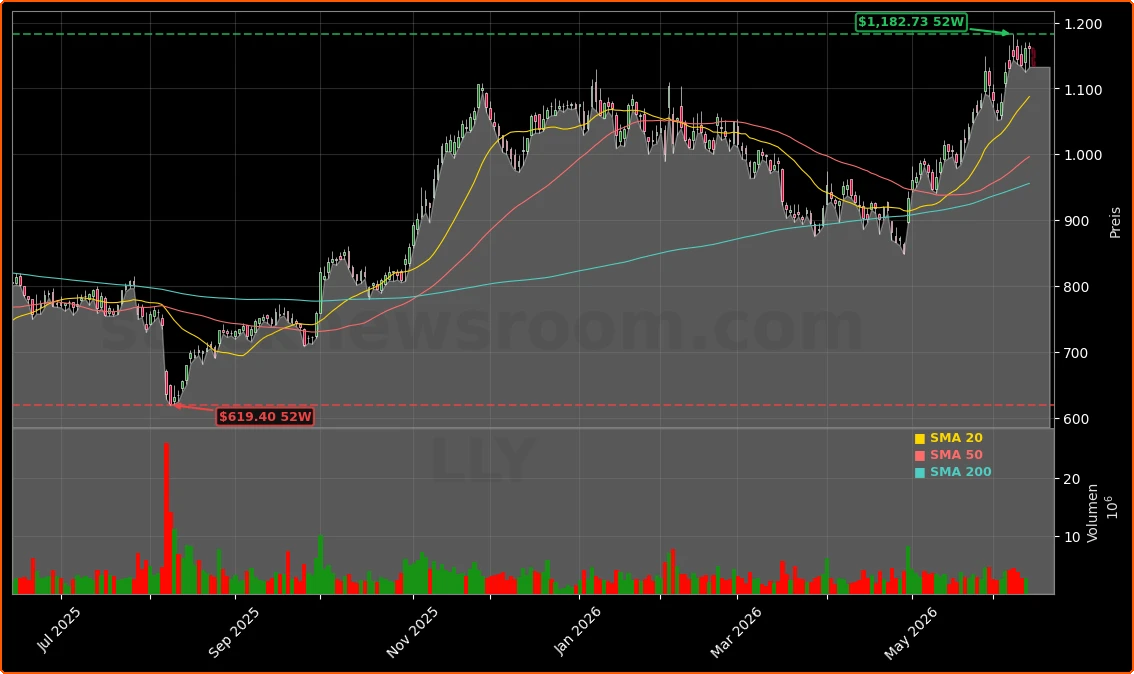
Revenue surged 56% year-over-year to $19.8 billion, driven overwhelmingly by GLP-1 products: Mounjaro ($8.66 billion, +125%) and Zepbound ($4.16 billion, +80%). But the real story lies beneath the headline—the 13% realized price decline for Mounjaro in Q1, driven by China’s national reimbursement list inclusion, signals mounting pricing pressure. Eli Lilly’s ability to offset that erosion hinges on Eli Lilly Orforglipron’s rapid uptake and the pending Phase 3 readout for retatrutide, which delivered 15.3% average weight loss in early trials. The company’s 2026 revenue guidance—$82–$85 billion—implies 28% growth at the midpoint, yet Morgan Stanley cautions that ‘multiple expansion is now fully priced in’ given LLY’s 41x trailing P/E and 31x forward multiple.
Is Eli Lilly’s pipeline deep enough to sustain leadership against Pfizer and Novo?
While Novo Nordisk reported $30 billion in U.S. GLP-1 revenue last year and Pfizer advances berobenatide—a monthly injectable with 15.9% weight loss at 32 weeks—Eli Lilly’s advantage lies in breadth. Its pipeline includes 42 Phase 3 and 32 Phase 2 trials, spanning donanemab (Alzheimer’s), Jaypirca (CLL), and KLN-1010 (multiple myeloma), plus a dozen obesity-adjacent assets. Crucially, Eli Lilly Orforglipron isn’t a standalone play—it’s the anchor for LillyDirect, the company’s integrated care platform now expanding via Weight Watchers partnerships. That vertical integration, RBC Capital Markets notes, ‘creates defensible economics beyond drug sales alone.’ Meanwhile, institutional buying is accelerating: Parnassus Investments boosted its stake by 60.8% to over 1.01 million shares in Q1.
What’s the risk to Eli Lilly’s $1.09 trillion valuation?
Eli Lilly Orforglipron’s oral profile, dual indication, and seamless integration into LillyDirect make it the first GLP-1 asset with true primary care adoption potential.— Citigroup Analyst Andrew Peters
Three structural headwinds loom. First, 70% of U.S. hospitals remain noncompliant with Lilly’s 340B data reporting policy—triggering potential reimbursement cuts and federal scrutiny. Second, employer groups are actively reviewing GLP-1 coverage beyond 2027, threatening commercial volume. Third, retail enthusiasm has peaked: Reddit sentiment hit 88 on June 7, a warning sign per sentiment analytics firms. Yet fundamentals remain resilient—the dividend just rose 15.3% to $1.73 quarterly, with a conservative 22.4% payout ratio and 12-year consecutive growth streak. As Goldman Sachs observes, ‘Lilly’s ability to monetize Eli Lilly Orforglipron in primary care—not just endocrinology—will be the true test of scalable, long-term earnings power.’