
Can Ethereum still justify a $4,000 target when weak ETF flows and fading fee burn keep pressure on ETH?

Why is Ethereum Forecast so divided?
Ethereum Forecast discussions have turned unusually polarized. On one side, Standard Chartered analyst Geoffrey Kendrick kept a year-end target of $4,000 for Ethereum and sees a path to $40,000 by the end of the decade. His thesis rests on Ethereum’s dominance in decentralized finance and stablecoins, where the network still hosts 54% of stablecoins and a large share of total value locked.
On the other side, market action is not yet validating that optimism. Ethereum exchange-traded funds have continued to post outflows, including $121 million in net withdrawals on Thursday. In derivatives, leverage remains elevated while funding rates stay positive even as prices struggle, a combination that suggests long positioning is still crowded. That mismatch is one reason ETH has repeatedly failed to build momentum despite a healthier backdrop for crypto broadly.
Compared with fast-moving rivals and speculative winners like Hyperliquid, Ethereum’s gains have looked muted. Even so, its ecosystem moat remains far larger, with deep liquidity, strong stablecoin penetration, and extensive developer infrastructure that still anchors major parts of crypto finance.
Is Ethereum losing its economic edge?
The sharpest criticism of Ethereum is no longer about relevance but monetization. The network processed more than 200 million transactions in Q1 2026, a record, while average gas fees fell to roughly $0.11. That is a win for usability, but not necessarily for holders.
The core problem is simple: lower fees mean less Ether is burned. Since the fee-burning mechanism works best when gas prices are much higher, today’s sub-1 gwei environment has weakened the deflation narrative that once supported the bull case. Circulating supply has been expanding again, and that has made some investors question whether rising activity directly benefits the asset itself.
Layer-2 adoption is a big reason. Those networks now handle most throughput, reducing congestion on the base chain while also limiting fee capture on the mainnet. That leaves Ethereum with a familiar big-tech style dilemma: usage is rising, but value accrual is harder to prove. The same debate has shaped valuations in parts of the NASDAQ before, especially when platform growth outpaces monetization.
Still, Ethereum remains central to tokenization and digital settlement. That is why firms tracking institutional blockchain adoption continue to spotlight Ethereum alongside networks competing for future capital markets activity.
Can Ethereum Forecast improve from here?
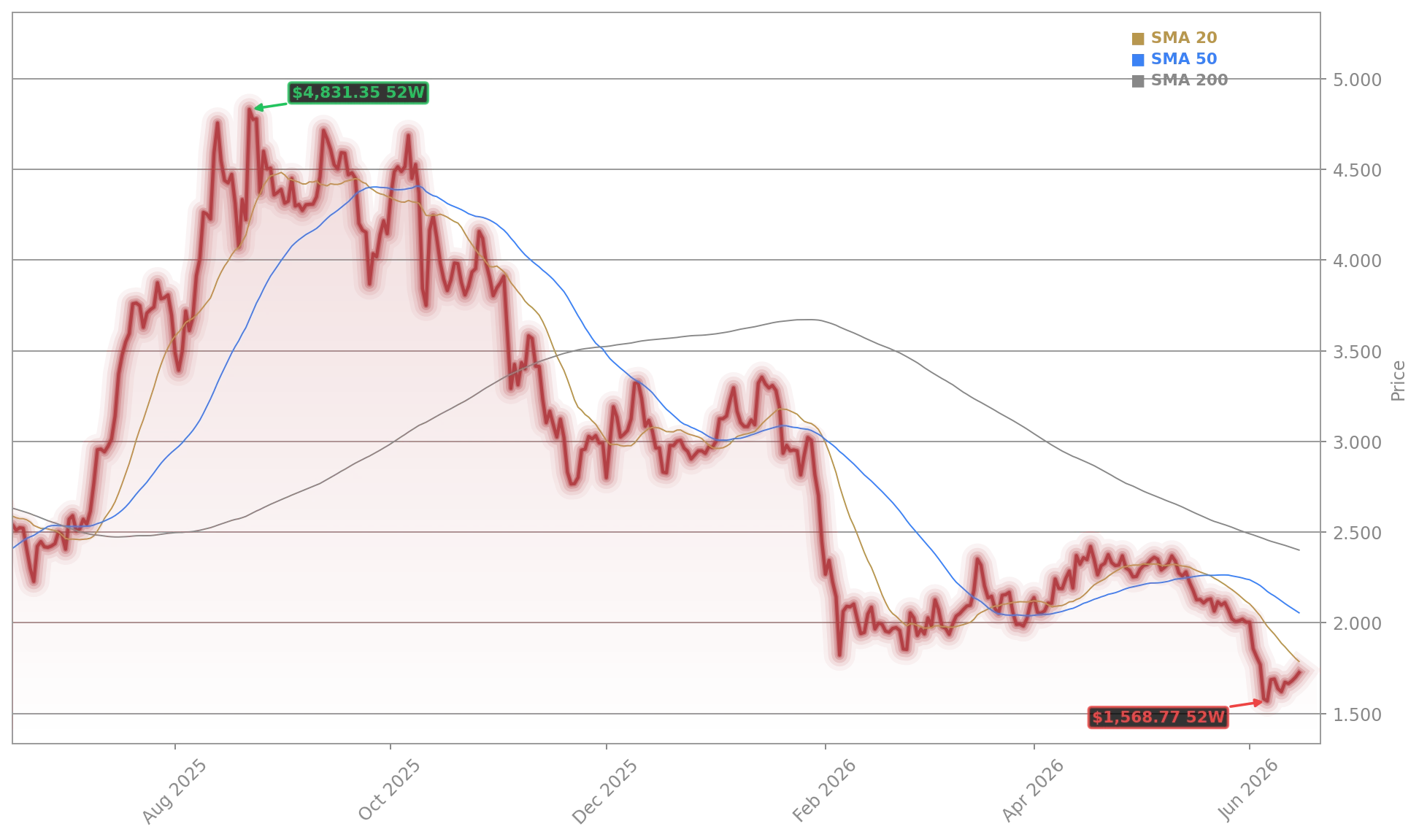
A more constructive Ethereum Forecast starts with market structure stabilizing above support. Traders are watching the $1,800 to $1,750 zone closely after recent warnings that a clean break below $2,000 could open the door to a deeper pullback. Some analysts see a possible retest of this year’s low near $1,823 if buyers fail to reassert control soon.
Yet the longer-term case is not hard to outline. Ethereum remains the leading smart-contract platform, and upcoming protocol work could further improve throughput. Mid-2026 expectations for the Glamsterdam upgrade, including higher gas limits and parallel transaction processing, may strengthen the chain’s appeal for institutional use cases tied to stablecoins and real-world assets.
That matters for investors already watching digital-asset infrastructure plays connected to NVIDIA, Amazon, and Apple through AI, cloud, and payments narratives. Ethereum’s role is different, but the valuation debate is similar: does the market focus too much on current monetization and too little on strategic positioning? Even treasury buyers such as Bit Digital are signaling that some public-market investors still see accumulation value in ETH.
The stock is not the company. And the company is not the stock.— Jeff Bezos
The near-term Ethereum Forecast remains fragile, but the longer-term setup still has credible support. If ETF flows stabilize, support holds, and network upgrades strengthen value capture, Ethereum could shift from a technical laggard back into a core digital-asset holding for diversified US portfolios.