

Why is Bitmine buying more ETH into weakness while much of the market is still heading for the exits?

Why is Bitmine expanding its Ethereum Treasury Strategy?
Bitmine, the largest publicly traded Ethereum holder globally, announced a $52 million ETH purchase last week — bringing its total on-balance-sheet holdings to 5.416 million ETH. That’s more than double the Ethereum reserves held by Grayscale’s ETHE ETF, which reported $1.78 billion in net assets as of Q1 2026 — down 30% from year-end. Crucially, Bitmine filed with the SEC to issue three million shares of a new preferred stock (BMNP) on the NYSE, offering a fixed 9.5% annual dividend. Proceeds will fund additional ETH acquisitions and staking infrastructure — cementing its Ethereum Treasury Strategy as both a balance sheet and capital markets initiative. The timing is stark: while retail investors flee ETH and Bitcoin ETFs saw $1.2 billion in net outflows since May, Bitmine is leveraging equity markets to scale its crypto treasury.
How does Bitmine’s strategy compare to Grayscale and other holders?
Grayscale’s Ethereum Staking ETF (ETHE) reported a $775.6 million net asset decline in Q1 2026 despite earning $10.5 million in staking rewards — a stark reminder that price depreciation overwhelms yield in bearish regimes. Meanwhile, FG Nexus offloaded $17.8 million in ETH as its unrealized losses surpassed $100 million. Bitmine stands in sharp contrast: it’s not only holding, but aggressively acquiring — mirroring the behavior of on-chain ‘whales’ like the ‘7 Siblings’ group, which borrowed $20 million in USDT to buy ETH near $1,760. Standard Chartered reaffirmed its $40,000 ETH price target last week, citing strengthening network fundamentals and Ethereum’s dominance in decentralized finance — a view echoed by Fundstrat’s Tom Lee, Bitmine’s chairman, who recently called Ethereum ‘the Amazon of Web3 infrastructure’.
What does this mean for Wall Street and S&P 500 investors?
For U.S. investors, Bitmine’s Ethereum Treasury Strategy represents a rare, regulated, equity-linked vehicle for pure Ethereum exposure — unlike ETFs that trade at persistent discounts to NAV. Its BMNP preferred shares introduce yield in a high-rate environment, offering a 9.5% cash return while retaining upside to ETH’s token appreciation. This contrasts with traditional tech holdings: NVIDIA’s rally has pulled capital from crypto, but Bitmine’s model bridges both worlds — infrastructure exposure with income. Analysts at RBC Capital Markets note that ‘corporate treasuries holding ETH could become a structural feature of the digital asset ecosystem’, especially as tokenization expands across the $300 trillion securities market — a trend Grayscale highlights as favoring Ethereum, Solana, and Canton Network.
Is Ethereum’s current weakness a buying opportunity?
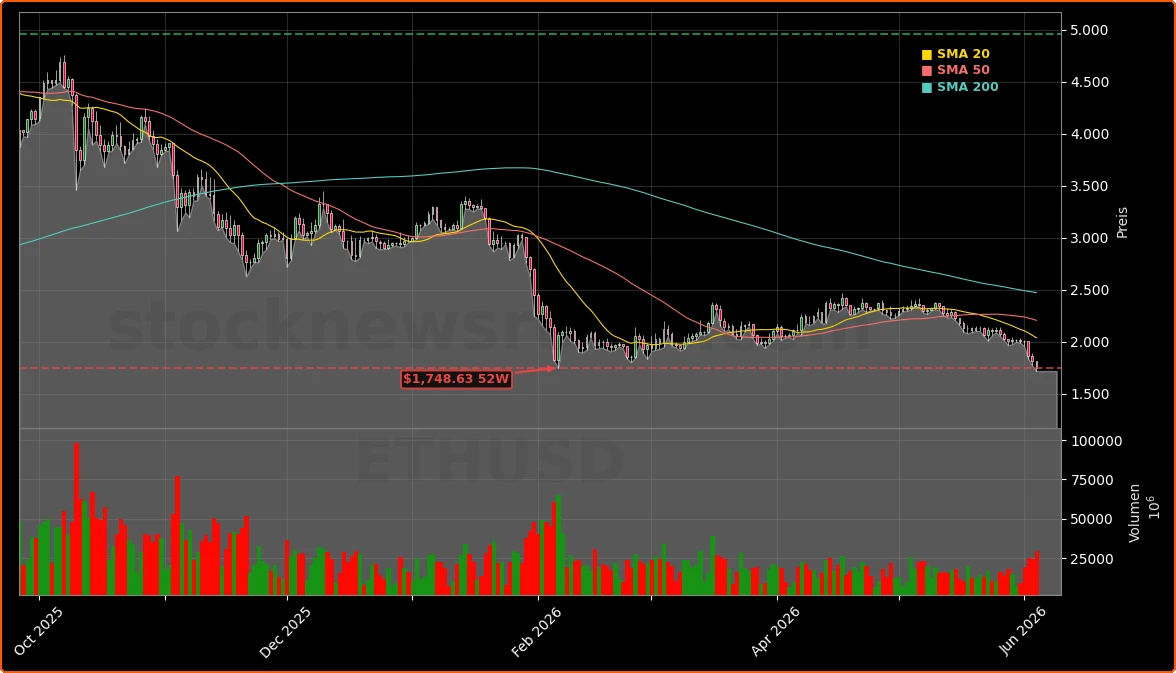
ETH’s drop to 14-week lows — now trading near $1,750 — has triggered oversold conditions on major momentum indicators, according to on-chain analytics. While the broader crypto market suffers from ETF outflows, geopolitical risk, and Fed rate uncertainty, institutional accumulation is accelerating. Bitmine’s latest purchase, combined with the ‘7 Siblings’ buy signal and Grayscale’s observation that ‘hardcore crypto holders’ now use ETFs for margin and estate planning, suggests a maturing market. Bloomberg’s analysis of the Hyperliquid HYPE token rally — which drew $180 million in new ETF inflows while ETH bled — underscores a shift: investors now prioritize revenue-linked utility over narrative. Ethereum’s role in tokenization, DeFi, and institutional-grade smart contracts positions it uniquely for this next phase — a thesis validated by Grayscale’s recent fund rebalancing into Ethereum-linked infrastructure tokens like Ethena (ENA).
What’s next for Bitmine’s Ethereum Treasury Strategy?
With $16 million in remaining purchasing power identified among major ETH buyers and Bitmine’s BMNP preferred shares expected to begin trading mid-June, the next catalyst is capital deployment velocity. If Bitmine executes even half of its planned ETH purchases this quarter, it could absorb over $250 million in selling pressure — a meaningful floor in a $15 billion daily ETH market. Meanwhile, Standard Chartered’s $40,000 target implies 2,200% upside from current levels — a projection grounded in Ethereum’s expanding share of onchain value accrual. For U.S. portfolios, Bitmine’s Ethereum Treasury Strategy isn’t just a crypto bet — it’s a high-conviction infrastructure play with yield, liquidity, and regulatory clarity.
Ethereum is the Amazon of Web3 infrastructure — its market performance has yet to fully reflect underlying network strength.— Tom Lee, Founder of Fundstrat and Chairman of Bitmine
Bitmine’s Ethereum Treasury Strategy remains the most aggressive institutional bet on Ethereum’s long-term value accrual. For U.S. investors seeking exposure to blockchain infrastructure without direct crypto custody, it offers a rare combination of income, growth, and transparency. The next quarterly earnings will confirm whether capital deployment continues at pace — and whether Wall Street begins pricing ETH’s utility, not just its volatility. For long-term portfolios, this is not a retreat — it’s a strategic advance.