
Is the Exxon Mobil Iran Truce narrative just a short-term oil shock or the start of a deeper reset for energy stocks?

Why did Exxon Mobil drop despite a strong market?
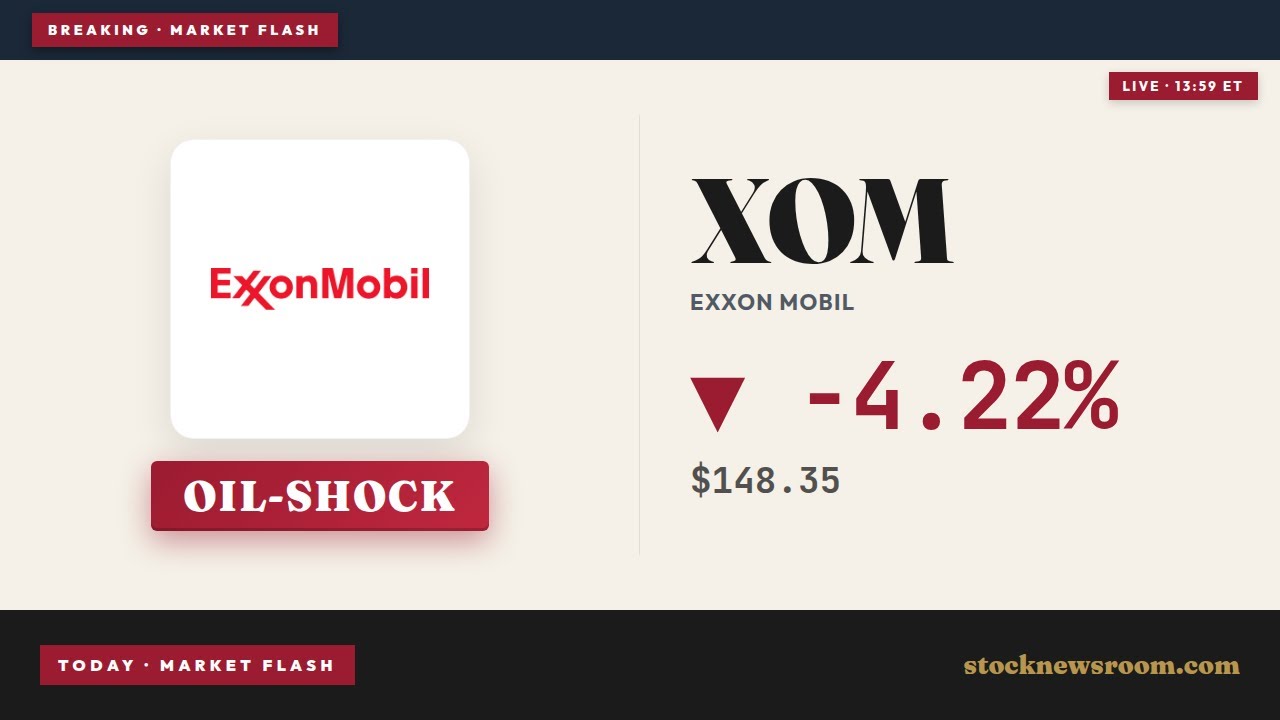
While futures tied to the S&P 500 were modestly higher, Exxon Mobil Corporation sharply underperformed as the Exxon Mobil Iran Truce narrative drove a rotation out of oil. The stock was recently quoted around $148.22, down 4.30% from Tuesday’s close of $154.11, extending a multi‑week slide that has already left Exxon more than 10% below its recent peak. The move reflects how quickly the market is unwinding the war‑premium that had lifted crude above $100 and supercharged integrated oil profits.
Oil itself saw a violent reaction. West Texas Intermediate (WTI) futures slumped roughly 9% intraday to around $92.90 a barrel after reports that Washington and Tehran are close to a one‑page memorandum of understanding that could halt hostilities and reduce threats to shipping through the Strait of Hormuz. For an oil supermajor whose earnings are tightly linked to upstream realizations, such a swift drop in crude translates directly into lower margin expectations and a reset of earnings models on Wall Street.
How is the Exxon Mobil Iran Truce story hitting the energy sector?
The Exxon Mobil Iran Truce narrative is not just an Exxon story; it is a sector‑wide shock. U.S. integrated peer Chevron (CVX) traded lower by roughly 4%, while exploration and production names were hit even harder. APA, Devon Energy, Diamondback Energy and ConocoPhillips all posted declines ranging from about 4% to over 6% as investors discounted a more benign geopolitical backdrop and the prospect of more stable, potentially lower, oil prices.
For Exxon specifically, the timing is painful. Prior to the war escalation, the stock had closed near $150, and war‑driven price spikes had helped deliver outsized profit and free‑cash‑flow generation. A truce now could mean the tailwind from elevated crude evaporates just as global demand growth shows signs of normalizing. That said, the same peace scenario could reduce operational and logistics risks in key supply routes, an offset that longer‑term investors will need to factor into their risk‑reward calculus.

What do fundamentals and dividends tell investors?
Despite the Exxon Mobil Iran Truce overhang, the company’s near‑term fundamentals remain solid. In its most recent quarter, Exxon beat Wall Street’s earnings expectations with adjusted EPS of about $1.16 on revenue of roughly $83.16 billion, underscoring the resilience of its integrated model even as commodity volatility increased. The board also declared a quarterly dividend of $1.03 per share, keeping Exxon firmly positioned as a core income holding for many U.S. portfolios and pension funds.
Institutional appetite has remained broadly constructive. Varma Mutual Pension Insurance Co modestly increased its position to more than 660,000 shares, while Principal Financial Group now holds over 6.5 million shares after slightly boosting its stake. Other asset managers, including AlphaStar Capital Management and FSA Advisors, have also added to positions, suggesting that large investors continue to view pullbacks as opportunities rather than existential threats to the investment case.
On the valuation front, Exxon currently carries a consensus “Moderate Buy” rating among analysts tracked by MarketBeat, with an average price target around $161.70. Royal Bank of Canada has reiterated its “sector perform” rating and set a $180 target, implying double‑digit upside from current levels if oil stabilizes and the company executes on capital returns. For income‑oriented investors comparing Exxon with dividend payers in other sectors such as Apple or NVIDIA, the yield and inflation‑hedging characteristics of an oil major remain a key differentiator.
How are governance and strategy debates evolving at Exxon Mobil?
The Exxon Mobil Iran Truce backdrop is unfolding as the company faces governance questions at home. The New York City Comptroller has urged shareholders to oppose Exxon’s proposed redomiciling to Texas and to back measures designed to expand retail investors’ voting options. The concern is that shifting the legal domicile and implementing an auto‑voting program that defaults retail votes to board recommendations could entrench management and dilute minority shareholder rights under Texas law.
At the same time, Exxon is refreshing parts of its leadership team. The company has appointed Susan Buchanan as Vice President and Chief Accounting Officer, effective July 1, 2026, succeeding Len M. Fox upon his retirement. Buchanan previously led ExxonMobil Global Business Solutions and held senior roles in upstream strategy and business development, experience that could be valuable as the company navigates both decarbonization pressures and a potentially less volatile post‑truce oil market.
What does this mean for U.S. portfolios now?
For diversified U.S. investors, the Exxon Mobil Iran Truce scenario raises immediate tactical questions. If peace progress continues and crude remains under pressure, broad energy exposure in index funds like the S&P 500 could lag high‑growth tech names such as Tesla or NVIDIA, which have driven much of the market’s recent upside. Yet a sudden de‑escalation also removes one of the biggest macro risks hanging over global equities, potentially supporting risk assets overall even as it compresses energy profits.
Short‑term traders may see further volatility in Exxon shares as headlines around negotiations ebb and flow. Longer‑term holders will likely focus on how management adjusts capital spending, buybacks, and its dividend policy to a more normalized price deck in the $70–$90 per barrel range. With institutional ownership above 60% and major firms still describing the name as a core holding, Exxon remains deeply embedded in U.S. retirement accounts and balanced funds despite the latest drawdown.
Related Coverage
Investors looking for a deeper dive into how earnings intersect with geopolitics can review recent analysis on Exxon’s first‑quarter report. The article “Exxon Mobil Earnings Q1 Beat but Profit Shock Deepens” examines how headline profit has fallen to a five‑year low even as war‑driven oil volatility boosted some metrics. Taken together with today’s Exxon Mobil Iran Truce‑driven selloff, it offers a fuller picture of the risk and opportunity facing shareholders in 2026.
In summary, the Exxon Mobil Iran Truce hopes have erased part of the war premium that had propelled both crude prices and Exxon’s stock, triggering a sharp but fundamentally driven pullback. For U.S. investors, the key debate now is whether today’s lower entry point adequately compensates for a future of potentially calmer oil markets and ongoing governance disputes. With solid institutional support, a hefty dividend, and clear sensitivity to geopolitical headlines, Exxon Mobil remains a pivotal energy holding to watch as negotiations in the Middle East evolve.