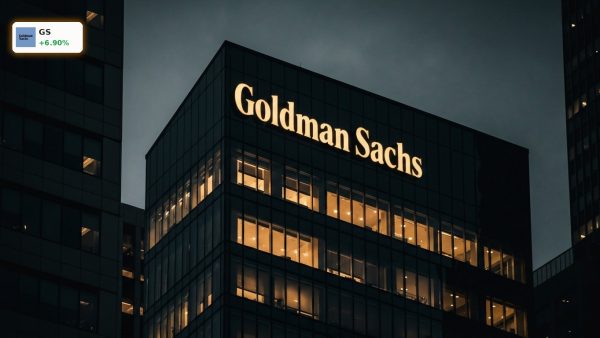
Can Goldman Sachs turn a wave of $60 billion IPO mandates into another breakout year for fees, market share, and shareholder returns?

What’s Driving the Goldman Sachs IPO Boom?
The Goldman Sachs IPO Boom isn’t speculation—it’s structural. As co-lead underwriter for SpaceX’s anticipated $60 billion+ debut, Goldman Sachs Group, Inc. is set to capture outsized fees despite reportedly accepting sub-0.75% underwriting spreads. MarketWatch confirms this deal alone may deliver the largest single payday in banking history. Beyond SpaceX, Goldman Sachs is also positioned to lead OpenAI’s and Anthropic’s planned IPOs—each forecast at $60 billion or more—reinforcing its dominance in high-profile, high-margin mandates. That momentum is already visible: Enliven Therapeutics’ $400 million offering, co-managed by Goldman Sachs & Co. LLC, closed just days ago, adding near-term fee visibility ahead of Q2 results.
How Is M&A Strength Amplifying Goldman Sachs’ Edge?
Goldman Sachs Group, Inc. remains the undisputed global leader in mergers and acquisitions—holding the top spot in league tables for over 20 consecutive years. President John Waldron recently confirmed the M&A market is thriving, with global volume approaching $1 trillion and Goldman Sachs commanding a $300 billion lead. That strength directly boosts Investment Banking Division (IBD) revenue, which surged to $17.23 billion in Q1 2026—the highest quarterly total on record. Crucially, this isn’t cyclical noise: robust nominal GDP growth, strong U.S. employment, and household wealth at an all-time $180 trillion provide durable tailwinds. Competitors like Morgan Stanley and JPMorgan Chase & Co. are active, but Goldman Sachs’ league-table lead and client trust in complex, cross-border deals give it a structural advantage no peer matches.
Is AI Strategy Delivering Real Financial Impact?
Unlike many firms touting AI as a buzzword, Goldman Sachs Group, Inc. is executing across four concrete vectors: AI literacy, software development, process reengineering, and client tooling. The bank recently acquired Innovator, an ETF platform, and Industry Ventures, a venture capital firm—both aligned with AI infrastructure plays. It’s also partnered with T. Rowe Price to embed AI-driven analytics into asset management workflows. This isn’t just about cost-cutting: Goldman Sachs is using AI to accelerate deal execution, improve risk modeling, and deepen client engagement—contributing directly to its near-20% return on equity in Q1. Citigroup analysts note that Goldman Sachs’ AI investments are already yielding measurable efficiency gains in equity capital markets and research operations.
How Does the Goldman Sachs IPO Boom Compare to Broader Market Trends?
The Goldman Sachs IPO Boom is occurring amid a broader resurgence in U.S. equity capital markets. While the S&P 500 and NASDAQ have delivered strong returns in 2026, IPO volume remains concentrated among tech and AI-native firms—exactly Goldman Sachs’ sweet spot. By contrast, traditional financial peers like Morgan Stanley and JPMorgan Chase & Co. are seeing solid but less explosive capital markets growth. Meanwhile, semiconductor leaders like NVIDIA and Apple continue to drive AI infrastructure demand—fueling the very ecosystem that spawns these mega-IPOs. Goldman Sachs’ ability to serve both the capital raisers (SpaceX, OpenAI) and the capital allocators (BlackRock, T. Rowe Price) gives it a unique vantage point across the innovation stack—something no pure-play tech or regional bank replicates.
What’s Next for Goldman Sachs Group, Inc. Shareholders?
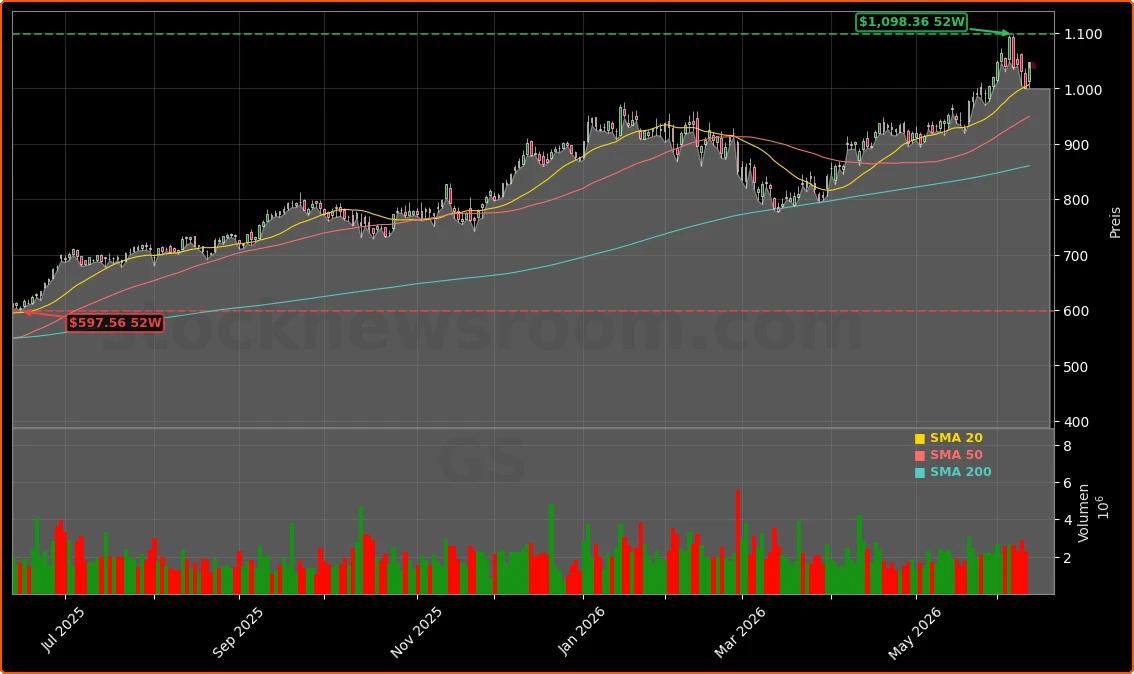
With shares trading at $1047.00—up 1.10% intraday and holding strong above the $1000 support level—Goldman Sachs Group, Inc. is signaling confidence ahead of Q2 earnings on July 14. The stock has rallied nearly 16% in the first half of 2026, outperforming the S&P 500 and the KBW Bank Index. Analysts at RBC Capital Markets recently reaffirmed their ‘Outperform’ rating, citing the bank’s capital return program—$15 billion in dividends and buybacks announced in Q1—as a key catalyst for valuation rerating. The Goldman Sachs IPO Boom is no longer just about fees: it’s about credibility, scale, and sustained strategic execution in a market where trust is the ultimate moat.
Related Coverage: Can the Goldman Sachs SpaceX IPO drive GS stock up 4.95%? Analysts point to fee acceleration and improved investor sentiment as key drivers. Meanwhile, Robinhood IPO underwriting approval highlights how even mid-tier banks are leveraging IPO mandates to boost fee income—though none match Goldman Sachs’ scale in mega-deals. For investors watching the broader capital markets cycle, these developments reinforce that the Goldman Sachs IPO Boom is both real and replicable across multiple high-impact mandates.
The IPO market could see global volume approaching $250–300 billion for the second half of the year.— John Waldron, President of Goldman Sachs Group, Inc.
Goldman Sachs remains Wall Street’s most strategically positioned investment bank. Its leadership in the Goldman Sachs IPO Boom is accelerating revenue, reinforcing market share, and delivering tangible returns to shareholders. The next quarterly earnings report will test whether this momentum sustains across all divisions—and whether AI-driven efficiency gains translate into even higher margins. For investors seeking exposure to the convergence of AI, capital markets, and financial infrastructure, Goldman Sachs Group, Inc. is the definitive proxy.