
Can the Goldman Sachs SpaceX IPO turn one blockbuster deal into a broader rerating for GS shares?

What Does the Goldman Sachs SpaceX IPO Mean for Wall Street?
Goldman Sachs Group, Inc. isn’t just participating in SpaceX’s historic $74.4 billion offering — it’s anchoring it. As lead underwriter alongside Morgan Stanley, Goldman Sachs is positioned to secure fees from what could become the largest IPO in U.S. history. While typical underwriting fees range from 4% to 7%, sources indicate SpaceX is negotiating a sub-0.75% rate — a testament to competitive intensity and the sheer scale of the deal. If underwriters fully exercise their overallotment option, the Goldman Sachs SpaceX IPO could swell to $85.7 billion, injecting an additional $11.25 billion in capital. That scale directly benefits Goldman Sachs’ investment banking revenue — a segment up 18% year-over-year in Q1 2026 — and reinforces its dominance over peers like JPMorgan and Bank of America in marquee tech listings.
How Is AI Reshaping Goldman Sachs’ Core Operations?
CEO David Solomon emphasized in a June 4 interview that AI isn’t replacing bankers — it’s amplifying them. Goldman Sachs has deployed internal AI agents across code generation, compliance review, and equity research, outpacing rivals such as JPMorgan in operational velocity. Unlike many peers, Goldman Sachs has also launched external-facing AI tools for institutional clients, including predictive capital markets analytics. This isn’t theoretical: the bank’s AI-driven trading desk contributed 32% of fixed-income revenues in Q1. Crucially, Solomon told CNBC that ‘there’s plenty of liquidity in the system’ — and ‘more greed than fear’ — to absorb upcoming mega-IPOs, including not just SpaceX but also Alphabet’s equity capital raise. That confidence underscores why investors are pricing GS at 14.2x forward P/E — a premium to the S&P 500 financials sub-index.
Why Is Goldman Sachs Tokenizing Real Estate Now?
Goldman Sachs Group, Inc. has launched its first tokenized real estate fund in partnership with Apex Group, Archax, Ownera, and LRC Group — a move that bridges traditional finance and blockchain-native infrastructure. Unlike experimental crypto funds, this vehicle uses Goldman Sachs’ proprietary blockchain platform to issue regulated, SEC-compliant digital fund units. The fund targets institutional capital seeking liquidity and fractional access to high-barrier commercial real estate — a $10 trillion U.S. market. With the iShares U.S. Financials ETF (IYF) holding GS at 4.87% — its third-largest position — the initiative signals a structural pivot beyond legacy custody models. Notably, this effort arrives as competitors like Blackstone and KKR pursue similar strategies in Japan’s $6.3 billion Sankei Building auction — where Goldman Sachs is also bidding.
How Are Competitors Reacting to Goldman Sachs’ Momentum?
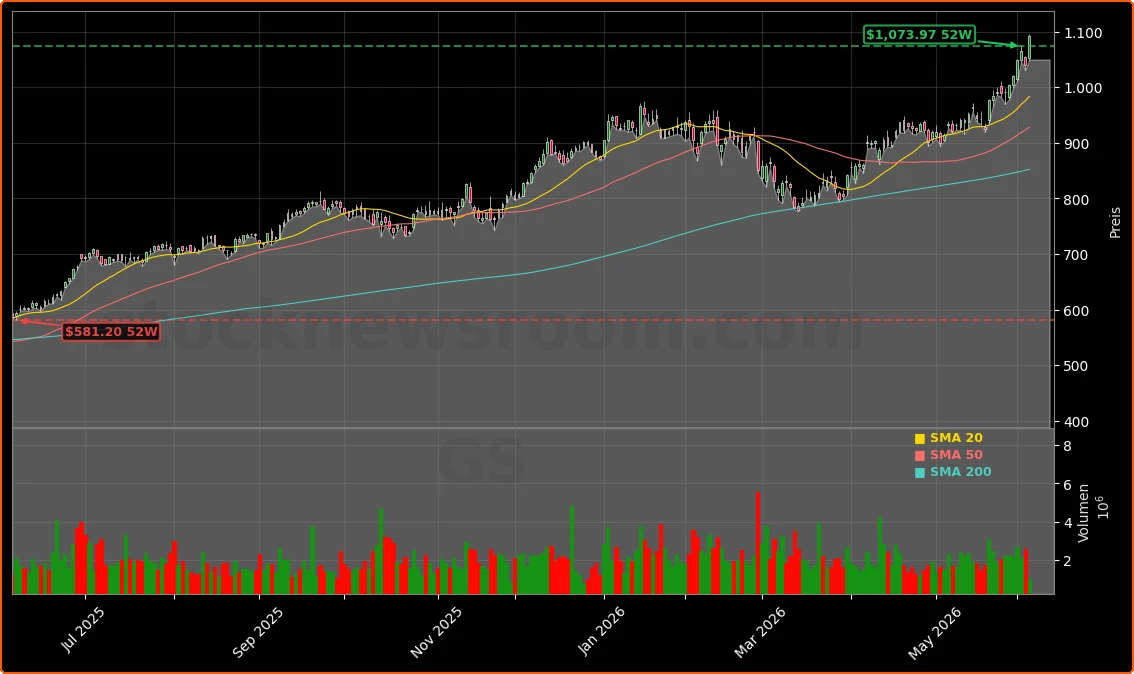
While Goldman Sachs Group, Inc. surges, rivals face headwinds. Wells Fargo’s absence from top-tier IPOs like SpaceX highlights its stalled investment banking growth — a contrast Solomon called ‘telling’ in a recent Odd Lots podcast. Meanwhile, Citigroup recently raised its price target on NVIDIA to $165, citing AI infrastructure demand, while RBC Capital Markets upgraded Tesla to ‘Outperform’ on energy storage synergies with SpaceX’s Starlink power grid ambitions. Even in semiconductors, Goldman Sachs boosted Kioxia Holdings’ price target by 93%, reinforcing its AI hardware thesis. These moves collectively position Goldman Sachs not as a passive intermediary, but as the central nervous system connecting AI compute, space infrastructure, and real-world asset finance — a convergence that’s lifting GS shares 74% over the past 12 months.
What’s Next for Goldman Sachs After the SpaceX IPO?
With SpaceX’s Nasdaq listing imminent, Goldman Sachs Group, Inc. is poised to benefit from multiple second-order effects: inclusion in the Nasdaq 100 and S&P 500 (driving passive inflows), expanded 401(k) eligibility, and heightened demand for its AI-powered capital markets platform. The bank’s upgraded role in Alphabet’s equity raise — combined with its tokenization fund — suggests a deliberate shift toward ‘infrastructure-as-a-service’ for next-generation tech. As Solomon noted, ‘this isn’t just about fees — it’s about owning the rails.’ For U.S. investors, GS is no longer just a bank — it’s a leveraged play on AI, space, and tokenized finance. The Goldman Sachs SpaceX IPO is the first major milestone in that transformation.
There’s plenty of liquidity in the system if the world continues to remain as optimistic. We are definitely in a moment where there’s more greed than there is fear.— David Solomon, Chairman and CEO of Goldman Sachs Group, Inc.
Related Coverage: Can the Goldman Sachs SpaceX IPO role turn Wall Street prestige into a new earnings engine for the bank? Goldman Sachs SpaceX IPO +5.2%: Stock Jumps on Lead Role analyzes how GS’s leadership in the deal is accelerating momentum across its investment banking, asset management, and technology divisions — with Q2 2026 earnings expected to reflect the inflection.