
Can Google Workforce Investment solve the labor bottleneck behind America’s AI buildout before rivals lock up the skilled trades pipeline?

Why Is Alphabet Prioritizing Skilled Trades Now?
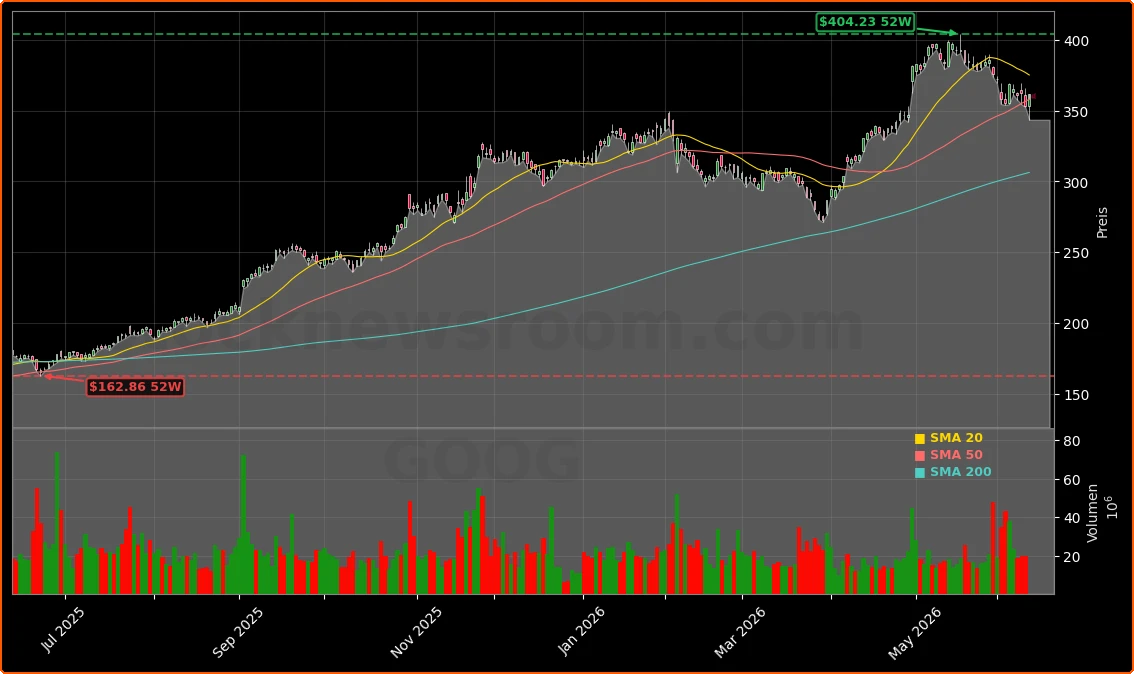
With U.S. data center construction projected to require over 200,000 new skilled laborers by 2027 — per the U.S. Bureau of Labor Statistics — Alphabet’s $50 million Google Workforce Investment is both timely and tactical. The funding will flow through Google.org to labor unions, contractor associations, and trade organizations, including the Electrical Training ALLIANCE and the Manufacturing Institute, both of which have already trained over 80,000 workers in AI-adjacent electrical and manufacturing roles. Unlike corporate upskilling programs targeting software engineers, this initiative addresses the physical layer of AI: the electricians wiring server farms, the welders assembling cooling infrastructure, and the pipefitters installing chilled water systems. For Wall Street, that means Alphabet is de-risking its $30+ billion annual infrastructure spend — a critical factor as Alphabet Inc. (Google) shares trade near their 52-week high and outperform the S&P 500 YTD.
How Does Google Workforce Investment Compare to Meta’s $115M Push?
Meta Platforms, Inc. launched its $115 million America’s Workforce Academy just days before Alphabet’s announcement — targeting data center construction and operations roles in Louisiana, Ohio, Indiana, and Texas. While Meta’s program emphasizes free training and direct employment pathways, Alphabet’s Google Workforce Investment focuses on certification modernization and union-aligned scalability. Crucially, Alphabet’s effort is embedded within a $1 billion+ global skilling commitment since 2022 — giving it deeper infrastructure than Meta’s standalone initiative. That distinction matters to investors: Meta faces margin pressure from its massive capital expenditures, whereas Alphabet’s Google Workforce Investment strengthens its cost-efficient, vertically integrated data center rollout. Analysts at RBC Capital Markets note Alphabet’s infrastructure execution remains best-in-class among the Magnificent Seven — a view reinforced by its 2026 capital allocation guidance and consistent cloud margin expansion.
What’s Behind Google’s Quantum Independence?
Alphabet’s quantum computing division, Google Quantum AI, declined federal funding from the Trump administration’s $2 billion Chips and Science Act quantum initiative — citing restrictive conditions that would have slowed progress toward a functional quantum computer. COO Charina Chou confirmed at the Semafor Tech summit that Google “wants to move as quickly as we can” and that talent mobility — especially for overseas academics — remains constrained by current U.S. visa policy. This stance positions Alphabet in contrast to IBM, which is launching the Anderon quantum foundry with $1 billion in co-investment, and Microsoft, which recently achieved stable qubits using lead-based shielding. For investors, Alphabet’s quantum autonomy signals confidence in its internal R&D cadence — and reinforces why Alphabet Inc. (Google) remains a top AI holding in Ken Griffin’s Citadel portfolio, per Yahoo Finance.
How Is Wall Street Reacting to the Google Workforce Investment?
America’s digital economy relies on our physical infrastructure and the electricians, pipefitters, welders, manufacturing workers & more who build and maintain it.— Sundar Pichai, CEO of Alphabet Inc. (Google)
Alphabet Inc. (GOOG) rose 1.39% to $361.50 on Thursday — outperforming the NASDAQ, which gained just 0.42%. After-hours trading added another 0.60%, signaling institutional interest. Benzinga Edge Stock Rankings place GOOG in the 94th percentile for Quality, citing strong long-term price trends and AI monetization velocity. Meanwhile, NVIDIA and Apple benefit indirectly: Apple relies on Google Cloud and NVIDIA chips for its Siri AI rollout, as noted in a recent Benzinga analysis — creating a virtuous loop where Alphabet’s infrastructure strength lifts both peers. Morgan Stanley maintains its Overweight rating on Alphabet, citing cloud growth acceleration and the strategic value of its AI infrastructure moat — a moat now fortified by the Google Workforce Investment.