Can the Honeywell Spin-off finally erase the conglomerate discount and turn Honeywell into a higher-growth industrial software story?

What Does the Honeywell Spin-off Mean for Wall Street?
The Honeywell Spin-off transforms Honeywell International Inc. from a $130 billion conglomerate into a streamlined, software-driven industrial tech platform. The aerospace unit — historically responsible for ~30% of revenue and a key supplier to Boeing and Airbus — will operate as an independent, publicly traded company. Shareholders of record as of June 15 will receive one share of the new aerospace entity for every share of Honeywell International Inc. held. The separation clears the path for Honeywell Technologies to pursue aggressive capital allocation: $2–4 billion annually for strategic M&A, a 35% dividend payout ratio, and 1% annual share count reduction. Analysts at RBC Capital Markets note the move ‘removes earnings volatility from airline cycle exposure and unlocks valuation upside for the software segment.’
How Will Honeywell Technologies Compete With Tech Giants?
Honeywell Technologies will anchor its growth on Honeywell Forge — its industrial IoT and AI platform now connecting over 324,000 facilities globally, up from under 10,000 at the start of the decade. That scale rivals early-stage deployments by NVIDIA’s AI infrastructure partners and Tesla’s Optimus-aligned manufacturing ecosystems. Morgan Stanley highlights that Honeywell Forge’s recurring software revenue now contributes 28% of total tech segment sales — up from 12% in 2022 — and is targeting 15% annual organic growth. The firm expects software margins to expand to 72% by 2028, narrowing the gap with pure-play SaaS peers. Still, Citigroup cautions that ‘execution risk remains high as Honeywell competes not just with Rockwell and Siemens, but with cloud-native entrants like Microsoft and Amazon in industrial AI.’
What Are the Financial Targets Post-Spin-off?
Honeywell International Inc. has set ambitious post-separation targets: 4–6% organic revenue growth, segment margins of ~24%, and adjusted EPS growth exceeding 10% annually through 2029. Free cash flow is projected to climb above $3 billion by 2029 — up from $2.1 billion in 2025 — enabling both shareholder returns and targeted acquisitions. The aerospace unit, meanwhile, will carry $7.2 billion in debt and operate with an EBITDA margin target of 18–20%, in line with peers like Spirit AeroSystems. Notably, Honeywell’s aerospace business posted a 1% revenue gain in Q2 2026 — outperforming traditional defense contractors — suggesting its standalone valuation could attract strategic bidders or private equity interest.
How Is the Market Pricing the Honeywell Spin-off?
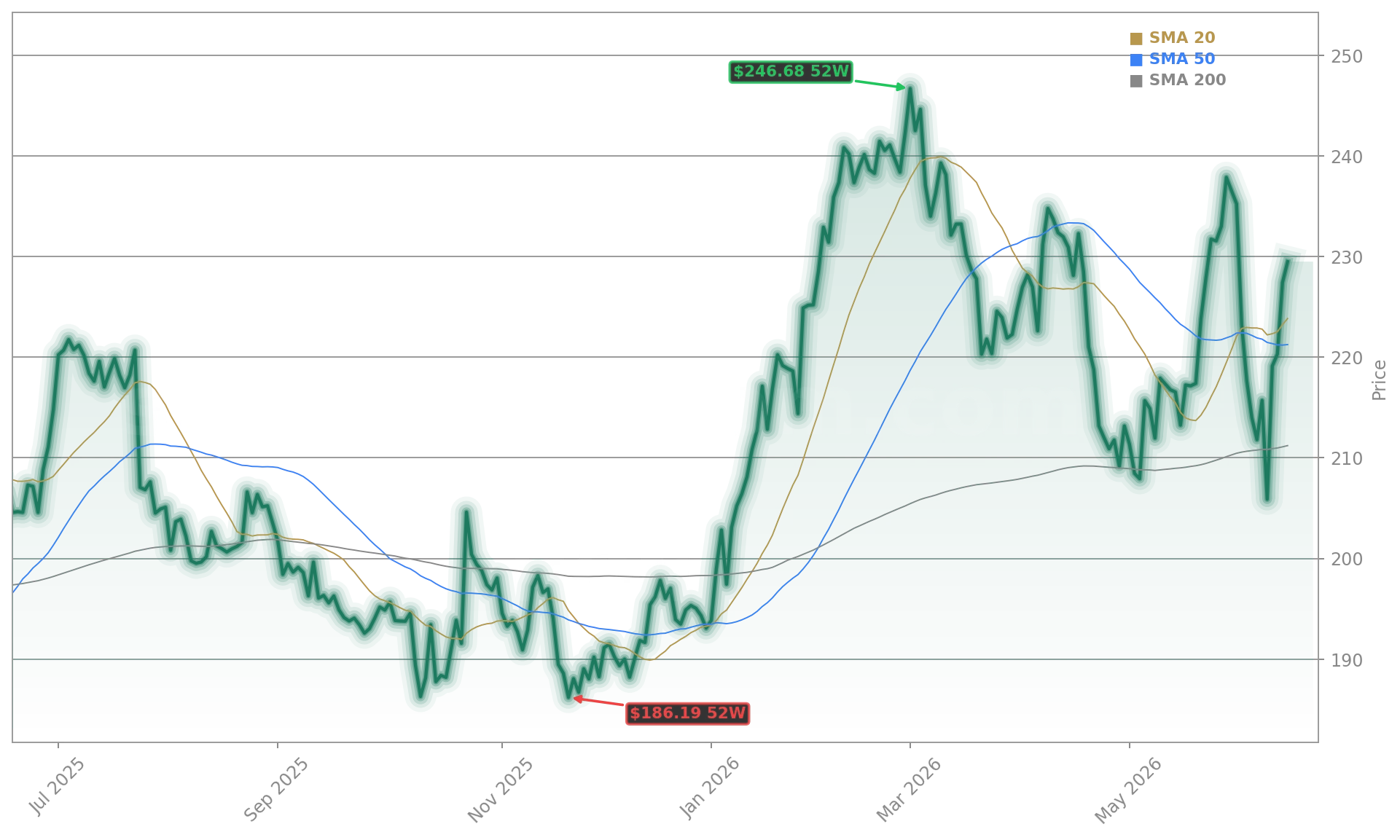
Despite the strategic clarity, Honeywell International Inc. shares trade ~7% below their 52-week high of $247.23 — a gap analysts attribute to lingering conglomerate discount concerns and broader industrial sector rotation. The RSI of 56.4 reflects neutral momentum, not overbought conditions. Bloomberg data shows institutional ownership rose 1.8% in Q1, with new positions from BlackRock and Vanguard indicating long-term confidence. Goldman Sachs recently reiterated its ‘Buy’ rating and raised its 12-month price target to $252, citing ‘accelerating Forge monetization and clean balance sheet flexibility post-spin.’ Meanwhile, the aerospace unit’s implied valuation — based on comparable multiples — suggests a $34–$38 billion market cap at separation, potentially making it the largest pure-play aerospace supplier on the NYSE.
What’s Next for Investors?
This isn’t just a divestiture — it’s a strategic reset that aligns Honeywell with where industrial value creation is happening: at the intersection of hardware, software, and AI.— Darius Adamczyk, Chairman & CEO, Honeywell International Inc.
Investors now face a dual opportunity: assess the standalone merits of Honeywell Technologies’ industrial AI play — and evaluate the aerospace unit’s growth in defense modernization and next-gen propulsion. With the separation complete by June 30, Q2 2026 earnings reports for both entities will be released separately starting in late July. Analysts at J.P. Morgan expect Honeywell Technologies to report Q2 software revenue growth of 19% year-over-year — well above the S&P 500 industrials average of 4.3%. The aerospace unit is forecast to post 7% defense-related revenue growth, buoyed by U.S. Air Force Next Generation Air Dominance (NGAD) contracts. For U.S. portfolios, the Honeywell Spin-off offers exposure to two high-conviction themes: onshoring-driven industrial automation and defense tech acceleration — without conglomerate dilution.