Can Meta’s aggressive AI strategy turn record spending and job cuts into lasting profit growth, or is Wall Street right to worry?

How is Meta’s AI spending hitting Wall Street?
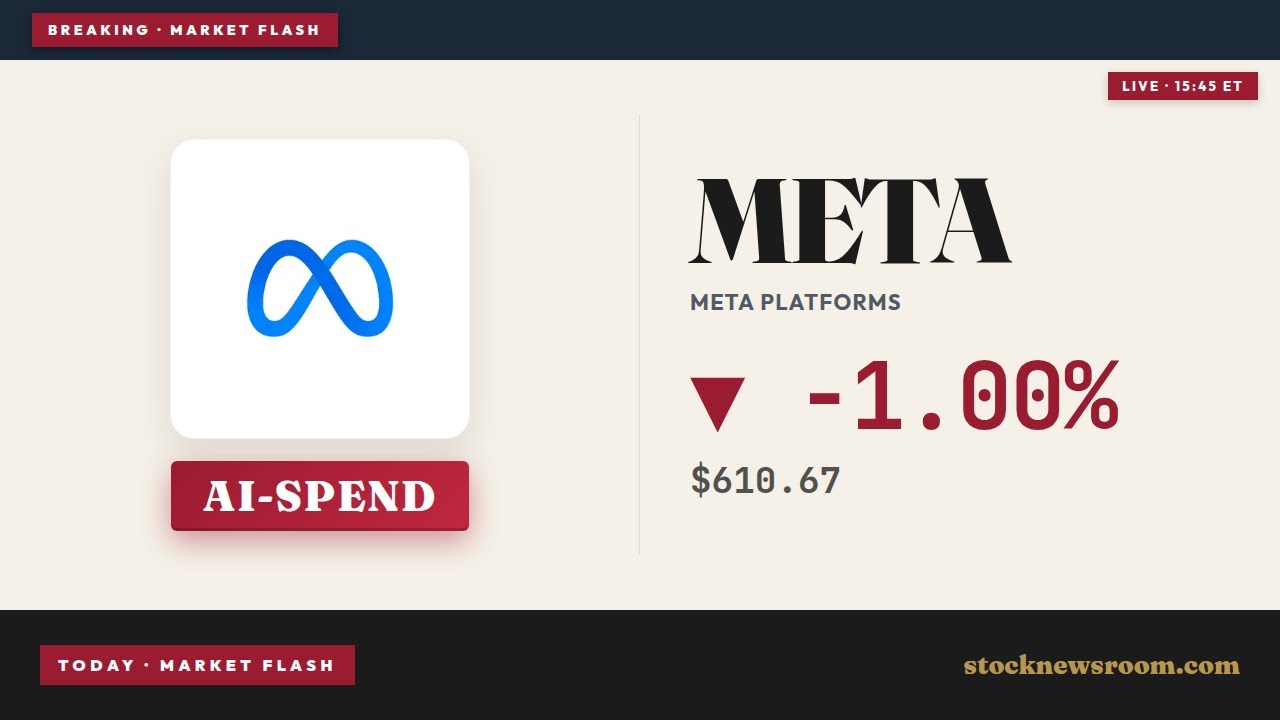
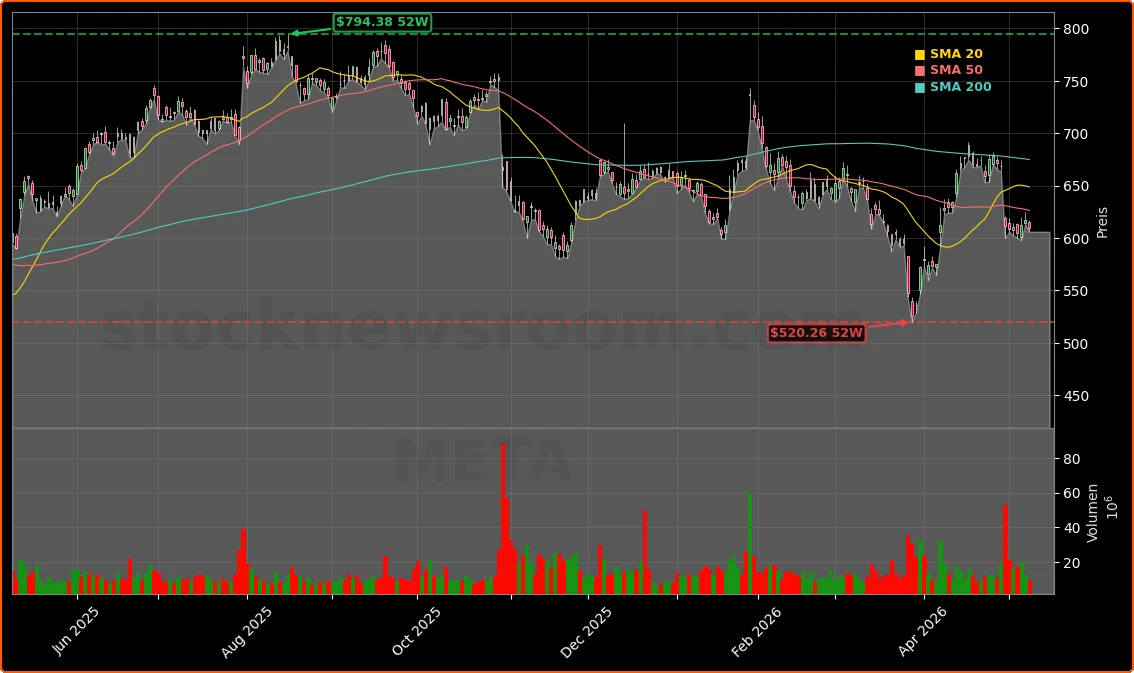
Meta Platforms, Inc. shares changed hands near $610.06 on Friday, about 1.09% below the prior close of $615.70, as traders digested a powerful but controversial mix of strong Q1 results and unprecedented AI spending plans. Communication Services lagged the broader market recently, with Meta slipping on profit-taking after a sharp post-earnings rebound.
In Q1 2026, Meta delivered $56.3 billion in revenue, up 33% year over year, with a robust 41% operating margin and earnings per share of $10.44. That performance keeps Meta firmly in the top tier of the NASDAQ and S&P 500 growth names, even as investors debate whether the Meta AI Strategy can justify the coming cash flow squeeze. Across hyperscalers, the combined free cash flow of Meta, Amazon, Alphabet, and Microsoft is projected to drop to roughly $4 billion in Q3, down from an average of about $45 billion per quarter since the pandemic, as AI capex explodes.
For U.S. portfolios heavily weighted to mega-cap tech, this shift means less near-term cash for buybacks and potential dividends, and more capital locked into data centers, GPUs and specialized chips. The key question is whether Meta’s AI-first pivot will continue to translate into higher ad revenue and engagement at a pace that compensates for thinner near-term free cash flow.
What defines the Meta AI Strategy now?
The Meta AI Strategy is increasingly about embedding artificial intelligence across the company’s entire ecosystem rather than chasing a single blockbuster app. Management has spent the past year pouring tens of billions into AI infrastructure, large language models and recommendation systems that touch Facebook, Instagram, WhatsApp and its core ad platform.
That investment is already visible in the operating metrics. Ad impressions climbed 19% year over year in Q1, while the average price per ad rose 12%. That combination indicates Meta is not merely showing more ads; it is delivering more effective ads that advertisers are willing to pay up for. With roughly 3.6 billion daily users, Meta can no longer rely on user growth as its primary driver, so extracting more value per user through AI-driven relevance has become central to the Meta AI Strategy.
Mark Zuckerberg has also highlighted AI as a force multiplier for productivity, noting cases where “one or two people are building something in a week that would have previously taken dozens of people months.” That philosophy underpins the company’s readiness to invest heavily in compute, even as it keeps a tight rein on headcount and operating expenses.
How do job cuts fit into Meta’s AI plan?
On the Q1 2026 call, CFO Susan Li signaled that Meta will reduce its workforce in May, with roughly 8,000 jobs at risk. She framed the move explicitly as a way to “offset the substantial investments we are making” in AI-related capex. Meta ended Q1 with about 77,900 employees, already 1% lower than at the end of Q4 2025, and the new cuts will take that efficiency drive further.
Across Silicon Valley, Meta is one of several tech names tying layoffs directly to AI adoption. Management argues that a leaner organization can move faster, especially when AI tools make individual teams more productive. Still, for employees and policymakers, this is an early, visible example of AI displacing certain types of work even as companies like Meta insist that “people will be more important in the future, not less.”
For shareholders, the message is clearer: when 8,000 roles are described as a line item in an AI infrastructure budget, capital is being reallocated from headcount to data centers, accelerators and specialized cloud deals. Meta has already added a $107 billion step-up in contractual cloud and infrastructure commitments in a single quarter, underscoring the scale of that trade-off.
Is Meta overspending on AI infrastructure?
Meta’s 2026 capital expenditure guidance now stands at an eye-watering $125 billion to $145 billion, much of it earmarked for AI data centers and hardware. Estimates suggest its AI capex is running at four to five times its total human compensation costs. Even if Meta hypothetically eliminated its entire workforce, it would only save around $27 billion in payroll—far short of the infrastructure tab it is willing to pay to stay competitive in AI.
The Meta AI Strategy relies on securing enough cutting-edge compute and networking to keep pace with rivals like NVIDIA, which is increasingly central to AI accelerators, and cloud partners such as Amazon and Microsoft. Meta has struck a five-year, multibillion-dollar capacity deal built on a large-scale deployment of Nvidia’s Vera Rubin platform and signed a $6 billion fiber-optic supply agreement with Corning through 2030 to wire its AI data centers. It is also expected to leverage Amazon’s Graviton chips for certain “agentic AI” workloads, aligning its infrastructure roadmap with that of another hyperscale player.
This aggressive approach is not limited to back-end compute. Through Reality Labs, Meta is betting that AI glasses and smart devices can open new consumer categories. Reality Labs lost $4.03 billion in Q1 2026, yet products like Ray-Ban Meta smart glasses have become early category leaders, with Luxottica reportedly doubling production targets to 20 million pairs by the end of 2026 and sales tripling in 2025. These losses are effectively bundled into the broader Meta AI Strategy as long-dated options on new platforms.
How does Meta stack up against Big Tech rivals?
Compared with Alphabet, Amazon, Microsoft and Apple, Meta is positioning itself as the “quiet category leader” in social AI and AI-enhanced consumer hardware, rather than as the top cloud platform. Alphabet is winning praise on Wall Street for its more obviously successful AI rollouts, while Amazon is transforming AWS into an AI component supplier, even selling in-house chips that Meta is expected to use. Microsoft, for its part, remains the leading enterprise AI distributor, leveraging OpenAI integrations across Office and Azure.
Meta’s edge lies in its unmatched social graph and engagement scale, which provide a real-time feedback loop for testing recommendation models, ad-targeting algorithms and creator tools. Every incremental improvement in those systems enhances user stickiness and advertiser ROI, feeding directly into revenue. That flywheel effect is a core pillar of the Meta AI Strategy and difficult for younger AI platforms to replicate.
Analysts at major Wall Street banks remain divided over how much upside this strategy leaves for the stock at roughly 20 times forward earnings. Some, such as Goldman Sachs and Morgan Stanley, have highlighted Meta’s operating leverage and ad momentum as reasons to stay constructive, even as they warn of capex-driven free cash flow compression. Others, including more cautious voices at firms like Citigroup and RBC Capital Markets, emphasize regulatory risks, Reality Labs losses and the possibility that AI capex could overshoot actual returns if demand normalizes.
What should investors watch next?
For U.S. investors, the near-term focus is on whether Meta can sustain double-digit ad pricing growth while keeping engagement high in its core apps. Any slowdown in impressions or pricing could quickly raise questions about whether the Meta AI Strategy is delivering enough incremental revenue to cover its mounting capital bills.
At the same time, regulators in Washington and Brussels are scrutinizing Meta’s data practices, potential stablecoin integrations using USDC for creator payouts, and its push into AI agents that could one day help run parts of the platform. Those efforts could unlock new monetization avenues but also bring fresh oversight and compliance costs.
Competition for chips and power remains another constraint. Foundry giant TSMC has flagged the need for elevated capex to keep up with AI demand from customers like Meta and NVIDIA, while networking supplier Arista Networks relies heavily on orders from hyperscalers such as Meta and Microsoft. Any delays or supply bottlenecks at those key vendors could slow Meta’s rollout plans and affect the timing of returns from its AI investments.
Related Coverage
Investors who want a deeper dive into how Wall Street initially reacted to Meta’s spending plans should read Meta Earnings -8.6% Shock as AI Capex Plan Backfires, which analyzes the stock’s sharp pullback after Meta unveiled its aggressive AI capex roadmap. That piece explores whether the market overreacted to the near-term hit to free cash flow or correctly priced in the execution risks embedded in the Meta AI Strategy.
We are seeing more and more examples where one or two people are building something in a week that would have previously taken dozens of people months.— Mark Zuckerberg, CEO of Meta Platforms, Inc.
The Meta AI Strategy is rapidly transforming the company from a social media giant into a capital-intensive AI infrastructure player, with massive data centers and smart devices at its core. For investors, the trade-off is clear: less immediate cash generation in exchange for a potentially wider moat in advertising, hardware and next-generation AI services. The next few quarters will show whether Meta can keep turning AI investments into revenue and profit growth, making the stock a compelling long-term holding for growth-focused portfolios.