Can blockbuster Meta Earnings still excite Wall Street when an aggressive new AI spending wave threatens to crush near-term cash flow?

How did Meta Earnings move the stock?
Meta Platforms, Inc. (Meta) reported Q1 2026 results after the close with headline numbers that looked impressive on paper. Revenue climbed 33% year over year to $56.31 billion, topping expectations of roughly $55.5 billion. Adjusted earnings per share came in at $7.31 once a one‑time $8.03 billion tax benefit is stripped out, still well ahead of analyst estimates around $6.8. Net income jumped 61% to $26.8 billion including that benefit.
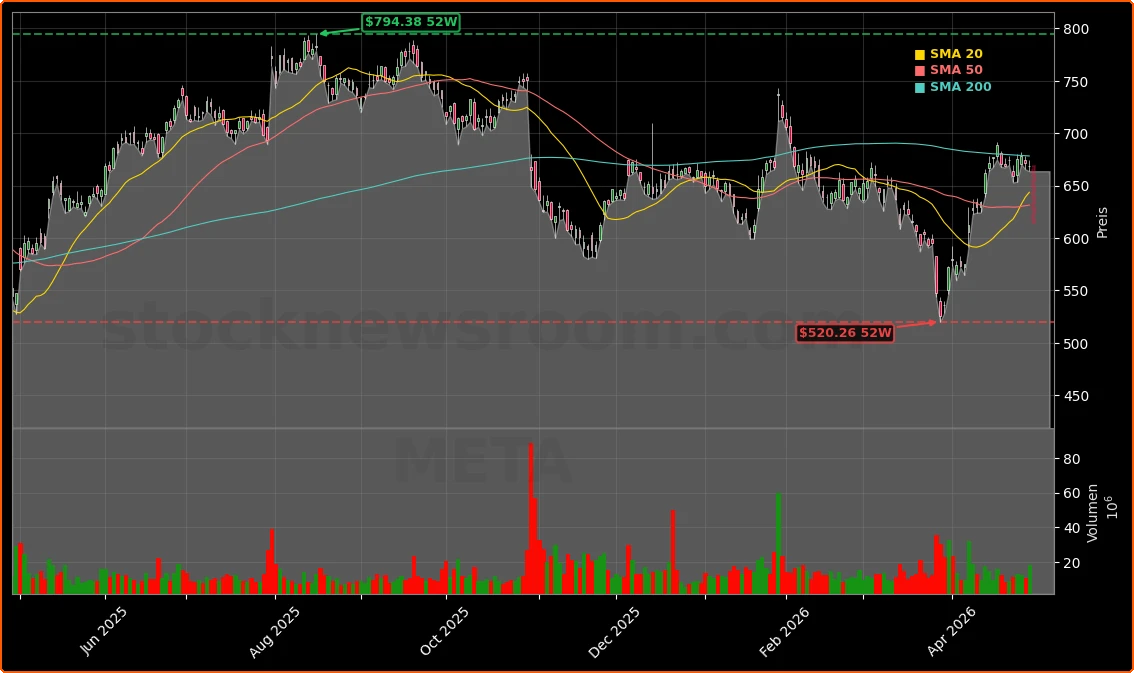
Despite this, the stock reaction has been brutal. Meta closed Wednesday at $669.12, only fractionally lower on the day, but slid more than 7% in the immediate post‑close session and now trades around $614.07 in early New York trading, down about 8.2% before the opening bell. That makes Meta one of the biggest weights on Nasdaq 100 futures and a notable drag within the S&P 500 tech complex. The shock is not about what Meta just earned, but about how much it plans to spend to chase the next leg of AI growth.
Why did Meta boost AI capex so aggressively?
The key message in the Meta Earnings call was another giant step‑up in investment. Management raised its 2026 capital expenditure forecast, including finance leases, to a range of $125 billion to $145 billion, versus a prior outlook of $115 billion to $135 billion. For comparison, Meta spent about $72.2 billion on capex in 2025, so the company is effectively on track to almost double that figure in a single year.
Chief Financial Officer Susan Li said the higher guide reflects sharply rising component prices, especially for memory chips, and additional data center builds to support future AI capacity. She acknowledged that Meta has “continued to underestimate our compute needs” even as it rapidly adds infrastructure. Meta is even extending the useful life of some non‑AI servers to seven years to bridge a “significant server supply deficit” caused by global shortages of DRAM and hard drives.
All of this intensifies investor anxiety about free cash flow. The company paused share repurchases in the quarter, after buying back nearly $13 billion of stock last year, and several portfolio managers now worry about the risk of at least a temporary negative cash flow profile if capex pushes toward the top of the new range.
Is Meta’s AI strategy paying off like Alphabet and Microsoft?
On the positive side, the Meta Earnings release shows that AI is clearly helping the core ad engine. Ad impressions across Meta’s apps rose 19% year over year, while the average price per ad increased 12%, a combination that suggests AI‑driven targeting and recommendation algorithms are working. Family of Apps operating income reached $26.9 billion with a robust 41% margin, cementing Meta’s role as one of the most profitable advertising platforms globally.
However, compared with rivals, the payoff picture is mixed. Alphabet’s Google is already seeing visible AI‑related revenue traction in both search and cloud, while Microsoft monetizes AI through its Azure platform and Copilot subscriptions. Meta remains heavily dependent on advertising, lacks a large enterprise cloud business, and its AI products—such as the Meta AI assistant and generative tools inside Facebook, Instagram and WhatsApp—are mostly embedded features rather than standalone services.
Analysts at Bernstein, led by Mark Shmulik, still rate the stock “outperform” with a $900 price target, calling Meta one of the “cleanest” AI monetization stories because investments feed directly into measurable ad uplift. But others, including strategists at BNP Paribas, highlight Meta’s concentration risk and its single‑ecosystem bet, especially as competitors like NVIDIA and hyperscalers diversify across chips, infrastructure and software layers.
What do users, Reality Labs and jobs tell investors?
Under the surface of the Meta Earnings headlines, several operational metrics raised eyebrows. Daily active people across Meta’s family of apps reached 3.56 billion, up 4% from a year ago but down slightly from 3.58 billion in the prior quarter and below expectations of roughly 3.62 billion. Management blamed temporary disruptions in Iran and restrictions on WhatsApp in Russia, yet markets are sensitive to any sign that user growth is flattening at these massive scales.
Reality Labs, Meta’s AR/VR and metaverse unit, remains a substantial drag. The division posted an operating loss of about $4 billion for the quarter and is still expected to lose roughly that amount every three months. Combined with AI infrastructure, these losses reinforce the sense that Meta is running multiple long‑dated experiments at once. At the same time, the company plans to cut around 8,000 roles and leave about 6,000 open positions unfilled, trimming roughly 10% of its workforce to help offset rising costs.
For long‑only U.S. investors, the question is whether the still‑powerful ad franchise can comfortably fund both AI supercomputing ambitions and metaverse R&D without eroding shareholder returns.
How does Meta compare inside Big Tech portfolios?
The latest Meta Earnings report lands in the middle of a pivotal week for Big Tech. Alphabet, Microsoft and Amazon all posted strong numbers, and together with Meta they are expected to steer roughly $650 billion of AI infrastructure spend this year. Yet only Meta is signaling such a concentrated, ecosystem‑centric bet with capex rising almost twice as fast as revenue.
Some investors argue that Meta’s open‑source AI strategy, deep partnerships with chipmakers and experimental energy deals—such as a new agreement with Overview Energy to explore space‑based solar power for data centers—could ultimately reinforce its moat. Others point to insider share sales, including recent transactions by Chief Operating Officer Javier Olivan, and the lack of a sizable enterprise cloud business as signs that risk is skewed to the downside in the near term.
In diversified tech portfolios that also hold Apple, Tesla and other megacaps, Meta is increasingly viewed as the most cyclical and sentiment‑driven AI exposure: a powerful cash generator, but with a thinner margin for error on capex execution.
Related Coverage
Regulatory pressure is another important layer on top of Meta Earnings. Investors following the stock should also read Meta Child Safety Warning as EU Targets Under‑13 Users, which explores how the European Union’s Digital Services Act investigation into youth protections on Facebook and Instagram could force costly safety upgrades or even lead to fines of up to 6% of global revenue. Taken together with soaring AI infrastructure costs, that piece helps frame the full risk‑reward picture facing Meta over the next 12 to 24 months.
We have continued to underestimate our compute needs even as we have been ramping capacity significantly.— Susan Li, Meta Chief Financial Officer
In summary, the latest Meta Earnings underscore a company firing on all cylinders today while betting unprecedented sums on tomorrow’s AI infrastructure. For U.S. investors, the stock now hinges less on ad growth—which remains strong—and more on whether Mark Zuckerberg can prove that $125–$145 billion of annual capex will ultimately compound into durable free cash flow. The next few quarters of Meta Earnings and guidance will be critical in showing if this AI gamble can justify the volatility now hitting the share price.