

Can Meta Cloud turn Meta’s massive AI spending from a Wall Street worry into its next major profit engine?

What Does Meta Cloud Mean for Wall Street?
Meta Cloud represents more than a cloud services extension — it’s a structural response to investor skepticism over Meta’s AI spending trajectory. With capital expenditures projected between $125 billion and $145 billion for 2026 — up $10 billion from prior guidance — the company is now betting that overbuilt infrastructure can become a profit center, not a cost burden. Unlike traditional cloud providers, Meta Cloud will offer two parallel paths: access to proprietary AI models like Muse Spark (similar to Amazon Web Services’ Bedrock) and raw GPU compute capacity, competing directly with neocloud firms such as CoreWeave and Nebius. The initiative is led by Santosh Janardhan (Head of Infrastructure), Daniel Gross (Meta Superintelligence Labs), and President Dina Powell McCormick — signaling top-tier operational commitment. Crucially, CEO Mark Zuckerberg confirmed the strategy at Meta’s May shareholder meeting, stating, ‘It’s definitely on the table… almost every week, companies ask us to stand up an API service or buy our compute at a premium.’ This isn’t speculation — it’s execution.
How Is Meta Cloud Reshaping AI Infrastructure Competition?
The ripple effects hit instantly and broadly. Within minutes of Bloomberg’s report, CoreWeave plunged 13.21% to $86.39, Nebius dropped 16.13% to $231.62, and IREN fell 6.67%. Why? Because Meta Cloud introduces a hyperscaler with unparalleled scale, balance-sheet strength, and vertically integrated AI stack — features no neocloud can match. While NVIDIA powers the chips and Tesla explores AI-driven autonomy, Meta is uniquely positioned to bundle infrastructure, models, and developer tools under one roof. Goldman Sachs’ 1-Delta desk has warned for months that ‘the market’s central premise has been that compute is scarce’ — and Meta’s admission of excess capacity directly undermines that thesis. That pressure is now flowing upstream: shares of chipmakers and memory suppliers dipped alongside the Nasdaq’s 0.8% intraday decline, as investors reassess near-term CapEx sustainability.
Does Meta Cloud Reduce Reliance on Advertising?
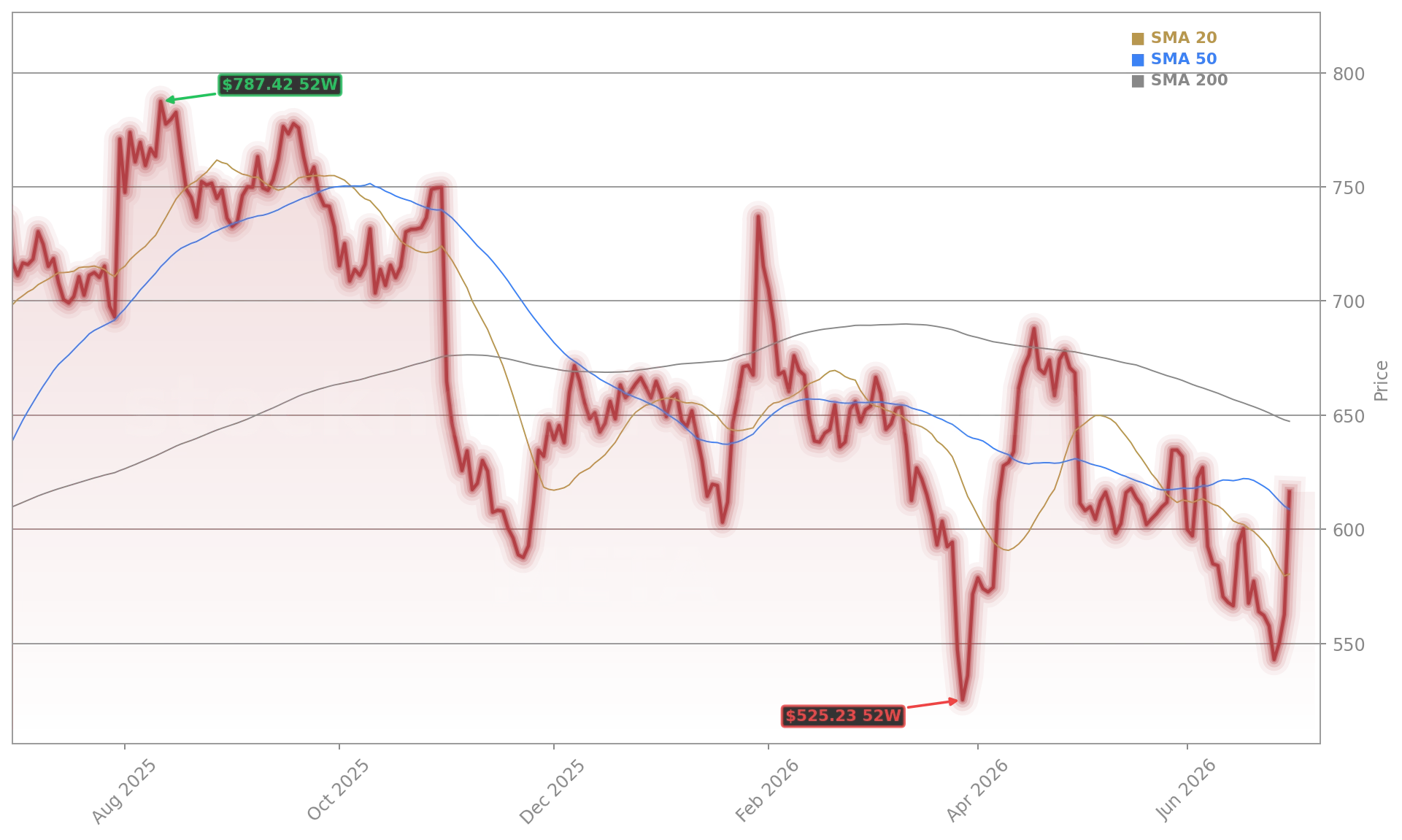
Absolutely — and that’s why analysts are taking notice. With over 97% of revenue still tied to digital advertising, Meta’s earnings remain vulnerable to macro shifts and regulatory headwinds. Meta Cloud offers a path toward enterprise revenue — high-margin, recurring, and diversified. Morgan Stanley analysts recently reiterated their ‘Overweight’ rating on Meta, citing ‘increasing optionality in AI monetization’ as a key upside catalyst. Meanwhile, Citigroup raised its price target to $840.60, highlighting ‘the strategic value of Meta Cloud in a $100B+ global AI infrastructure market.’ For S&P 500 investors, this matters: Meta’s 4.1% weight in the index means any acceleration in non-ad revenue could lift the entire tech-heavy benchmark. And with Meta’s shares up 11.09% over four consecutive days — its strongest streak since May — the market is pricing in execution, not just ambition.
How Does Meta Cloud Compare to Rivals?
It’s definitely on the table… almost every week, companies ask us to stand up an API service or buy our compute at a premium.— Mark Zuckerberg, CEO of Meta Platforms, Inc.
Meta Cloud isn’t replicating Amazon Web Services or Microsoft Azure — it’s augmenting them. Where AWS and Azure prioritize general-purpose cloud and broad enterprise integration, Meta Cloud is laser-focused on AI-native workloads: model inference, fine-tuning, and distributed training. Its Muse Spark models are already deployed across Meta’s product suite, and external developers could soon access them via API — with pricing likely tied to tokenized usage, as Zuckerberg hinted. That approach mirrors Apple’s tightly controlled ecosystem, but at hyperscale. Alphabet’s Google Cloud, meanwhile, faces headwinds: it recently restricted Meta’s access to Gemini models due to compute constraints — a sharp irony now that Meta is building its own commercial AI infrastructure. For investors comparing cloud exposures, Meta Cloud adds a new, high-conviction name to the AI infrastructure basket alongside NVIDIA and Microsoft — one with zero legacy cloud debt and pure AI focus.