
Is Micron’s HBM-fueled AI supercycle just taking a breather, or is this sharp pullback the first crack in the memory boom?

How is Micron trading in early Friday action?
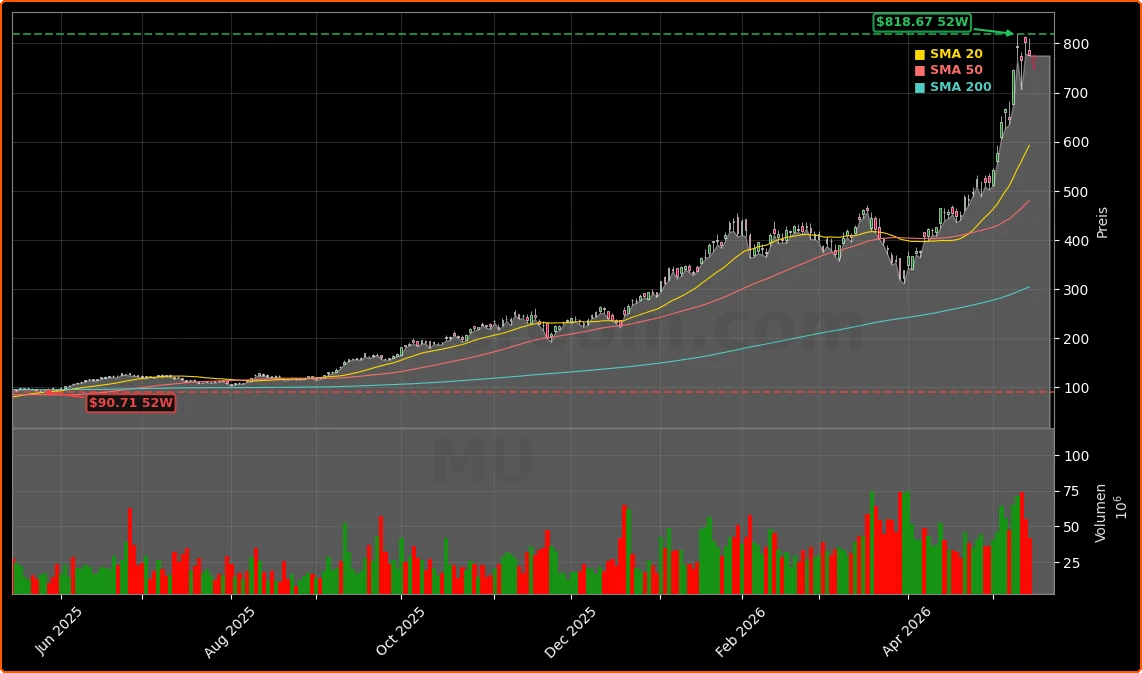
Micron (MU) closed Thursday on the Nasdaq at $776.01, down 3.44% on the day, and is indicated another 3.5% lower pre‑market around $748.71. At times overnight, the stock fell toward $700 before dip buyers stepped in, briefly pushing it back close to the $800 mark. The pullback comes after Micron recently crossed $800 for the first time and lifted its market value above $900 billion, putting it among the most valuable chipmakers in the world alongside NVIDIA.
Technically, the stock remains overheated. Over the past twelve months, MU has gained roughly 674%, far outpacing the Nasdaq and S&P 500. The 52‑week range on European venues runs from about EUR 80 to just under EUR 700, leaving the current price only modestly below its recent peak. A relative strength index around 77 flags overbought territory, which helps explain why any hint of weakness in the memory trade is triggering profit‑taking.
What is driving the Micron HBM Boom?
The Micron HBM Boom is rooted in a structural shift in AI infrastructure demand rather than a typical short memory upcycle. Together with Samsung and SK Hynix, Micron effectively dominates the HBM market, a critical component for training and running large AI models on accelerators from NVIDIA and others. Industry commentary shows “memory pricing” being mentioned hundreds of times in recent earnings calls across hyperscalers and data‑center players, underscoring how central HBM and DRAM availability have become.
Micron’s HBM capacity is essentially sold out through at least 2026, with supply constraints expected to persist into 2027 and possibly 2028. That backdrop has supercharged fundamentals: in its fiscal Q2 2026, Micron generated nearly $24 billion in revenue, roughly triple the prior‑year period’s $8+ billion. For fiscal Q3, management is guiding to about $33.5 billion in sales and a striking gross margin near 81%, numbers that place Micron among the most profitable large companies globally on a forward basis.
How does Micron fit into the AI build‑out?
Wall Street increasingly views Micron as the “second phase” of the AI build‑out. The first phase was all about compute — GPUs and custom accelerators — led by names like NVIDIA. The second phase is about feeding those chips with enough high‑bandwidth, low‑latency memory to keep them running at full utilization. CEO Sanjay Mehrotra has framed memory as a strategic AI asset, essential to reducing the cost per token for large language models and enabling real‑time inference at scale.
Beyond HBM, Micron is pushing cutting‑edge DRAM for mainstream servers. The company recently began sampling 256GB DDR5 RDIMM modules built on 1‑gamma DRAM technology, offering up to 40% performance gains and better power efficiency for AI and high‑performance computing systems. These 3D‑stacked modules, with speeds up to 9,200 MT/s, aim to support rapidly growing model sizes and emerging “agentic AI” workloads that put even more stress on memory bandwidth and capacity.
Are investors rotating out of memory winners?
The latest sell‑off is not isolated to Micron. Korean memory producers have also come under pressure, and traders report a broader rotation out of pure memory plays after a blistering run. The DRAM‑focused ETF DRAM has soared about 96% since its April 2 launch, a signal of how crowded the trade has become. Some portfolio managers are redeploying profits into other AI infrastructure names like Marvell or storage peers such as Western Digital, whose shares have been more muted despite the same macro tailwinds.
Still, the Micron HBM Boom narrative remains intact: supply is tight, pricing power is strong, and hyperscaler capex on AI data centers is projected to climb from roughly $600 billion toward $700 billion in the coming years. That spending supports not only HBM but also NAND flash and enterprise SSDs, where Micron competes directly with Western Digital and other NAND specialists.
What are analysts and Wall Street watching next?
Major investment banks like Citigroup, Morgan Stanley, and Goldman Sachs have recently highlighted Micron as a prime beneficiary of the AI memory cycle, with several firms raising price targets and talking about a long‑term re‑rating of the stock. While exact targets vary, the consensus remains firmly bullish, even as strategists warn that memory has historically been one of the most cyclical segments in semiconductors.
Key debates now center on how long the Micron HBM Boom can defy that cyclicality. Bulls argue that AI represents a structural shift, with agentic AI, edge inference, and next‑generation data centers creating multi‑year visibility. Bears counter that today’s extraordinary margins and utilization levels effectively “pull forward” future profits, making the stock vulnerable if AI spending normalizes or competitors add capacity faster than expected.
For U.S. investors, position sizing and entry timing are front of mind. After a 90% rally in just one month highlighted by several Wall Street outlets, some traders are looking down the market‑cap spectrum to smaller AI infrastructure names that have outpaced even Micron’s meteoric gains. Others are using the current weakness to scale into MU on the thesis that it will remain a core component supplier to giants like NVIDIA, Apple, and Tesla as they build out AI capabilities.
Related coverage on Micron’s AI supercycle
For a deeper dive into how AI demand is transforming Micron from a historically cyclical memory maker into a potential long‑term AI infrastructure champion, readers can explore this detailed analysis of Micron’s AI demand, record boom and margin outlook. That piece walks through the company’s latest guidance, profitability trajectory, and what it could mean for valuation as the AI build‑out enters its next phase.
In summary, the Micron HBM Boom has propelled the company into the top tier of global chipmakers, even as the stock now grapples with overbought signals and a bout of profit‑taking. For investors, the key question is whether today’s pullback marks the start of a deeper consolidation or a chance to buy a structurally stronger memory leader at a discount. The next quarters of AI data‑center spending and Micron’s HBM ramp will determine whether this boom can turn into a durable, multi‑year growth story.