
Is the Micron AI Memory Boom entering a new supercycle or has the market finally pushed this AI winner too far, too fast?

Is Micron’s AI rally finally overheating?
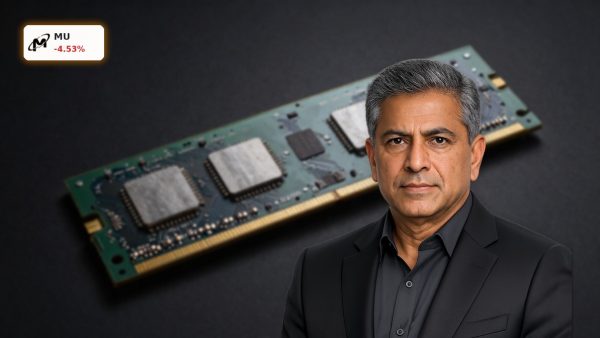
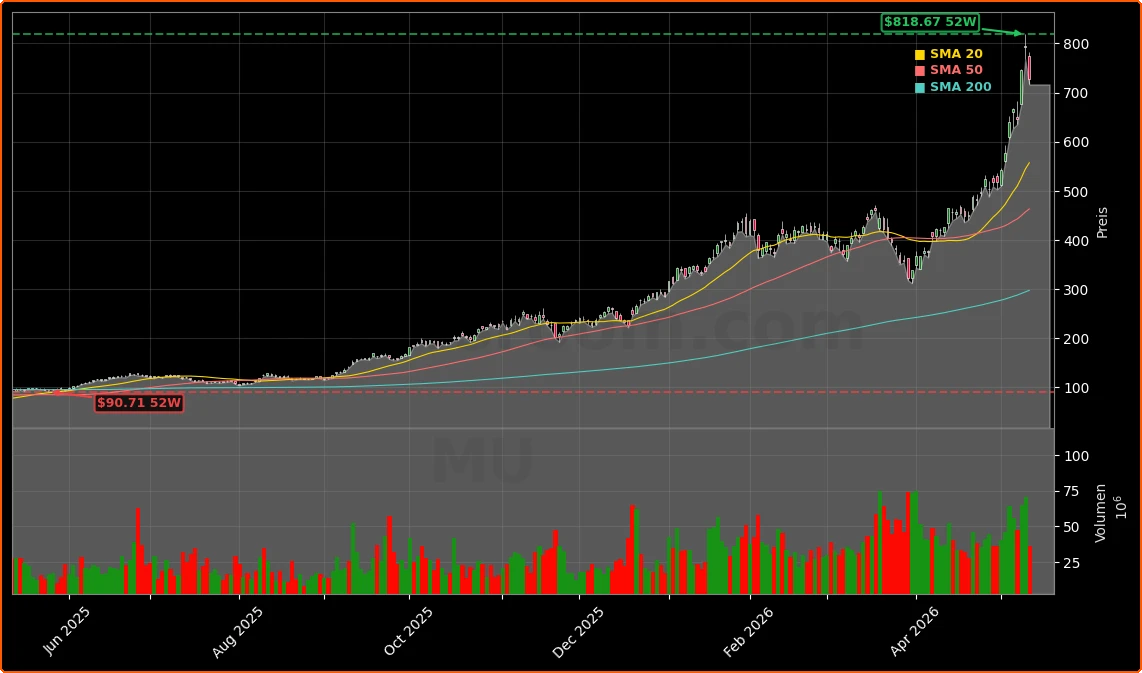
MU’s slide on Tuesday comes after a period of parabolic gains in which the stock repeatedly printed new highs while the broader S&P 500 moved sideways. Over the last year Micron’s market value has vaulted past $800 billion as data‑center operators scrambled to secure scarce high‑bandwidth memory (HBM) for AI accelerators from NVIDIA and other chipmakers. The move has been so extreme that some chart watchers compare Micron’s trajectory with the infamous Volkswagen short squeeze, pointing to a high‑volume doji and subsequent break lower as signals of a potential top.
The immediate trigger for today’s weakness is not a collapse in fundamentals but a shift in sentiment. A proposal from a senior South Korean official to tax AI companies and fund a “national dividend” rattled memory stocks globally, even though Micron does not manufacture in Korea. The episode has reminded investors that governments may seek a larger share of AI profits, adding policy risk to an already cyclical industry.
How strong is Micron’s AI memory supercycle?
Fundamentally, the Micron AI Memory Boom remains underpinned by a historic supply‑demand imbalance. Contract prices for standard DRAM are reported to be jumping as much as 63% in Q2 2026 after a 90%‑plus surge in the prior quarter, while DRAM, NAND flash and HBM all show supply gaps of roughly 5%—the tightest conditions since 2011. Micron’s management argues that new fabs in Taiwan, Singapore and the U.S. will not add meaningful capacity until fiscal 2028, and has lifted annual capex guidance to more than $25 billion to meet demand.
At the high end of the market, Micron is rapidly scaling next‑generation HBM4, with mass production underway and plans to ramp to about 15,000 wafers per month. These premium chips command significantly higher margins than commodity DRAM. Recent quarterly results back up the story: revenue surged to nearly $24 billion and crushed Wall Street estimates, and consensus now calls for an “explosive” earnings ramp over the current fiscal year as AI deployments proliferate across hyperscalers like Apple’s cloud partners, Microsoft and Meta Platforms.
What are analysts saying about Micron now?
Despite the volatility, Wall Street remains broadly constructive on the Micron AI Memory Boom. The Globe and Mail highlights that D.A. Davidson has reiterated a Buy rating on Micron with a bold $1,000 price target, underscoring confidence that AI‑driven memory demand can sustain elevated pricing and margins over several years. Other research houses point to Micron’s seemingly modest valuation versus growth: shares trade at roughly 14x estimated fiscal 2026 earnings and around 8x next year’s profits, levels that would be considered inexpensive for a company with this kind of top‑line and EPS momentum.
Broader industry data support that optimism. The VanEck Semiconductor ETF recently hit an all‑time high, propelled in part by Micron and AMD, while the Roundhill Memory ETF (DRAM) has doubled year‑to‑date on the back of an “AI memory supercycle” featuring HBM and NAND providers like Micron, SanDisk and Western Digital. At the same time, some macro‑focused investors, such as Jordi Visser of 22V Research, have started rotating away from Micron into later‑cycle plays in power, chemicals and silver, arguing that the market is moving from chip shortages to physical infrastructure bottlenecks.
How does Micron compare with other AI chip leaders?
The Micron AI Memory Boom is part of a wider AI infrastructure rush that has also sent NVIDIA, Tesla and storage peers soaring. SanDisk’s spin‑off has produced more than 4,000% gains in just 15 months, outpacing even NVIDIA’s nine‑year run, as NAND pricing tightens. Western Digital, another key memory player, has notched an all‑time high near $490 on strong AI‑related storage demand and a dividend hike. Micron is now a top‑traded name alongside these leaders on major broker platforms, reflecting its central role in AI data centers.
Yet the memory business remains structurally more cyclical than the GPU or software layers of the stack. Building new DRAM and HBM fabs takes years and tens of billions of dollars, but once capacity is installed, producers are incentivized to run at full tilt. History shows what happens when demand normalizes: the 2018‑2019 downturn saw Micron’s stock fall about 57%, while the 2014‑2016 crash cut the share price by roughly 70%. The 2022‑2023 memory bust led to record losses and a 10% workforce reduction before the current rebound.
What are the key risks for investors?
Three main risks now loom over the Micron AI Memory Boom. First, synchronized capex: Micron, SK Hynix and Samsung Electronics are all pouring capital into new HBM and DRAM lines, raising the risk of oversupply within two to three years if AI spending slows. Second, policy and tax uncertainty: the Korean “AI dividend” discussion may not directly hit Micron today, but similar ideas could spread to countries where the company operates, including China or the U.S. Third, positioning and technicals: Micron’s relative strength index recently hovered near 78—deeply overbought territory—and some traders openly target a pullback toward $600 to fill a gap and reset sentiment.
Countering those risks, Micron continues to roll out products designed specifically for AI and high‑performance computing. The company has begun sampling a 256GB DDR5 RDIMM built on its 1‑gamma node and advanced 3D stacking with through‑silicon vias, delivering up to 9,200 MT/s while cutting power use by over 40% versus two 128GB modules. That kind of density and efficiency is crucial for data‑center operators looking to manage the rising power and cost footprint of AI servers.
Related Coverage
Investors who want to dive deeper into Micron’s parabolic move and the underlying AI memory dynamics can read the detailed analysis in “Micron Record +15.5% Surge: Is the AI Memory Boom Just Starting?”. That piece explores whether Micron’s latest vertical spike marks the beginning of a lasting supercycle or just another peak ahead of the next memory downturn, and complements today’s focus on the emerging risks.
The Micron AI Memory Boom has propelled the stock into the top tier of global chip leaders, but today’s drop underlines that policy headlines and cycle fears can quickly shake even the strongest narratives. For U.S. investors, Micron remains a high‑beta way to play AI infrastructure—with valuation still reasonable, but volatility and downside risk rising as capacity expands. The next quarters of hyperscaler capex updates and Micron product ramps will determine whether this AI memory boom continues to reward dip buyers or morphs into the start of a classic semiconductor correction.