Is the latest Micron Record rally a sustainable AI memory supercycle or just another euphoric spike in semiconductor stocks?

Is Micron Technology redefining AI market leadership?
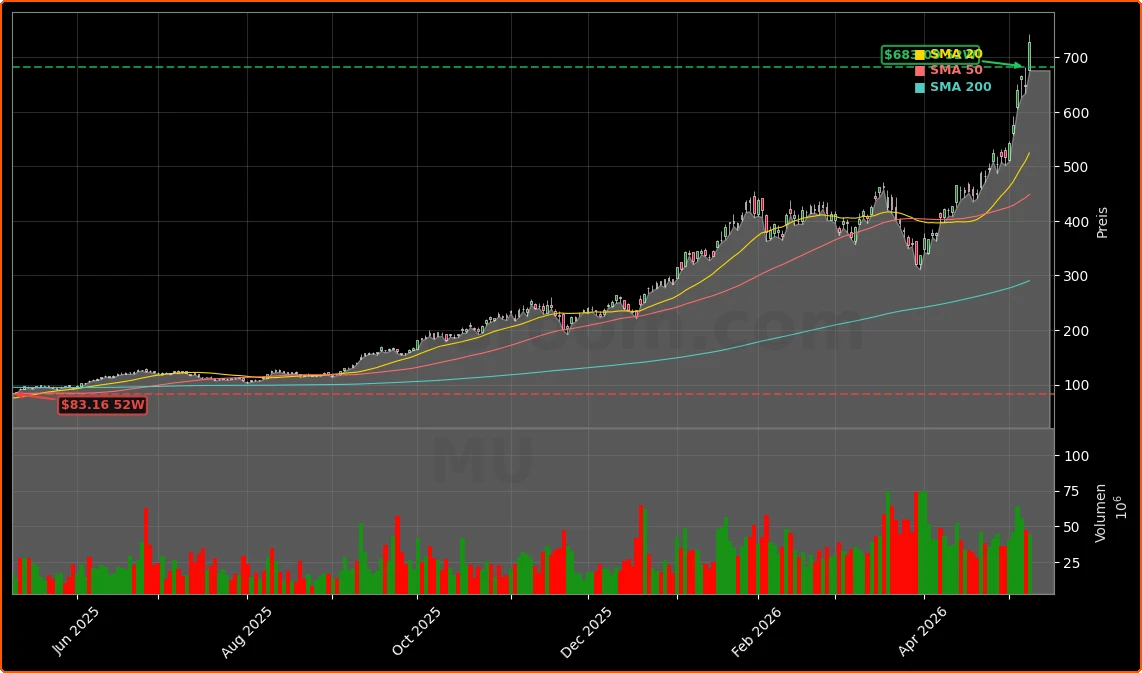
At around $728 in late-Friday trading, Micron (MU) is up more than 12% on the day and has added over 30% this week, extending a multi-month parabolic rally. The stock has notched dozens of intraday highs in 2026 and now trades near its latest Micron Record zone, fueled by relentless demand for high-bandwidth memory (HBM), DRAM, and NAND used in AI accelerators and data centers. With the PHLX Semiconductor Index massively outperforming the S&P 500 and Nasdaq 100, Micron has emerged as one of the core AI hardware winners alongside NVIDIA, AMD, and Taiwan Semiconductor.
Fundamentals have kept pace with the share-price explosion. In its fiscal Q2 2026, Micron generated roughly $23.9 billion in revenue, a 196% year-over-year increase and its fourth consecutive quarterly revenue record. Earnings per share ramped nearly eightfold to about $12.20, with guidance pointing to roughly $19.15 per share in the current quarter as pricing power and utilization remain strong across AI memory products.
How strong is AI memory demand for Micron?
Micron’s bull case hinges on a structural shortage in advanced memory tied directly to AI infrastructure. DRAM prices jumped about 57% in April versus Q1 averages, while NAND prices climbed 65%–70%, reflecting tight supply as hyperscalers race to build GPU clusters. Micron’s Cloud Memory Business Unit has become a key profit engine, recently delivering $5.28 billion in revenue at a hefty 66% gross margin.
Crucially for long-term visibility, Micron has already sold out its entire HBM4 supply for 2026 under binding contracts, and customers are now signing three- to five-year agreements instead of the traditional quarterly or annual deals. That shift reduces the historic boom-bust pattern in memory and helps support the current Micron Record run. Gartner forecasts that industrywide spending on memory chips could nearly triple from $216 billion to $633 billion by 2026, positioning Micron and rivals like SanDisk and Western Digital as central beneficiaries of AI-driven storage and compute demand.
What are analysts and institutions signaling?
On Wall Street, sentiment remains overwhelmingly positive even as the stock outruns many models. Bernstein has highlighted both the upside from elevated DRAM and NAND pricing and the near-term risk that some OEMs and module houses may cut back on purchases as spot prices spike. Bernstein previously carried a $510 price target and a Buy rating on Micron, and investors widely expect a target hike if the current earnings trajectory holds.
Other institutions are leaning in as well. Zacks Investment Research recently highlighted Micron as a Zacks Rank #1 (Strong Buy) with a top-tier Growth Score, grouping it with other large-cap growth names that have beaten expectations in the current earnings season. Mizuho has also raised price targets on Micron, Western Digital, and SanDisk, citing strong AI tailwinds across high-bandwidth memory, enterprise NAND, and high-capacity drives. Despite the rally, Micron trades at roughly 6–11 times forward earnings depending on the model used, a discount to many AI peers such as NVIDIA and Marvell, which carry far richer multiples.
Does insider selling undermine the Micron Record rally?
Amid the euphoria, some caution flags have appeared. Micron’s CEO Sanjay Mehrotra recently sold about $21.5 million worth of stock, part of a broader wave of insider selling seen in several semiconductor names after large runs. While insider transactions don’t automatically signal a top, they do remind traders that management is aware of how far and how fast valuations have moved.
At the same time, institutional demand remains robust. Large mutual funds have been accumulating leading semiconductor and AI infrastructure names, with Micron, Broadcom, and others benefiting from portfolio rotation into high-growth technology. Networking players have also called out Micron as a critical supplier; for example, Extreme Networks’ management has emphasized secure component supply from partners like Micron and Broadcom through at least 2027, underscoring how deeply embedded Micron’s products are in next-generation networking gear.
How does Micron compare with other AI leaders?
For U.S. investors, Micron now sits alongside NVIDIA, Apple, and other mega-cap tech names as a core way to play AI infrastructure, but with a different risk-reward profile. While Nvidia remains the dominant GPU vendor and has briefly flirted with a $5 trillion market-cap narrative, Micron’s story is more about memory capacity, bandwidth, and storage—critical complements to GPU compute rather than direct competition. Micron’s valuation multiple is far below those of front-line AI chip designers, yet its earnings and revenue growth rates are, for now, comparably explosive.
Volatility remains a key risk. Memory has historically been the most cyclical corner of semis, and any slowdown in hyperscaler capex or a normalization in DRAM and NAND pricing could hit results quickly. Still, order books reportedly stretch into 2027, suggesting the current Micron Record phase may be more sustained than prior cycles. For diversified U.S. portfolios, Micron now behaves less like a traditional cyclical and more like a high-beta AI infrastructure pure play.
Related Coverage
Investors looking for more context on Micron’s sharp swings can read Micron AI Memory Boom: -3% Plunge or New Record Rally?, which analyzes whether the latest pullbacks are mere noise or early warning signs in the broader AI memory supercycle. That piece dives deeper into technical levels, short-term sentiment, and how traders are positioning around each new Micron Record break.
Micron’s surge to another Micron Record underscores how central AI memory has become to the current Wall Street cycle, offering U.S. investors both outsized upside and elevated volatility. The stock’s combination of explosive earnings growth, relatively modest forward valuation, and multi-year AI contracts keeps the long-term bull case intact, and the next few quarters of capex and pricing data will show whether this Micron Record phase can translate into durable leadership in the S&P 500 and Nasdaq 100.