
Is the Micron China Trip a catalyst for the next AI memory leg higher or a warning shot on geopolitical risk?

How is Micron trading after the latest swing?
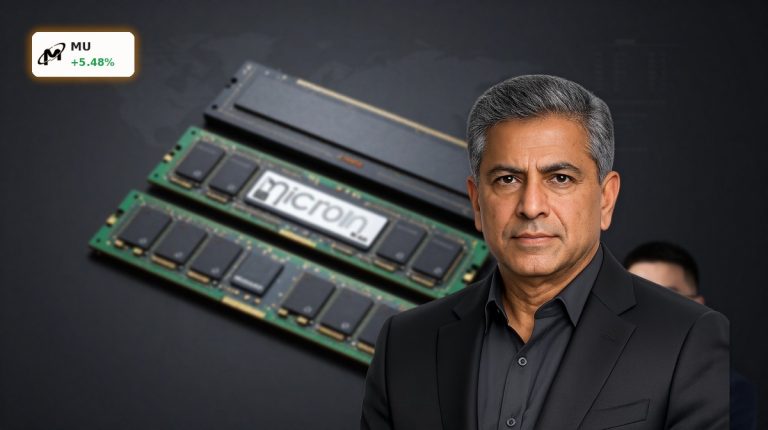
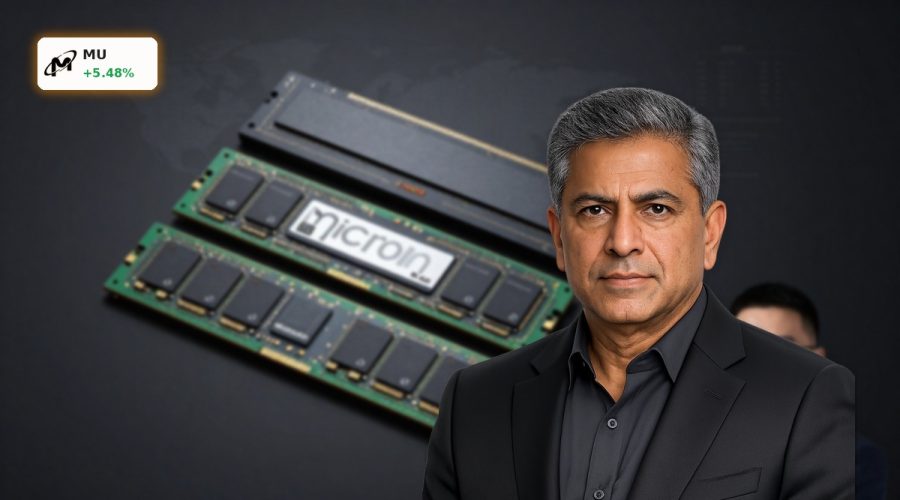
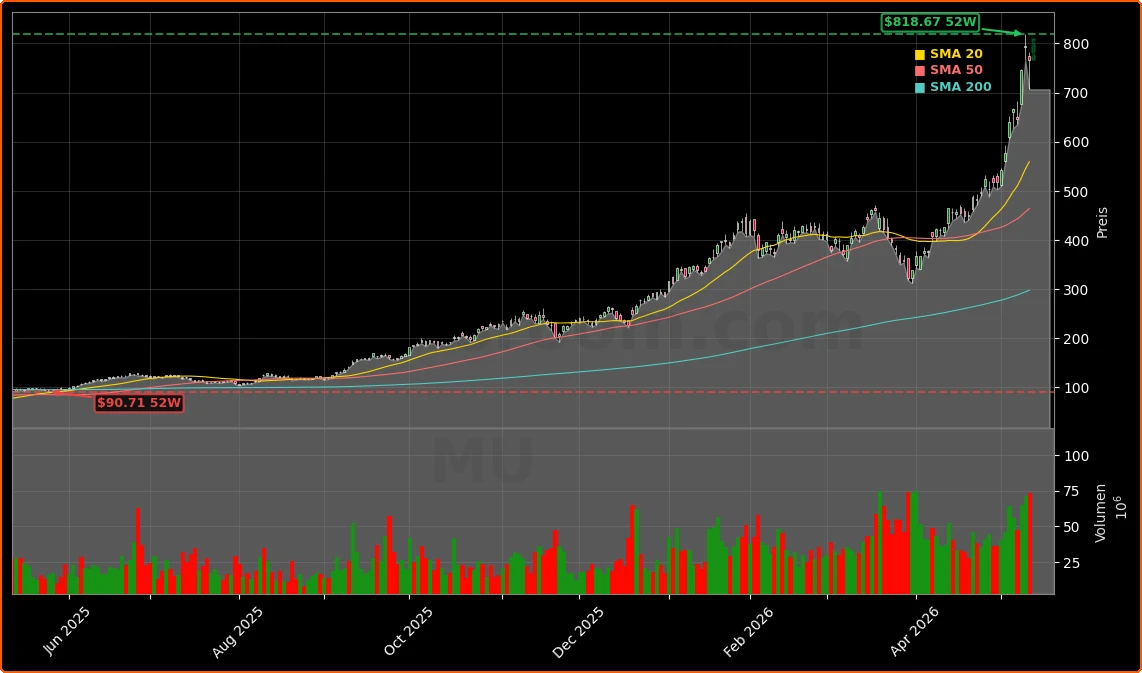
Micron shares have become a volatility magnet. After a parabolic 160% surge in just 28 days, the stock saw a quick 14% pullback and another drop of around 8–9% as the broader memory trade briefly hit pause. Yesterday MU closed at $747.00, down 3.61% on the day, but pre-market trading has flipped the script with the stock indicated 5.48% higher at $808.60 as of early Wednesday ET.
Part of the recent turbulence reflects profit-taking in a sector that has surged on the so‑called “AI memory supercycle.” The VanEck semiconductor ETF has hit all‑time highs, and the specialized DRAM ETF has doubled in 2026, powered by tight DRAM and NAND supply and relentless AI infrastructure spending. Single‑day swings of 5–10% are becoming common as traders react to headlines around AI demand, tax rumors in Korea and changing expectations about how long this upcycle can last.
Despite valuation concerns — the trailing P/E has pushed into the mid‑30s versus a five‑year average below 30 — forward metrics still suggest Micron is priced for strong growth rather than excess. Management describes the current phase as a multi‑year supercycle rather than a typical boom‑bust PC memory cycle, with AI, cloud and automotive diversifying end markets beyond traditional PCs and smartphones.
What does the Micron China Trip signal?
The **Micron China Trip** has become a key narrative for global tech investors. Micron’s CEO is part of the U.S. delegation accompanying President Trump to meet China’s President Xi, alongside heavyweight chip peers. The inclusion of Micron underlines how central advanced memory and storage have become in U.S.–China technology negotiations, especially around market access, export rules and data-center build‑outs.
For Micron, deeper or more stable access to the Chinese market would be material. China remains one of the largest end markets for DRAM, NAND and SSDs used in hyperscale data centers, smartphones and industrial systems. Any constructive outcomes from the **Micron China Trip** — such as clearer rules for AI‑related components, or assurances on cross‑border supply — could reduce one of the biggest geopolitical overhangs on the stock.
At the same time, investors will be watching whether Chinese customers continue to diversify suppliers or invest in domestic alternatives, particularly for AI data centers where Micron’s high‑bandwidth memory (HBM) and SSDs compete directly with Korean rivals. The trip underscores that Micron is now not just an AI winner but also a strategic asset in the broader tech race between Washington and Beijing.
How strong is Micron’s AI memory and storage pipeline?
Fundamentally, Micron’s story is being driven by AI infrastructure more than diplomacy. The company has already sold out its entire 2026 HBM supply, a key component for GPUs and AI accelerators from players like NVIDIA. Revenue nearly tripled year over year, from roughly $8 billion in Q2 2025 to about $23.8 billion in 2026, as hyperscalers and cloud providers race to expand AI training and inference capacity.
On the DRAM side, Micron is now sampling 256GB DDR5 RDIMMs built on its 1‑gamma node for AI and HPC servers, pushing speeds up to 9,200 MT/s while cutting operating power by more than 40% versus prior two‑module setups. This higher‑density, lower‑power memory allows server makers to pack more capacity around each accelerator, addressing a critical bottleneck in next‑generation AI clusters.
Micron is also broadening its AI role beyond memory with storage products such as the 245TB Micron 6600 ION SSD, which targets AI data lakes and cloud‑scale file and object storage. By shrinking rack requirements and dramatically improving energy efficiency versus HDD-based systems, these SSDs make it cheaper to feed GPUs with the vast datasets required for training large language models and agentic systems used by companies like Apple and Tesla.
Does a Samsung strike change the supply picture?
A new wildcard for Micron is a deepening labor dispute at Samsung Electronics. With failed mediation talks raising the risk of a multi‑week strike, markets are bracing for potential disruptions to Samsung’s advanced memory production, including chips used in AI processors. Any meaningful hit to Samsung’s DRAM or HBM output would tighten an already constrained market and could push contract prices higher.
That scenario would likely benefit Micron and SK Hynix, which compete directly with Samsung in HBM and high‑end DRAM. Micron is already seeing tailwinds from rising memory prices, as fears of supply shortages combine with the broader AI boom. For now, this remains a risk factor rather than a certainty, but the prospect of reduced Samsung output is one reason analysts believe the current pricing environment could stay favorable longer than in past cycles.
On the flip side, Micron has not been immune to sector-wide pullbacks. When Korean tax rumors hit semiconductor names earlier this week, Micron slid alongside peers before bouncing. That volatility highlights how quickly sentiment can swing in such a crowded trade, even as the fundamental supply/demand backdrop remains tight.
What are analysts saying about Micron now?
Wall Street remains broadly constructive on the stock. D.A. Davidson’s Gil Luria has one of the most aggressive calls, lifting his Micron price target to $1,000 per share, arguing that investors still underestimate what he calls the “new math” of the AI era, where ever‑larger models require exponentially more high‑performance memory. Deutsche Bank analyst Melissa Weathers has echoed this $1,000 target, reinforcing the idea that Micron could still have substantial upside if AI infrastructure spending stays elevated.
Recent commentary from other firms has also skewed positive. A note highlighting top technology picks from Monness and D.A. Davidson put Micron alongside software names like Twilio and Jack Henry, emphasizing its position as a core AI enabler. While some strategists warn about near‑term overbought conditions in memory ETFs and the potential for further consolidations after such a steep run, few dispute that Micron sits at the center of the AI hardware stack, from HBM for GPUs to SSDs and DDR5 for cloud and enterprise servers.
Valuation remains the main point of contention. Micron trades at roughly eight times forward earnings, a level bulls see as cheap given the growth trajectory, while bears caution that even a structurally stronger cycle can see sharp corrections if capacity ramps too quickly or AI demand slows. For now, the balance of opinion leans toward the view that Micron is still reasonably priced for a multi‑year build‑out.
Related Coverage
Investors looking for deeper context on Micron’s recent volatility can revisit our earlier piece, “Micron AI Memory Boom: -8.5% Plunge Tests the Rally”, which explores whether the stock’s sharp drop signaled the end of the run or a healthy reset within a larger AI supercycle. Together with today’s focus on the **Micron China Trip**, that analysis helps frame both the risks and the structural drivers shaping Micron’s trajectory.
Investors still underestimate the new mathematics of the AI era — the larger the models get, the more memory they need.— Gil Luria, D.A. Davidson
In summary, the **Micron China Trip** puts geopolitics back on center stage just as AI-driven demand, potential Samsung production issues and record memory pricing define Micron’s fundamentals. For U.S. investors, the stock remains a high‑beta way to play the AI hardware build‑out, with outsized sensitivity to both Washington–Beijing headlines and hyperscaler capex cycles. If Trump–Xi talks avoid new shocks and the AI supercycle continues, Micron is likely to stay a core holding for those willing to tolerate volatility in pursuit of long‑term growth.