
Is Micron’s sudden pullback just noise in the Micron AI Memory Boom or the first warning sign of an overheated trade?

Is Micron’s pullback a pause in the AI memory boom?
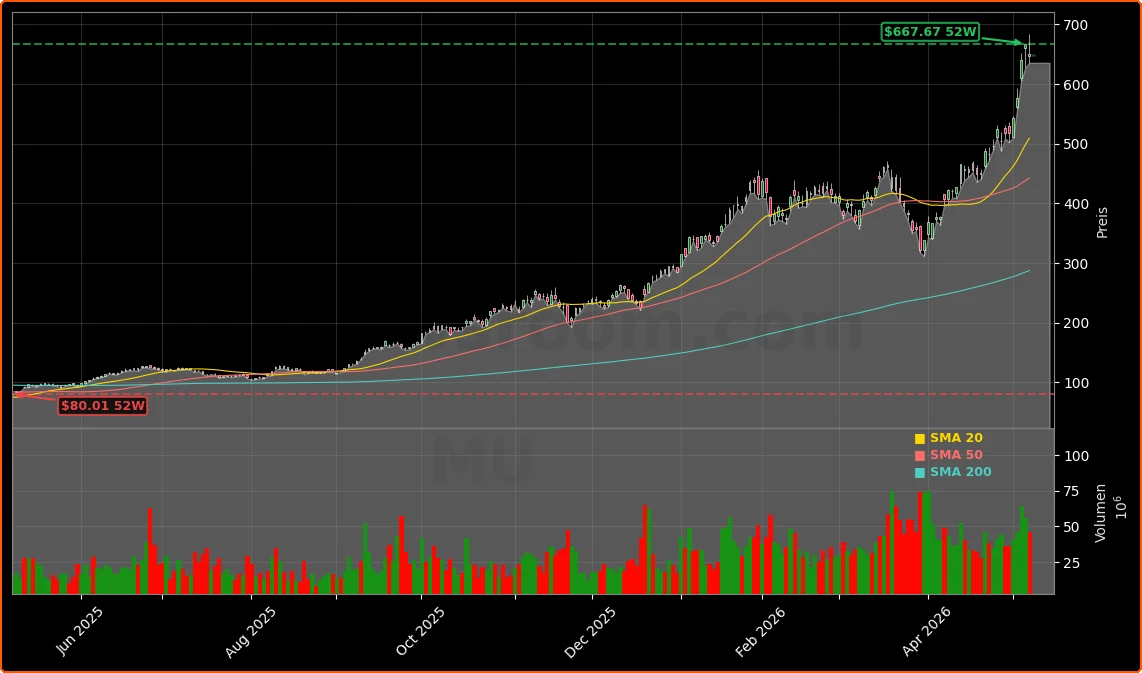
Shares of Micron Technology, Inc. (MU) traded around $646.63 on Thursday, down about 3% from the previous close of $666.80, as the broader Philadelphia Semiconductor Index cooled after a spectacular run. The stock remains one of the biggest winners of the AI infrastructure trade, up roughly 700% over the past year and more than 100% year-to-date, even after the latest dip. That makes Micron one of the highest-profile ways for investors to play the Micron AI Memory Boom, but also leaves it exposed to sharp swings as traders reassess positioning.
Technically, MU gapped higher in recent sessions and formed an island pattern, with no meaningful pullback to offer textbook entry points. Some chart watchers now point to the $607–$608 area as a potential support zone; if the stock revisits that band and holds, it could reset the risk-reward for new buyers who missed the initial breakout. Options activity remains intense, with a large bullish call sweep reported around the $680 strike expiring May 8, underscoring ongoing speculative interest even into short-dated contracts.
How is Micron turning AI demand into record numbers?
The fundamental engine behind the Micron AI Memory Boom is simple: AI data centers consume enormous amounts of DRAM, NAND and especially high-bandwidth memory (HBM), and supply has struggled to keep up. In its fiscal Q2 2026, Micron Technology, Inc. posted revenue of about $23.9 billion, a 196% year-over-year surge and the company’s fourth straight quarterly record. Non-GAAP EPS climbed to $12.20, up more than 600% from the prior year, as tighter supply and richer AI-focused product mix pushed margins sharply higher.
Micron has confirmed that its entire 2026 HBM4 output is already sold under binding agreements, and that key cloud and hyperscale customers are increasingly signing three- to five-year supply contracts instead of the old quarterly or annual deals. Management now expects the HBM total addressable market to grow from roughly $35 billion in 2025 to around $100 billion by 2028, implying a 40% annual growth rate. CEO Sanjay Mehrotra describes memory as a “strategic asset” in the AI era, noting that some customers are currently receiving only roughly half to two-thirds of the HBM they would like, a scarcity that keeps pricing power firmly in Micron’s hands.
Where does Micron stand versus NVIDIA, Tesla and Apple?
On Wall Street, Micron has increasingly been grouped with leading AI hardware names such as NVIDIA, whose latest accelerators rely on massive stacks of HBM to achieve headline-grabbing performance gains. While NVIDIA captures much of the attention as the compute provider, the Micron AI Memory Boom is a critical enabling layer underneath that ecosystem. Tight HBM supply has become one of the main constraints on how fast new GPU clusters can be deployed, which in turn supports Micron’s pricing and visibility.
For investors comparing AI plays, Micron’s valuation still looks moderate relative to many high-profile names. At about 25 times trailing earnings and roughly 11 times forward earnings, MU trades at a discount to several AI beneficiaries and memory peers, even after its massive rally. By contrast, mega-cap platform companies like Apple or high-growth innovators such as Tesla are typically valued more on ecosystem or software narratives than on hardware cycles, making Micron an unusually pure, but cyclical, way to bet on AI infrastructure build-out.
Are analysts and rating agencies still backing the rally?
Analyst sentiment has shifted decisively in Micron’s favor as the Micron AI Memory Boom gathered pace. Out of 44 analysts tracked, the consensus rating now sits at a firm Buy, with an average price target around $551.40 and the most aggressive target on the Street — from DA Davidson — at $1,000. TD Cowen recently lifted its own target to $660, roughly in line with where the stock has been trading this week, signaling that some houses see the near-term move as largely reflecting their base-case outlook.
Credit markets are responding as well. Fitch upgraded Micron’s rating to BBB+, highlighting improved cash flow and visibility as long-term HBM contracts and cloud memory margins above 60% feed through to the balance sheet. Other research houses such as Bernstein see further upside to DRAM and NAND pricing into 2027, arguing that AI-related demand will keep the industry in a “memory supercycle” for several more years, even as traditional PC and smartphone markets remain more cyclical.
Is a Micron stock split on the horizon for U.S. investors?
With MU now well above $600, speculation around a potential stock split is intensifying. Micron has split its stock three times in the past, most recently in 2000, and the current nominal price is high enough to discourage some smaller retail investors. A 10-for-1 split at $700, for example, would turn each share into 10 at $70 without changing the company’s market value, but could increase liquidity and options accessibility, similar to the playbook seen at other high-flying tech names in recent years.
Importantly for long-term investors, a split would be cosmetic; the real driver remains whether the Micron AI Memory Boom can extend beyond 2026. Order books for cloud memory already stretch into 2027, and management expects industry tightness to persist well into that timeframe as AI use cases proliferate. If AI infrastructure capex stays robust and new capacity ramps remain disciplined, Micron could maintain elevated margins longer than in past cycles — but any sign of overbuilding or a macro slowdown could quickly test that thesis.
Related Coverage
Investors who want to dive deeper into how the Micron AI Memory Boom has reshaped sentiment can read the detailed analysis in Micron Record +11.1% Surge as AI Memory Demand Explodes. That piece examines whether the latest record-breaking move is just another AI-fueled spike or the start of a new era for memory valuations, and how the shifting demand picture might influence Micron’s next leg higher.
In the AI era, memory has become a strategic asset for our customers, and we are investing in our global manufacturing footprint to support their growing demand.— Sanjay Mehrotra, CEO of Micron Technology, Inc.
The Micron AI Memory Boom has turned memory into one of the most sought-after ways to play AI infrastructure, with HBM sold out, long-term contracts in place and Wall Street analysts openly debating a path to $1,000 per share. For U.S. investors, MU now sits at the intersection of secular AI growth and classic semiconductor cyclicality, demanding careful risk management rather than blind momentum chasing. The next few quarters of pricing, capacity decisions and AI capex trends will determine whether today’s volatility is merely noise in a powerful uptrend or the first sign that the supercycle is peaking.