Is the latest Micron Record just another AI-fueled spike, or the start of a new era for memory valuations?

How big is the new Micron Record for Wall Street?
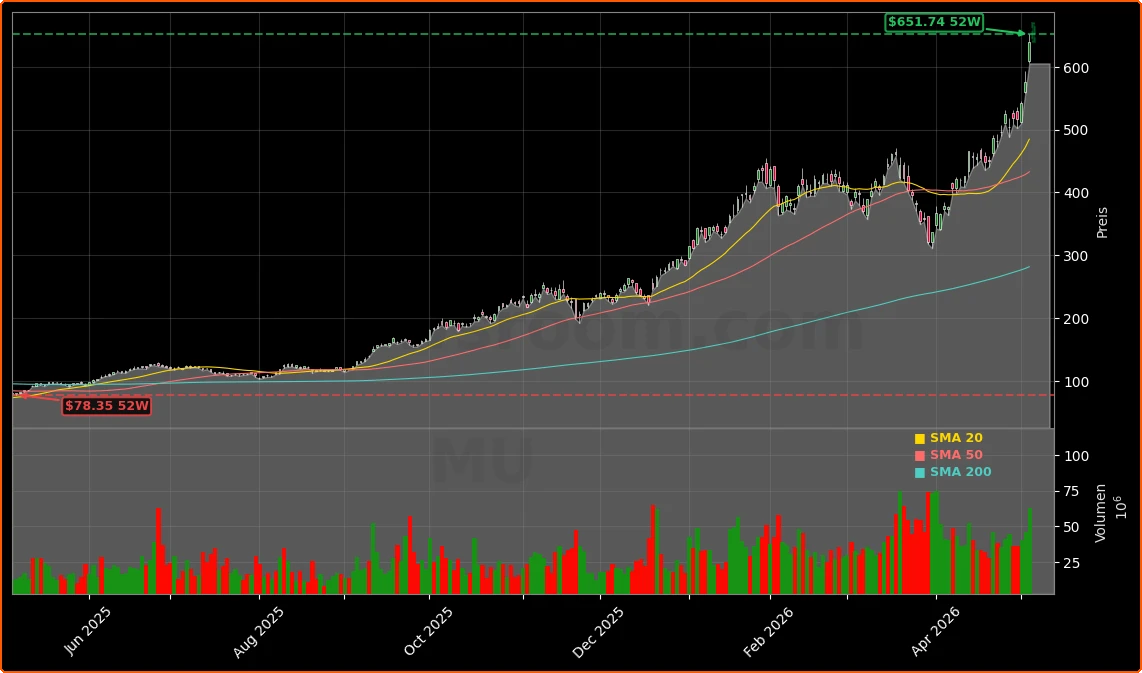
Micron’s latest rally has turned the stock into one of the ten most valuable U.S. technology companies, placing it in the same market-cap neighborhood as AI leaders like NVIDIA and cloud titans that anchor the S&P 500 and NASDAQ. As of early Wednesday in Europe, MU trades around $640.20 after a double-digit percentage jump, while pre-market indications near $669.50 point to another strong open in New York. The stock gained about 11% during Tuesday’s U.S. session and extended the surge by roughly 5% in late trading, setting a fresh Micron Record in both price and enterprise value.
The parabolic run is tightly linked to the AI investment wave. Over the last month alone, Micron has outpaced the PHLX Semiconductor Index, helping lift the S&P 500 to new territory as investors rotate toward companies supplying critical AI infrastructure. Memory, once viewed as a cyclical commodity, is suddenly the bottleneck sitting alongside GPUs in AI data centers, and that perception shift is embedded in the new Micron Record valuation.
Why are AI memory dynamics driving Micron Record highs?
The fundamental backdrop behind the Micron Record is a dramatic imbalance between AI memory demand and available supply. Hyperscale cloud providers and large tech platforms building out generative AI capabilities are scrambling for high-bandwidth DRAM, HBM and advanced NAND. Executives at Micron have noted that some key customers can currently cover only about half to two-thirds of their true memory needs, underscoring how tight the market has become.
This shortfall is reinforced by commentary from mega-cap buyers: companies such as Apple, Meta Platforms and Microsoft have openly flagged rising memory costs on recent earnings calls. That is translating directly into revenue and pricing power for memory specialists. Industry data now show Micron and peers like Sandisk capturing roughly $0.80 of gross profit for every dollar of revenue, far above historical norms for this notoriously volatile industry and a clear driver of the latest Micron Record in profitability metrics.
On the sell-side, the mood has turned decidedly optimistic. Zacks and other research aggregators report that more than three quarters of covering brokerages rate Micron a Strong Buy, with several houses lifting targets into the high triple digits. While the average price target still lags the current quote, the high-end target around $1,000 per share reflects growing conviction that the AI-driven memory upcycle could be more durable than past PC and smartphone cycles.
How important is Micron’s 245TB SSD launch?
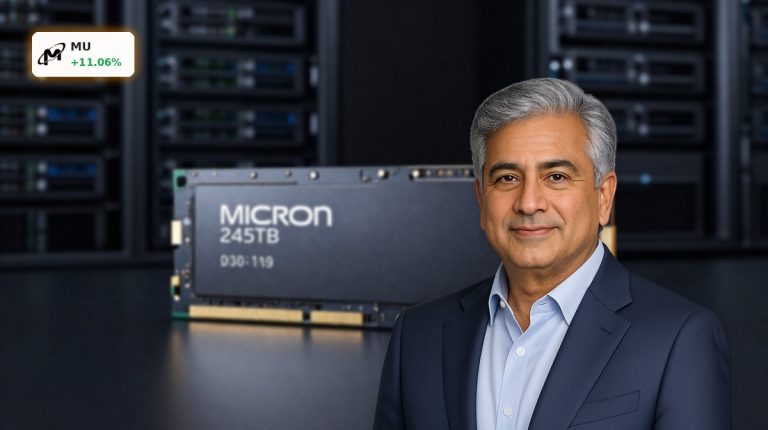
Another pillar of the Micron Record story is product-driven: Micron has begun shipping the 245TB Micron 6600 ION SSD, currently the largest commercially available solid-state drive for data centers. Built on Micron’s G9 QLC NAND, the drive allows operators to store vastly more data using up to 82% fewer racks compared with traditional HDD-based architectures, while delivering up to 84x better energy efficiency for AI preprocessing workloads.
For hyperscalers racing to expand AI capacity, power and space have become hard constraints. Data centers in key markets are bumping up against grid limits, making higher-density, lower-wattage solutions strategically valuable. Micron’s new SSD directly attacks this bottleneck by lowering total cost of ownership at the rack level and enabling more AI compute per square foot. TipRanks and Investing.com both highlight this launch as a major catalyst behind the share-price spike and a key factor in the latest Micron Record valuation.
Strategically, the drive also deepens Micron’s role as a systems-level partner rather than just a component vendor. By bundling high-capacity SSDs with leading-edge DRAM and HBM offerings, Micron can secure long-term supply agreements and embed itself more deeply into AI data-center roadmaps, similar to the ecosystem advantages enjoyed by NVIDIA.
What does the Fitch upgrade signal for Micron Record valuation?
The third leg of the bullish thesis is balance-sheet strength. Fitch Ratings has upgraded Micron’s credit rating from BBB to BBB+, citing significant debt reduction over the past 12 months, improved profitability and better revenue visibility as AI demand locks in multi-year supply contracts. The upgrade lowers Micron’s cost of capital and reinforces the argument that the current upcycle is underpinned by structurally different behavior from both suppliers and customers.
Fitch also pointed to the trend of hyperscalers signing long-dated supply deals to secure capacity, a sharp departure from the 30-day contracting norms that historically amplified volatility in the memory space. For equity investors, that means the new Micron Record in earnings and cash flow could prove more sustainable, even as the industry eventually works through current shortages. With Micron trading at a single-digit forward earnings multiple compared with far higher valuations for CPU and GPU leaders, bulls argue there is still room for multiple expansion if AI capex holds up.
Related Coverage
For a deeper dive into whether this Micron Record phase marks a new AI supercycle or just another cyclical peak, readers can explore our detailed outlook in Micron Forecast +6.3% Rally: Can the AI Memory Boom Last?. That analysis examines scenario-based paths for pricing, capacity additions and long-term returns should memory demand from AI, cloud and high-performance computing continue at today’s pace.
In summary, the latest Micron Record in share price, market cap and profitability underscores how central AI memory has become to the broader tech rally. For U.S. and global investors, Micron now sits alongside NVIDIA and other AI enablers as a core way to play the buildout of next-generation data centers. The next few quarters of capex commentary and pricing data will show whether this Micron Record era evolves into a lasting AI memory supercycle.