Is the Micron Forecast signaling a durable AI-driven supercycle in memory chips or just another cyclical peak in disguise?

Is the Micron Forecast justified after new highs?
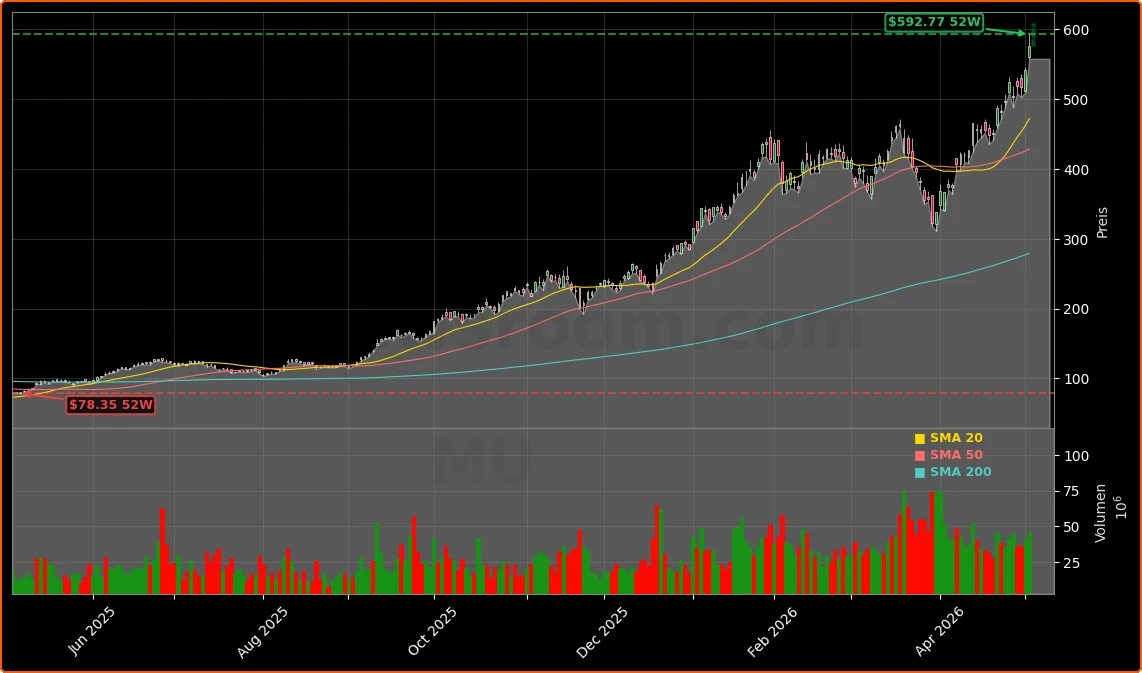
Micron Technology, Inc. (MU) continues to ride the AI infrastructure wave. The stock closed Monday at $576.45, up 6.31% on the day, and was indicated about 5% higher near $607 in early Tuesday trading. That move comes just days after MU notched an all‑time high around $592.77 as demand for AI‑oriented semiconductors spilled over from GPU leaders like NVIDIA into the memory space.
The latest rally follows a blowout fiscal Q2, where Micron’s revenue jumped roughly 196% to about $23.8 billion and adjusted earnings per share surged more than 600%. Management highlighted that AI data centers require far more DRAM, NAND and high‑bandwidth memory (HBM) than traditional cloud workloads, pushing contract prices for key memory products up multiple times over the past year. CEO Sanjay Mehrotra framed memory as a “defining strategic asset in the AI era,” arguing that Micron’s technology and capacity place it at the center of that trend.
At the same time, the Micron Forecast must account for the stock’s breathtaking volatility. Over the past several months, shares dropped by roughly a third before doubling again, underscoring how quickly sentiment can swing in cyclical memory names even when fundamentals are improving.
How do analysts shape the Micron Forecast?
Wall Street has become increasingly bullish on Micron as AI spending accelerates. TD Cowen recently reiterated its Buy rating and lifted its price target from $550 to $660, citing sustained strength in HBM, DRAM and NAND tied to AI data center build‑outs. DA Davidson went even further, raising its target to $1,000 while keeping a Buy rating and arguing that Micron could be in the early stages of a longer‑than‑usual memory upcycle.
Other firms have also moved to the bullish camp. Melius Research initiated coverage with a Buy rating and a $700 target, pointing to memory’s critical role in AI compute stacks and suggesting that Micron’s HBM portfolio could enjoy durable demand through the decade. Cantor Fitzgerald likewise values MU around $700 per share, implying upside of roughly 20–30% from current levels depending on the entry point.
Not every Micron Forecast is upbeat, however. Morningstar recently added Micron to its list of newly overvalued U.S. stocks, assigning a lower star rating after the sharp rally pushed the share price well above its fair‑value estimate. That split between bullish investment banks and more cautious valuation‑driven research underlines the central question for investors: is Micron being structurally re‑rated as a strategic AI supplier, or is this simply another cyclical peak?
How does Micron compare with other chip leaders?
Relative to other big U.S. semiconductor names, Micron’s recent performance has stood out. On a day when parts of the sector traded lower—with several CPU and wireless chip makers under pressure—Micron was among the few clear winners. Over the past year, MU’s share price has climbed more than 500%, outpacing many broader NASDAQ and S&P 500 technology constituents and rivaling some AI beneficiaries such as NVIDIA.
Fundamentally, Micron stacks up well against peers in the Semiconductors & Semiconductor Equipment industry. Recent cross‑company comparisons highlight its strong revenue growth, sizable gross profit, solid EBITDA generation and robust return on equity. Micron’s valuation multiples, including price‑to‑earnings, price‑to‑book and price‑to‑sales, still screen as lower than several high‑flying AI hardware names, while its debt‑to‑equity ratio remains relatively conservative. For U.S. investors, that combination of growth, profitability and balance‑sheet strength is central to a constructive Micron Forecast even after the stock’s meteoric rise.
At the same time, investors must weigh elevated expectations. Consensus currently pencils in roughly low‑teens annual growth in adjusted earnings through fiscal 2029. With MU now trading at around 25 times forward earnings, the multiple assumes that AI‑driven memory demand will remain robust and that competitors such as NVIDIA ecosystem partners and other memory makers will not flood the market with capacity too quickly.
What are the key risks to the Micron Forecast?
Memory remains historically cyclical, and that is the main risk that could derail even the most optimistic Micron Forecast. The current environment features acute supply shortages in DRAM and NAND, particularly in HBM products that feed AI accelerators. Industry history suggests that such shortages eventually give way to oversupply as manufacturers ramp output, which can trigger steep price declines and margin compression.
Some on Wall Street expect the present upcycle to run longer than usual, potentially into the early 2030s, thanks to structural AI demand from hyperscale data centers, cloud providers and enterprise AI rollouts by companies like Apple and Tesla. Others warn that AI capital‑expenditure budgets could normalize later this decade, especially if macro conditions tighten or if efficiency gains reduce the need for as much incremental memory per unit of compute. For now, Micron is gaining notable HBM market share with what it calls the fastest and highest‑capacity HBM3E on the market, but investors need to monitor how quickly rivals respond.
Related Coverage
For a deeper dive into how earnings are feeding into the broader Micron Forecast, readers can explore the recent analysis “Micron Earnings +4.8% Surge as AI Memory Demand Explodes.” That piece looks closely at the latest quarterly numbers, margin trends and AI‑driven order visibility and asks whether the memory market is entering a new supercycle or just another temporary peak. You can read the full article at Micron Earnings +4.8% Surge as AI Memory Demand Explodes for additional context on MU’s risk‑reward profile.
Overall, the Micron Forecast now hinges on whether AI truly transforms memory into a durable strategic asset rather than a boom‑bust commodity, and whether earnings can keep pace with the stock’s explosive move. For U.S. investors building AI‑exposed portfolios, MU remains a high‑beta way to play data center spending, but position sizing and time horizon are critical given the sector’s volatility. The next few quarters of results and guidance will be decisive in showing whether Micron can grow into the ambitious expectations that Wall Street has now placed on the stock.