

Are MicroStrategy Convertible Notes turning a bold Bitcoin bet into a balance-sheet stress test for equity investors?

How is MicroStrategy trading after the debt move?
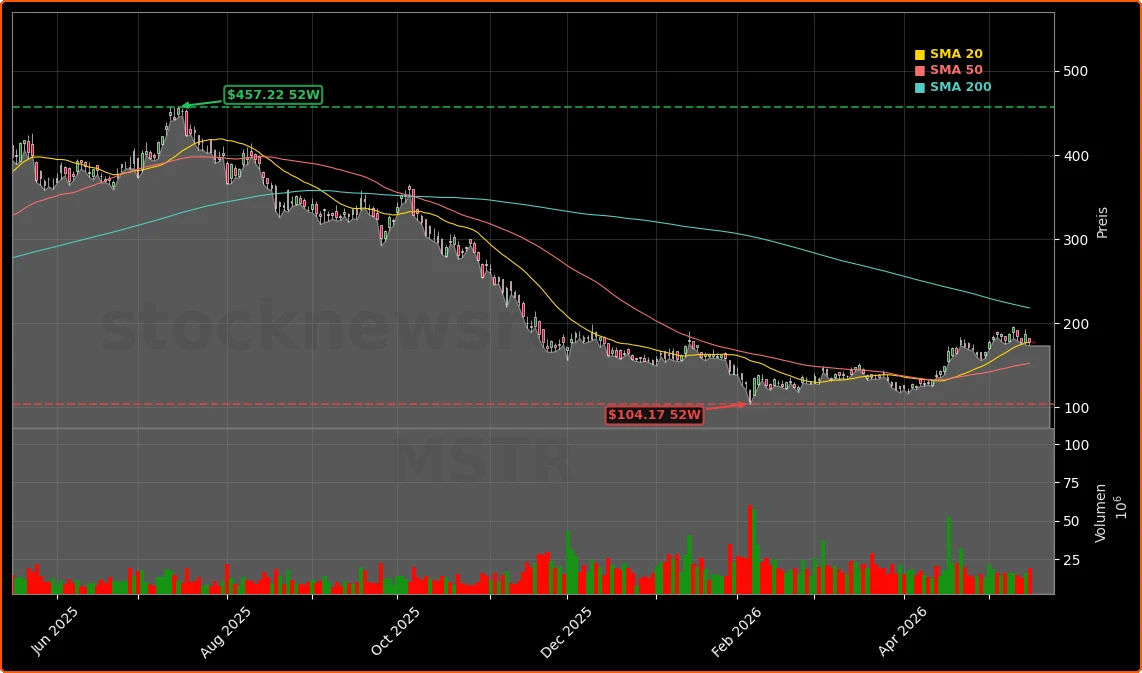
MicroStrategy Incorporated (MSTR) fell 5.11% to $177.42 today from a prior close near $186.45, with the stock slipping further to about $176.15 (-0.72%) in after-hours action. The pullback mirrors weaker crypto sentiment as Bitcoin trades just below $79,000, a level uncomfortably close to MicroStrategy’s average BTC acquisition cost of roughly $75,500–75,540 per coin. For U.S. traders on NASDAQ, MSTR continues to behave like a leveraged Bitcoin proxy, routinely amplifying single‑day swings in the underlying crypto tape.
Despite today’s drop, the stock remains positive year to date, but the risk profile has grown more complex. The firm now holds about 818,869 BTC, acquired for roughly $61.86 billion, making it the largest corporate Bitcoin treasury. Any sign that MicroStrategy might monetize a portion of that stash to service debt or dividends could shift how Wall Street values the equity from a pure BTC tracker toward a more conventional, capital‑structure‑driven story.
What exactly is happening with MicroStrategy Convertible Notes?
According to a new SEC filing, MicroStrategy has entered privately negotiated deals with certain holders of its outstanding 0% Convertible Senior Notes due 2029 to repurchase $1.5 billion in face value for roughly $1.38 billion. The focus on MicroStrategy Convertible Notes is not just about the discount to par; it is about how the company chooses to finance the repurchase in a market that is already watching its balance sheet closely.
Management outlined three potential funding sources: existing cash reserves, proceeds from its at‑the‑market equity offering program, and/or proceeds from Bitcoin sales. The first option would draw down a reported cash war chest of about $2.25 billion, shortening the runway for nearly $1.5 billion in annual preferred dividend obligations. Tapping the ATM program would effectively use new equity capital to retire old obligations, a structure some skeptics already compare to a financing flywheel. Selling BTC, meanwhile, would modestly weaken the core appeal of MSTR as a high‑beta Bitcoin exposure vehicle.
The MicroStrategy Convertible Notes buyback comes just days after Executive Chairman Michael Saylor acknowledged the company may sell Bitcoin to help fund dividends linked to its preferred share programs. That marks a striking rhetorical shift from the long‑promoted “never sell BTC” mantra and has pushed prediction‑market odds of a MicroStrategy Bitcoin sale this year above 80%.
Does the balance sheet force a shift in Bitcoin strategy?
On the surface, retiring MicroStrategy Convertible Notes at a discount looks accretive, especially with zero‑coupon debt and a volatile equity valuation. But the move lands at a time when the firm’s leverage, preferred‑stock stack, and dividend commitments are under more scrutiny. Annual preferred dividends tied to instruments like STRK, STRF, STRD and STRC are estimated around $1.4–1.5 billion, leaving limited flexibility if Bitcoin trades sideways near the acquisition cost.
Polymarket traders and institutional desks are increasingly focused on whether MicroStrategy can keep leaning on equity issuance at a premium to net asset value. If that premium compresses, each new share raises less incremental capital relative to the embedded BTC, diluting existing holders without significantly expanding the Bitcoin pile. In that environment, a controlled BTC sale in the $1–2 billion range could fund several quarters of dividends while only trimming a small portion of the 818,000+ BTC stack — a trade‑off some portfolio managers see as pragmatic treasury management rather than a bearish pivot.
Not all institutional players are doubling down. Jane Street, once one of MicroStrategy’s more visible holders, cut its position sharply, reducing its stake by about 78% in the latest quarter to just over 209,000 shares. That reduction underscores how fast fast‑money support can ebb when balance sheet complexity rises, even as other institutional investors have been net buyers over recent periods.
How does MSTR compare with other crypto and tech proxies?
Digital asset equities are trading more as a thematic cluster than on idiosyncratic fundamentals. Coinbase, which has been moving in lockstep with MicroStrategy, has seen similar volatility as traders reassess regulatory catalysts like the Digital Asset Market Clarity Act. Both names can swing 5–6% in a single session without any change in long‑term theses, underscoring their high‑beta status compared with broader NASDAQ and S&P 500 components.
For U.S. investors, MSTR sits alongside crypto‑sensitive growth names and large‑cap tech leaders such as NVIDIA, Tesla and Apple as part of a broader risk‑on basket, but with notably higher balance‑sheet leverage. While analyst targets mentioned for MicroStrategy cluster around the high‑$300s with a bias toward Buy ratings, sentiment is increasingly tied to the sustainability of its financing engine, not just Bitcoin’s trajectory. Compared with Coinbase, which earns transaction revenue on trading volumes, MicroStrategy’s fortunes are far more directly tethered to the mark‑to‑market value of its BTC holdings and to how it manages debt like the MicroStrategy Convertible Notes.
Related Coverage
For a deeper dive into how MicroStrategy’s funding model evolved into a multi‑billion‑dollar Bitcoin accumulator, read MicroStrategy Bitcoin Financing: $30B Boom or Fragile Flywheel?, which analyzes whether the company’s financing flywheel can keep scaling without over‑stretching the balance sheet. If you are also tracking regulatory currents shaping crypto‑linked stocks, Coinbase CLARITY Act: -6.7% Plunge After Regulatory Hype examines how the proposed legislation is fueling volatility in Coinbase and what it might imply for other crypto‑sensitive names like MSTR.
In the end, the MicroStrategy Convertible Notes repurchase crystallizes the trade‑offs at the core of the MSTR story: leverage, dividends and Bitcoin exposure. For investors, the key question is whether management can use this deal to strengthen the balance sheet without sacrificing the stock’s appeal as a BTC‑rich vehicle. The next few quarters of funding decisions, BTC price action and preferred‑dividend management will show whether MicroStrategy’s high‑wire act remains a powerful way to play Bitcoin or shifts toward a more conventional corporate capital‑structure narrative.