Is MicroStrategy’s refined Bitcoin playbook a sustainable leverage bet on digital gold or a high-risk experiment in corporate finance?

Is MicroStrategy shifting its Bitcoin playbook?
MicroStrategy Incorporated has become a de facto proxy for Bitcoin on the NASDAQ, and the MicroStrategy Bitcoin Strategy remains the company’s central investment narrative. After years of championing a hardline “never sell” doctrine, Michael Saylor recently acknowledged that this slogan oversimplified how a listed U.S. corporation must actually manage its balance sheet.
Saylor now describes the approach more precisely as “never be a net seller of Bitcoin.” In practice, that means MicroStrategy may occasionally sell small portions of its holdings, but only with the intention of buying substantially more over time. He illustrated the idea with a simple ratio: selling one Bitcoin to help finance the purchase of 10 to 20 additional coins, resulting in a net increase of around nine or more Bitcoin.
This nuance matters to institutional investors who have to reconcile Saylor’s high-conviction messaging with corporate governance, liquidity management, and regulatory disclosure. It also helps explain why MSTR tends to move with amplified volatility relative to Bitcoin itself, offering leveraged directional exposure rather than a neutral treasury position.
How big is MicroStrategy’s Bitcoin bet now?
MicroStrategy has spent the past several years transforming from a traditional business intelligence software firm into what Saylor calls a “digital treasury company.” As of late March 2026, the group reported holding roughly 762,099 Bitcoin at an average purchase price of about $75,694 per coin. That scale dwarfs the Bitcoin exposure of most other public companies and has effectively turned the stock into a listed Bitcoin fund wrapped around an operating software business.
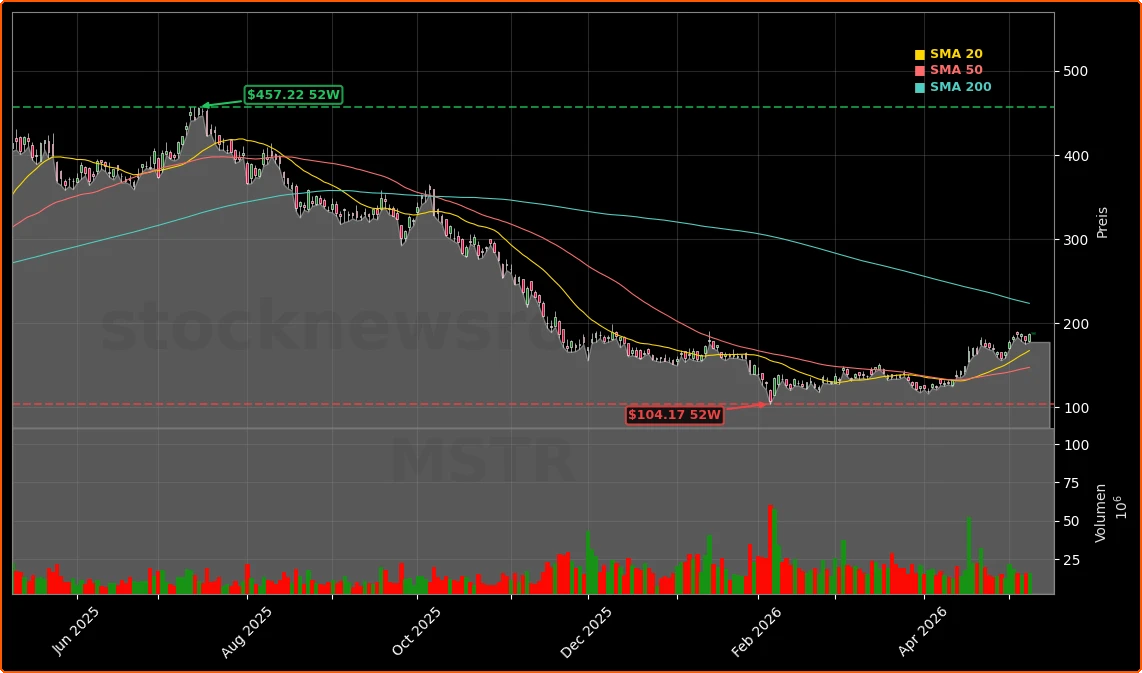
Recent months have reinforced this aggressive accumulation stance. In April, the company disclosed the purchase of 34,164 additional Bitcoin for roughly $2.54 billion, a move that coincided with a 9.4% single-day jump in MSTR. Earlier in May, the stock gained more than 7% in one session as Bitcoin rallied and analysts raised price targets on the expectation that MicroStrategy’s mark-to-market gains would materially support upcoming earnings.
For U.S. investors used to comparing large-cap tech names like NVIDIA or Tesla, MicroStrategy’s risk profile is fundamentally different. The balance sheet is highly concentrated in a single, volatile digital asset rather than diversified across products and services. That concentration cuts both ways: it has powered outsized gains during Bitcoin upswings, but it also leaves the company, and its shareholders, exposed to sharp drawdowns if crypto sentiment sours.
What exactly is the MicroStrategy Bitcoin Strategy?
The refined MicroStrategy Bitcoin Strategy centers on using equity and debt markets to acquire as much Bitcoin as possible while staying net long and, in Saylor’s words, treating Bitcoin as “digital capital.” The firm has repeatedly issued stock and convertible notes, then deployed the proceeds into new Bitcoin purchases rather than traditional capital expenditures or share buybacks.
Saylor compares this to a mega-cap tech company reinvesting in core infrastructure. He argues that just as a cloud giant might invest billions into data centers to unlock even larger future cash flows, MicroStrategy is investing capital into Bitcoin as a long-duration, scarce asset that he believes will appreciate significantly over time. Under this framework, limited, opportunistic Bitcoin sales are viewed as tactical financing steps intended to amplify the long-term accumulation, not unwind it.
Critics, including gold advocate Peter Schiff, have characterized the strategy as dangerously circular, going so far as to label it a Ponzi-like scheme that must eventually collapse either through a sharp reduction in Bitcoin holdings or a breakdown in the stock’s valuation. Saylor strongly rejects this framing, insisting that Bitcoin is a legitimate form of digital property and that MicroStrategy’s equity and credit instruments simply provide investors exposure to that capital. He notes that those who dismiss Bitcoin outright will naturally reject any financial structure built on top of it.
How is Wall Street treating the stock?
On Wall Street, coverage of MSTR increasingly treats the name as a Bitcoin-levered vehicle rather than a pure software play. Quant and technical analysts on major trading platforms frequently publish trade ideas that hinge on Bitcoin support and resistance levels, options flows, and correlations between MSTR and the broader crypto complex. Long-only portfolio managers, meanwhile, are weighing the stock as a high-beta satellite position alongside other volatile innovators rather than a core S&P 500-style holding like Apple.
Fundamentally focused research notes in recent weeks have emphasized MicroStrategy’s “healthy underlying business” and high growth potential, while also flagging the extreme sensitivity of earnings and book value to Bitcoin price swings. Several U.S. brokerages currently rate the stock as a Buy with elevated price targets, explicitly tying their upside scenarios to sustained strength in Bitcoin. By contrast, more cautious houses describe MSTR as suitable only for investors who fully understand that they are effectively adding crypto exposure to their portfolio.
The stock’s recent rebound from around $120 in early April to the high $180s reflects both Bitcoin’s recovery and growing acceptance that the MicroStrategy Bitcoin Strategy is not being abandoned, merely refined. Insider Form 144 filings detailing modest planned sales of Class A shares have attracted some attention but have so far been overshadowed by the company’s much larger Bitcoin-related moves.
Related Coverage: What else should investors read?
Investors looking for a deeper dive into the risk-reward calculus can review StockNewsroom’s earlier analysis in “MicroStrategy Bitcoin Strategy +4.3% Surge Sparks Warning”, which dissects whether the company’s aggressive accumulation could lead to an explosive upside breakout or a painful reset for latecomers. The piece also discusses Saylor’s willingness to sell Bitcoin when advantageous, setting the stage for the clarifications he is now offering. Because MicroStrategy sits at the intersection of software and digital assets, that article effectively doubles as a sector overview, exploring how Bitcoin-heavy balance sheets may reshape the broader tech and crypto landscape in the coming quarters.
If I were being more precise, I’d say never be a net seller of Bitcoin.— Michael Saylor, MicroStrategy founder
In summary, the MicroStrategy Bitcoin Strategy remains firmly intact even as Michael Saylor tones down the absolutist “never sell” rhetoric in favor of a more nuanced “never be a net seller” stance. For U.S. investors, MSTR continues to function as a high-octane, equity-based way to express a bullish view on Bitcoin, with all the upside and downside that implies. The next few quarters of Bitcoin price action and capital market conditions will determine whether this leveraged digital-treasury model cements MicroStrategy’s status as a pioneering winner or exposes the limits of balance-sheet concentration in a single volatile asset.