

Is the MicroStrategy Bitcoin Strategy still a smart high-beta BTC proxy, or is the latest pullback a warning shot for bulls?

How is MicroStrategy moving the Bitcoin market?
MicroStrategy Incorporated has reactivated its aggressive accumulation playbook, buying 535 Bitcoin for roughly $43 million at an average price of $80,340 per coin in early May. The purchase lifts the company’s holdings to about 818,869 BTC, making it by far the largest corporate owner of the cryptocurrency. With Bitcoin hovering near $81,000, every additional tranche reinforces the MicroStrategy Bitcoin Strategy as a high-beta way to express a bullish view on digital gold.
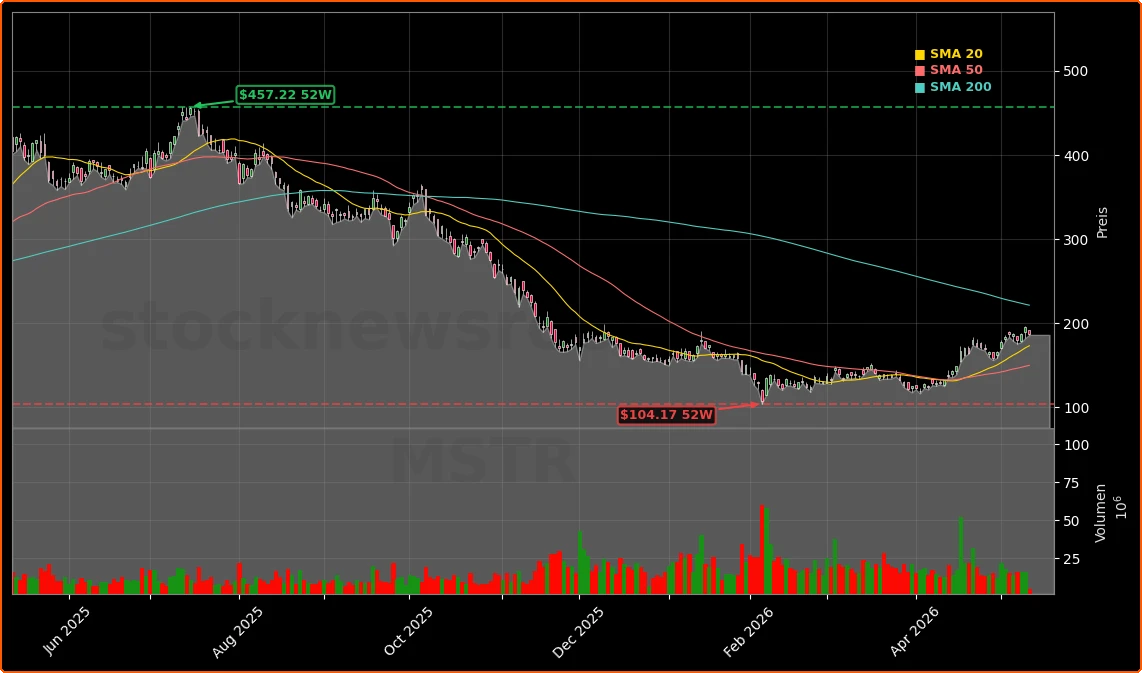
Over the past month, MSTR has rallied roughly 46% to around $188 as Bitcoin bounced about 12% off its April lows. The linkage has become so tight that the stock now trades more like a leveraged crypto instrument than a traditional software name, a dynamic that has drawn in short-term traders and options speculators on Wall Street.
Still, today’s 4.39% pullback to $187.34 highlights just how quickly sentiment can swing, even as the underlying thesis remains centered on long-term BTC appreciation rather than near-term fundamentals.
What did Michael Saylor clarify about selling BTC?
After the Q1 2026 earnings call, some investors feared that commentary about potential Bitcoin sales signaled a strategic shift. Michael Saylor pushed back hard on that interpretation, explaining that any sale would be a technical maneuver rather than a reversal of the MicroStrategy Bitcoin Strategy.
Saylor outlined a scenario in which the company might sell a small portion of its holdings to fund dividends or crystallize tax losses, while simultaneously buying far more BTC than it sells. Based on his math, selling one Bitcoin to unlock tax benefits while buying twenty more would be economically equivalent to simply buying twenty and not selling at all.
The company has used that playbook before. In December 2022, it sold 704 BTC at around $16,776 and repurchased 810 BTC two days later, locking in tax advantages without reducing net exposure. A similar pattern today would convert part of the Q1 2026 unrealized loss on digital assets — roughly $12.5 billion — into a deferred tax asset, while keeping Bitcoin holdings on an upward path.
How fragile are MicroStrategy’s fundamentals?
Q1 2026 underlined how detached MSTR’s valuation has become from traditional metrics. Revenue from its legacy enterprise analytics and cloud software business totaled about $124 million, but the company reported an operating loss of $14.5 billion — 116 times the size of its top line. The swing was driven almost entirely by mark-to-market accounting for its BTC stash under new FASB rules.
An unrealized loss of $14.5 billion on digital assets, following a 23% drop in Bitcoin from roughly $87,500 to $67,700 during the quarter, flowed straight through the income statement. Because these losses are non-cash, equity investors have largely shrugged, focusing instead on the direction of BTC. The stock even traded higher after earnings, underscoring that the MicroStrategy Bitcoin Strategy now eclipses any discussion of software margins or subscription growth.
For risk-averse investors, that’s a red flag: MSTR’s value is effectively tethered to Bitcoin sentiment, not fundamentals. Those who simply want BTC exposure can opt for spot holdings or ETFs, while traders willing to embrace more volatility can turn to MSTR or even 2x products built on it.
How are Wall Street and leveraged ETFs reacting?
Analysts remain divided but several major firms have turned more optimistic on the upside potential. TD Cowen recently raised its price target on MSTR to $395 from $385 and reiterated a Buy rating, citing higher expected BTC yield and the rebound in Bitcoin prices. Canaccord also lifted its target to $224 from $185, likewise keeping a Buy rating and highlighting MicroStrategy’s shift toward issuing preferred securities and digital credit instead of dilutive common equity.
On the trading side, leverage is stacking on leverage. The T-Rex 2X Long MSTR Daily Target ETF (MSTU) uses swaps to deliver twice the daily move of MSTR, which itself is a leveraged play on Bitcoin. During the latest upswing, MSTR’s 46% monthly gain translated into roughly 101% for MSTU, showing how well leverage can work in a clean uptrend. Over a full year, though, MSTR’s 55% decline turned into a 91% loss for MSTU due to volatility decay — a stark reminder that these products are tactical tools, not long-term holdings.
Defiance’s 2x MSTR vehicle (MSTX) offers similar exposure with comparable fees and the same decay problem. Investors already holding Bitcoin or high-beta tech leaders like NVIDIA or Tesla need to recognize that adding MSTR or its leveraged ETFs can push portfolio risk well beyond standard NASDAQ or S&P 500 levels.
How does MicroStrategy compare with other BTC proxies?
Unlike diversified mega caps such as Apple, which generate vast cash flows from hardware and services, MicroStrategy is now effectively a Bitcoin treasury entity with a software arm attached. The MicroStrategy Bitcoin Strategy is simple: accumulate as much BTC as possible using corporate leverage and capital markets, then hold through cycles in expectation of six-figure prices.
This profile puts MSTR in its own niche versus miners, which face operational risk and energy costs, and versus spot Bitcoin ETFs, which offer clean exposure without corporate leverage. For traders who believe Bitcoin’s next leg higher is imminent, MSTR can still function as a high-octane bet, especially when combined with options or short-dated leveraged ETFs. For conservative, benchmark-focused portfolios tied to the S&P 500, however, the position size likely needs to remain small.
Related Coverage
For a deeper dive into whether the MicroStrategy Bitcoin Strategy is a sustainable leverage play or a dangerous experiment in corporate finance, readers can explore this detailed analysis of the recent 4.3% rally in MSTR shares. The piece examines how Saylor’s evolving capital structure and BTC accumulation tactics could shape risk-reward for aggressive growth investors over the coming quarters.
Overall, the MicroStrategy Bitcoin Strategy continues to hinge on one core idea: that Bitcoin will appreciate enough to justify stacking leverage on the balance sheet and in the stock price. For U.S. investors, MSTR remains a speculative satellite position rather than a core holding, best suited for those comfortable with crypto-level drawdowns. The next major Bitcoin move — up or down — will likely decide whether this strategy looks visionary or reckless.