Is the MicroStrategy Bitcoin Strategy entering a new phase as Saylor flirts with selling BTC while analysts turn more bullish?

Is the MicroStrategy Bitcoin Strategy turning a corner?
For years, the MicroStrategy Bitcoin Strategy was synonymous with one message from Michael Saylor: buy Bitcoin and never sell. That narrative is shifting. After three straight quarterly losses and a massive first-quarter net loss driven by BTC volatility, Saylor now admits the company may sell some coins, primarily to fund dividends on preferred and potentially common stock. This marks a tactical evolution rather than a full reversal; management still aims to be a net accumulator of Bitcoin over time.
On the latest earnings call, Saylor said the company will “probably sell some Bitcoin to fund a dividend,” framing it as a way to demonstrate flexibility to the market rather than a loss of conviction. CEO Phong Le echoed that stance, noting that the company “will sell bitcoin when it’s advantageous to the company,” with the emphasis on increasing Bitcoin per share instead of simply hoarding the largest possible BTC pile.
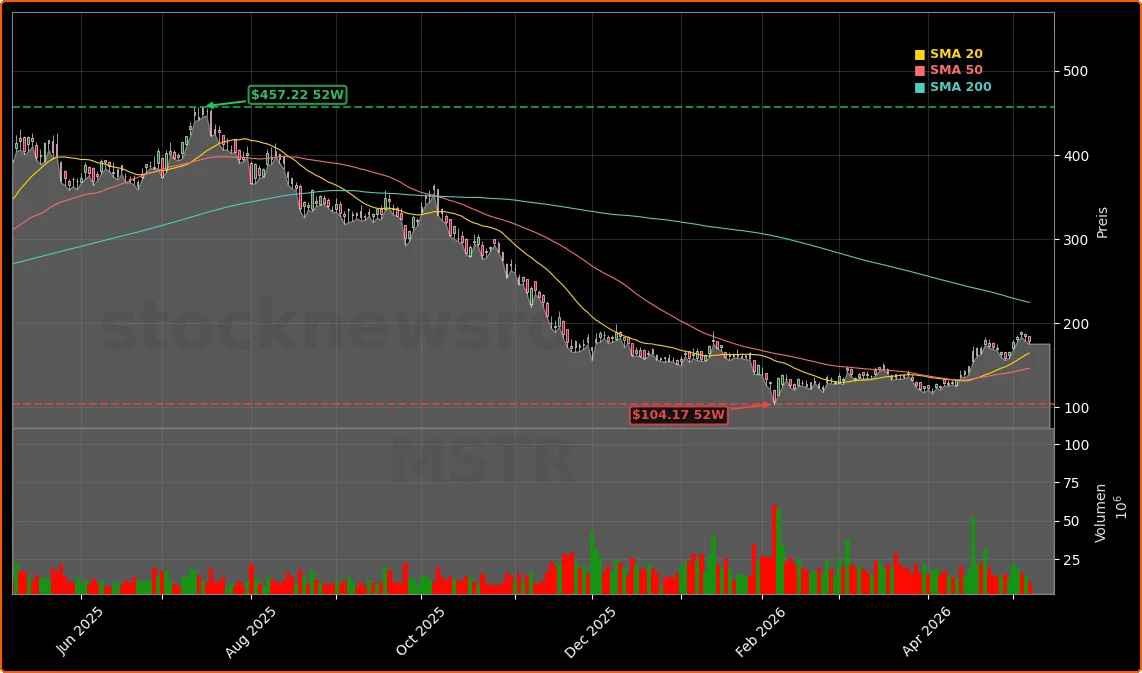
Bitcoin itself has been on a wild ride, trading above $106,000 last November, plunging below $65,000 in February, and recently stabilizing just under $80,000. With an average purchase price around $75,537 per BTC, **MicroStrategy Incorporated** currently sits on a modest unrealized gain, but its income statement remains hostage to mark-to-market swings.
How are TD Cowen and Canaccord valuing MicroStrategy?
Despite the turbulence, Wall Street is leaning in. TD Cowen analysts Lance Vitanza and Jonnathan Navarrete have raised their price target on MSTR to $395 from $385, implying more than 110% upside from today’s $179.03 close. They highlight a major shift in the capital stack: heavier reliance on STRC perpetual preferred shares with an 11.5% variable dividend, and less on common-equity issuance.
According to their model, the company has already raised over $5 billion this year via STRC and is executing on Saylor’s so‑called “42/42 plan,” which envisions raising $42 billion over three years through equity and fixed-income–like instruments. The aim is to scale the MicroStrategy Bitcoin Strategy while curbing dilution. TD Cowen boosted its internal “BTC Yield” forecasts — a metric that tracks how efficiently the firm grows its BTC versus share count — to 18.2% for 2026 (from 16.7%) and 9.6% for 2027 (from 5.4%), driven by a more constructive Bitcoin outlook.
Canaccord is also constructive, lifting its MSTR price target to $224 from $185 and reiterating a Buy rating. Its note focuses on the accretive economics of preferred-stock and digital-credit financing, arguing that these structures support Bitcoin accumulation without the drag of continuous common-share dilution. For U.S. investors accustomed to cleaner balance sheets at mega‑caps like Apple or NVIDIA, this kind of financial engineering is unusual, but it’s central to the MicroStrategy Bitcoin Strategy.
Can MicroStrategy balance dilution, debt and BTC upside?
Critics say the company risks becoming a “dilution machine,” pointing to heavy interest and dividend obligations alongside aggressive issuance. TD Cowen pushes back, estimating annual preferred obligations around $1.5 billion — just 2.2% of the current value of roughly 818,334 Bitcoin on the balance sheet. In their base case, where Bitcoin reaches $140,000 by the end of 2026, that burden appears manageable. In a more bullish scenario with BTC at $175,000, they see MicroStrategy potentially buying over $5 billion of Bitcoin per quarter.
A key technical point is the break-even multiple versus net asset value (NAV). Many investors assumed that issuing new capital at 1.0x NAV was neutral; TD Cowen argues the real threshold is closer to 1.22x. As long as the company sells STRC or equity above 1.22 times NAV, existing shareholders should benefit from incremental Bitcoin purchases. The firm currently anticipates about $4 billion of BTC buying per quarter in its base assumptions.
However, this engine is not frictionless. STRC issuance temporarily stalled when the preferred traded below its $100 par, forcing MicroStrategy back into at-the-market common-stock sales and briefly halting BTC purchases. That episode underscored how dependent the model is on receptive capital markets and robust instrument pricing.
What does this mean for U.S. crypto exposure and peers?
On Wall Street, MSTR continues to function as a high‑beta proxy on Bitcoin, similar to how Tesla once acted as a quasi‑index for EV sentiment. But unlike pure software peers on the NASDAQ or S&P 500, MicroStrategy’s valuation is dominated by its BTC treasury and financing structure, with the legacy analytics business largely a footnote.
For U.S. investors who don’t want to hold spot crypto directly or navigate ETFs, the MicroStrategy Bitcoin Strategy offers leveraged exposure: when Bitcoin rises, MSTR often outperforms, but in deep drawdowns the stock can trade below the firm’s underlying BTC value due to leverage and preferred obligations. That makes position sizing and risk controls critical, especially in diversified portfolios that already include tech leaders like Apple or NVIDIA.
The strategic shift from “never sell” to “buy more than you sell” aligns MicroStrategy more closely with traditional corporate treasury management, where assets are managed dynamically to support dividends, debt service, and growth investments. This may make the story more palatable for institutional allocators who require clearer paths to shareholder returns, even if it dilutes the ideological purity that once defined Saylor’s narrative.
Related Coverage
Readers who want a deeper dive into the latest earnings catalyst can review how the company’s massive BTC impairment shaped sentiment in “MicroStrategy Earnings: $14.5B Bitcoin Loss Shock as MSTR Gains +1.7%”, which examines whether mounting paper losses are forcing a strategic rethink. For a broader sector angle on how a temporary pause in BTC buying influences the bull case, see “MicroStrategy Earnings: +1.8% Surge as Bitcoin Pause Tests Bulls”, which explores how traders on Wall Street are pricing this high‑octane Bitcoin proxy.
We will sell bitcoin when it’s advantageous to the company.— Phong Le, CEO of MicroStrategy Incorporated
In sum, the MicroStrategy Bitcoin Strategy is evolving from a one‑way HODL bet into a more nuanced capital machine that juggles BTC accumulation, preferred dividends, and potential coin sales. For investors, MSTR remains a leveraged Bitcoin vehicle with sophisticated financing rather than a conventional software stock. The next few quarters — and the path of Bitcoin toward TD Cowen’s $140,000–$175,000 range — will determine whether this refined strategy rewards shareholders or simply magnifies crypto’s inherent volatility.