Will the next MicroStrategy Earnings turn its huge Bitcoin bet into a breakout catalyst or expose the risks behind the rally?

How are MicroStrategy Earnings shaping the stock move?
MicroStrategy Incorporated (MSTR) will report Q1 2026 results this evening ET with expectations centered less on the legacy software business and more on mark‑to‑market swings from its massive Bitcoin position. The company reported a steep $42.93 per‑share loss in early February as Bitcoin weakness forced large accounting charges. Since then, Bitcoin has surged back above $80,000, turning those paper losses into a roughly $3.7 billion unrealized gain on more than 818,000 BTC held at an average cost near $75,500.
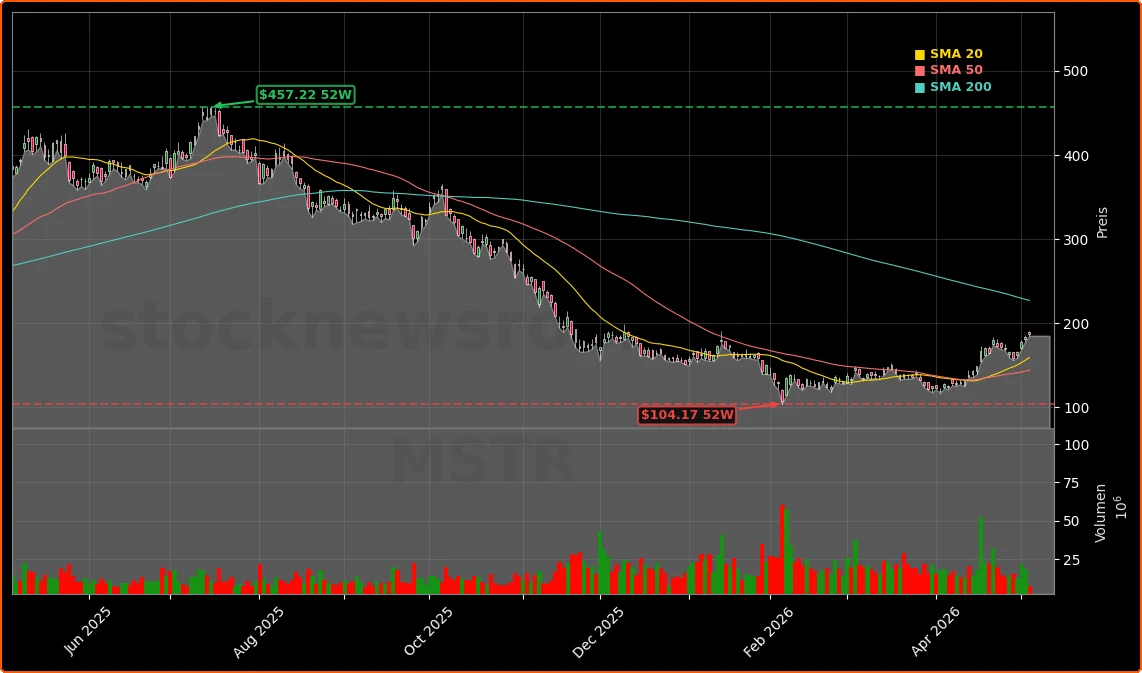
That accounting tailwind is a key reason MicroStrategy shares have rebounded about 47% from the February low and are trading near a major technical breakout zone. Traders are betting that MicroStrategy Earnings will flip from a deep loss to a large profit purely on fair‑value adjustments, even though the underlying analytics business remains relatively stable and small compared with the crypto exposure.
The current stock price of $187.15, versus a previous close of $183.90, leaves MicroStrategy sitting right on the neckline of a textbook inverse head‑and‑shoulders pattern. A convincing earnings‑driven push above roughly $186–187 on strong volume would confirm the breakout and put Fibonacci targets near $205, $219 and potentially $236 in play over the coming weeks.
Is the Bitcoin buying pause a warning sign?
From early February to late April, MicroStrategy aggressively added about 103,690 Bitcoin, spending more than $7.5 billion and lifting its holdings to more than 3.9% of Bitcoin’s eventual 21 million‑coin supply. That buying pace rivaled, and at times exceeded, net new coins coming from miners after the April 2024 halving, tightening available supply and contributing to Bitcoin’s rebound.
Into this week’s MicroStrategy Earnings, however, executive chairman Michael Saylor has paused new purchases, breaking the pattern of near‑weekly announcements that had become synonymous with the stock. The pause has sparked debate: some traders view it as simple earnings‑window discipline or short‑term cash management, while others worry it could hint at balance sheet strain or a reassessment of the ultra‑levered Bitcoin bet.
MicroStrategy’s new perpetual preferred share class, Stretch, with an 11.5% annual dividend, has funded a large share of recent BTC buys without diluting common stockholders. But those Stretch shares create an estimated $1.2 billion annual dividend obligation and rely on the company’s ability to monetize Bitcoin at favorable prices. If Bitcoin were to fall sharply after MicroStrategy Earnings, the combination of leverage, fixed payouts and mark‑to‑market volatility could quickly tighten liquidity.
What do options and analysts say about MicroStrategy Earnings?
The options market has swung from highly defensive before the February report to clearly bullish ahead of tonight’s MicroStrategy Earnings. The put‑call volume ratio has dropped from 1.66 in early February to around 0.60 now, signaling more traders are chasing upside exposure than buying protection. Implied volatility near the mid‑70s suggests options desks are braced for a large post‑earnings move in either direction.
On Wall Street, B. Riley recently raised its MicroStrategy price target from $188 to $200 with a Buy rating, while Cantor Fitzgerald lifted its target from $192 to $212, also with a Buy. Separate bullish notes from TradingKey highlighted the stock’s 7% gain on May 1 and 9% jump on April 22, crediting Bitcoin’s strength, fresh BTC purchases and institutional buying interest, including a notable allocation from Capital Group. Those upgrades and flows underscore how tightly MicroStrategy’s equity narrative is now bound to crypto macro rather than enterprise software fundamentals.
At the same time, insider selling disclosures filed with the SEC show small but visible stock sales by executive Jarrod M. Patten in late March and early April. The transactions are modest in size but serve as a reminder that management is not solely accumulating equity, even as they ramp Bitcoin exposure.
How does MicroStrategy compare with other crypto plays?
MicroStrategy is trading like a high‑beta Bitcoin proxy, similar to Coinbase and other crypto‑sensitive names. Shares of Coinbase and Circle Internet Group have rallied in tandem with MicroStrategy after U.S. lawmakers unveiled revised stablecoin rules under the Clarity Act, clarifying how exchanges can pay yield on stablecoin balances. While MicroStrategy does not issue stablecoins, any progress on regulatory clarity has helped lift sentiment across crypto‑linked equities.
Compared with mega‑cap tech leaders such as NVIDIA, Tesla and Apple, MicroStrategy’s risk profile is far more concentrated. Those companies derive cash flows from diversified hardware, software and EV businesses, while MicroStrategy’s equity value is now dominated by a single volatile asset on its balance sheet. For U.S. investors running diversified NASDAQ or S&P 500‑style portfolios, that distinction is critical: MicroStrategy behaves less like a conventional software stock and more like an actively leveraged Bitcoin ETF with corporate debt and preferred equity layered on top.
Position sizing has become the key risk tool. Some traders are expressing views through derivatives such as capped discount or bonus certificates and call spreads that limit downside while keeping exposure to a potential move toward the technical projection near $330–340 if the breakout fully plays out. Others are using MicroStrategy as a liquid trading vehicle around Bitcoin catalysts rather than as a core holding.
Related Coverage
For a deeper dive into the recent rally and the surprising halt in weekly coin purchases, readers can review the detailed breakdown in MicroStrategy Bitcoin Update: +3.9% Rally Shocks Traders, which examines whether the pause is a tactical reset or an early sign of stress in the ultra‑bullish BTC thesis.
In sum, MicroStrategy Earnings arrive at a pivotal moment: the stock is testing a bullish technical pattern, Bitcoin has rebounded strongly, and an unexpected pause in purchases highlights the funding risks behind the strategy. For U.S. investors, the outcome will determine whether MicroStrategy can continue trading as the premier leveraged Bitcoin vehicle or whether balance sheet complexity and volatility start to cap the upside. The next few quarters of MicroStrategy Earnings will show whether this bold bet can keep rewarding shareholders without breaking under its own weight.